Takes 30 seconds. We call you back to set a time.
A rolling steel door that will not close leaves a loading bay, a shop or a parking entrance open to weather and theft. Sometimes the door refuses to move at all, sometimes it comes down partway and stops, sometimes it touches the floor and goes back up, and sometimes it closes but leaves a gap that light and water come through. Each of those points to a different part. This page explains what can cause each one, what to avoid while the door is stuck and how a technician tracks it down. Free estimate at (929) 429-2429.
By Sean Cohen, owner, On Point Garage Doors · Updated
These photos are from our own jobs, with our logo on them.


When a door is stuck open, the first job is keeping the building safe, not winning a fight with the door. Do not drive a forklift or truck against it, do not hang on the bottom bar and do not stand under a curtain that has stopped at an odd point. Tell us the door is stuck open when you call. On the visit, closing and securing the opening comes before chasing the root cause.
Noticing exactly what the door does narrows the search a lot.
The curtain runs down two guides at the sides. A guide bent by a forklift or a pallet pinches the slats and stops the door at the same spot every time. A slat that has shifted sideways or has a broken end lock can catch on the guide. Wind locks on the ends of slats can hook on a damaged guide too. These are mechanical stops, and running the operator against them only makes the damage worse.
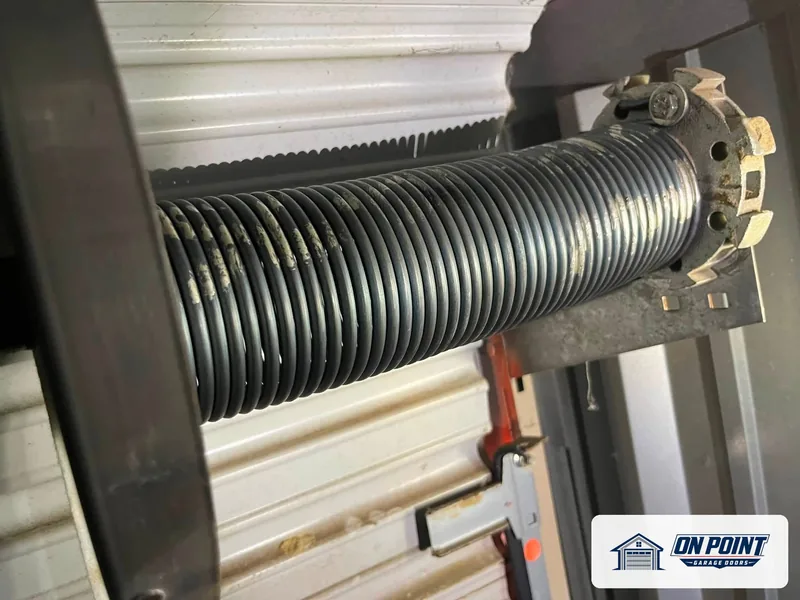
The spring inside the barrel balances the curtain. If it has too much tension, the door wants to stay up. It may drift back up after closing, feel very light when lifted or refuse to come down without force. This can follow a spring adjustment that went too far or a curtain that lost weight when slats were removed. Spring work on a rolling door is for a technician, since the barrel holds a large amount of stored energy.
A motor operator has settings that tell it where to stop at the top and bottom. If the close limit has moved, the door can stop short of the floor or press too hard into it and reverse. Many commercial operators also have a brake that holds the curtain still. A worn or misadjusted brake can let the door creep. Limits, brake and clutch are checked together, because they affect each other.
Motorized rolling doors often have a sensing edge on the bottom bar and sometimes photo eyes across the opening. A cut edge cable, a crushed edge or misaligned eyes tell the operator something is in the way, and the door reverses or stops. Snow, ice or a pallet near the guides can do the same. These devices are there to protect people and should be repaired, not bypassed.
On a door run by a hand chain, a jumped chain, a broken sprocket or a seized gearbox can keep the curtain from coming down. On a door pushed by hand, a lock bar left in the guide, a damaged bottom bar or worn bearings in the barrel can make it refuse to drop. A hand-run door that has turned very heavy or very light is telling you the spring balance is off.
In winter, ice at the sill, in the guides or along the bottom seal can stop a door or make it reverse. A pile of debris, a pallet edge or a dropped tool in the guide does the same. Over time, a floor that has heaved or been patched can leave the bottom bar resting on a high point with gaps beside it. The fix for a gap is sometimes in the floor, not the door.
The bottom bar takes the hits. Once bent, it no longer sits flat, and light, water and rodents get in along the gap. A torn or missing astragal, the rubber strip along the bottom, has the same effect. Replacing a damaged bottom bar or astragal often restores the seal without touching the rest of the door.
Some rolling doors are fire-rated and close by themselves when a fusible link melts or an alarm signal releases them. If such a door has dropped, it should be reset only after the cause is known and by someone qualified for that system. Never tie a fire door open or force one to stay up. If you are not sure whether your door is fire-rated, look for a label on the guide or the hood.
We start with how the door fails, then check the guides, curtain, bottom bar, spring tension, barrel bearings, chain or operator, brake, limits and safety devices. Once the door can close safely, the written estimate covers what failed and anything else that is close to failing, and work begins after you approve it.
A bent guide, a damaged slat or a limit setting that has moved are common causes. If it stops at the same spot each time, a mechanical catch is likely.
The safety edge, photo eyes or close limit is telling the operator something is wrong. Ice, debris or a damaged edge are frequent culprits.
The spring may have too much tension, or the operator brake may be worn. Both are jobs for a technician.
Please do not. Forcing a rolling door can bend the curtain and guides or release spring energy. Call and say the building is open.
Yes. We find out why the door will not close and give you a written estimate before work begins.
Across Brooklyn, Queens and Long Island, tell us what the door is doing and we set a visit that fits your day.
Free estimate, call (929) 429-2429.
Tell us what the door is doing and we will give you an honest arrival time. The estimate is free.
Easier to explain by phone? Call (929) 429-2429.
Tell us what the door is doing. The estimate is free either way.