On Point Garage Doors repairs automatic sliding gates across Brooklyn, Queens and Long Island: gates that jump their track, grind on worn wheels, stall halfway or stop answering the keypad. The estimate is free and comes before any work.
Tell us what the door is doing. The estimate is free either way.
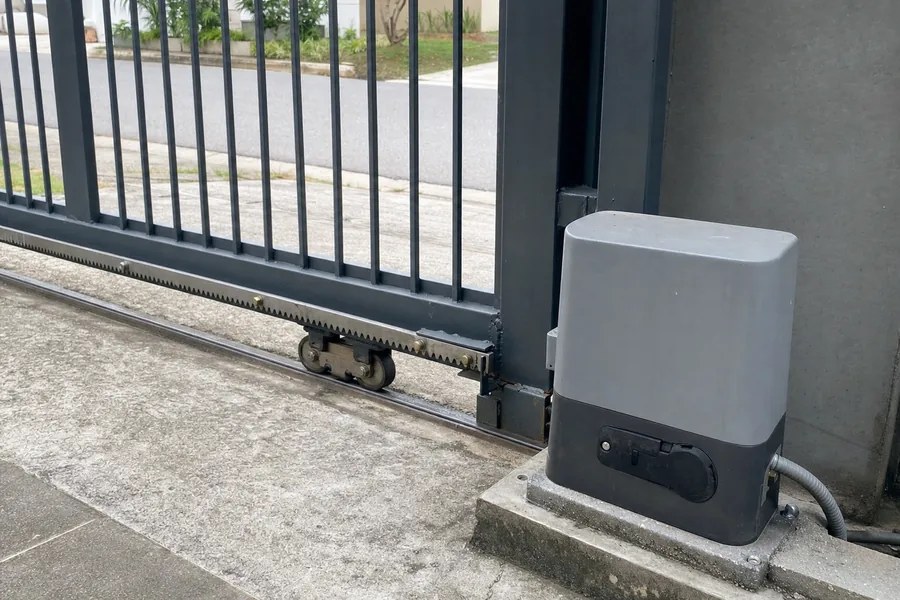
Most automatic sliding gates follow one of two designs. A track gate rolls on grooved wheels along a rail set into the driveway, with guide rollers at the top of a post holding it upright. A cantilever gate never touches the ground: it rides on roller trucks mounted to posts beside the opening, and a tail section reaching past the last post keeps it balanced.
They fail in different places. Track gates suffer at the ground, where gravel, leaves, ice and a heaving slab all get between wheel and rail. Cantilever gates suffer at the rollers and in the frame, where a sagging tail or a worn truck lets the gate dip and drag. Knowing which one you have tells the technician where to begin.

The wheels and their bearings carry the full weight of the gate on every trip, and a flat spot or a seized bearing turns a smooth run into a shudder. The rail they ride on gets bent by a tire, chipped by a plow or buried in grit until the wheels climb out of the groove.
Higher up, the guide rollers wear, the stops loosen, and the gear rack bolted along the gate works loose or loses teeth where the operator's drive gear meets it. Chain-driven gates stretch their chain until it slaps and skips. Each of those is a part, not a new gate.
An operator is built to move a gate that rolls freely. When a wheel drags or the rail is bent, the motor works harder on every trip, runs hot and trips its own protection, and from the driveway that looks like a motor problem.
That is why the gate is released from the operator and rolled by hand before any electrical part is condemned. If the gate fights back, the rolling problem is fixed first. Very often an operator that seemed to be failing runs normally again once the gate moves the way it should.
Slide operators drive the gate in one of two ways. A gear on the operator meshes with a toothed rack bolted along the gate, or a chain runs the length of the gate between two brackets. Racks shift as their bolts loosen and the gate settles, until the gear rides too high or bites too deep, and chains stretch and sag.
Both are set so the drive meets the gate the same way from one end of its travel to the other. After that the operator's travel limits are set again, so the gate stops where it should at both ends instead of hitting the post or pulling up short of it.
Power is part of the same look. Some slide operators run from a transformer on a household circuit, others from a battery topped up by a solar panel, and a battery near the end of its life shows up as a gate that crawls on cold mornings long before it stops for good.
A sliding gate can trap a hand or a foot in two places: at the leading edge as it closes, and at the back, where the gate slides past its post and rollers. Photo eyes across the opening and contact edges on the gate are what tell the operator to stop and reverse.
Those devices are tested on every visit, whatever the call was about, and a gate whose safety devices have been disconnected gets them back before anything else is done. A gate that closes on a car or a person is the one failure nobody can undo afterwards.
Grit, leaves and slush collect in a ground track faster than anyone notices, and a single stone in the groove can lift a wheel right out of it. In a hard freeze, ice in the track does the same, and an operator straining against it may stall or reverse.
The ground itself moves as well. A concrete pad that settles or heaves takes the rail and the operator with it, which is why a gate that ran well for years can begin to bind after one winter. Where the ground keeps moving, a cantilever gate, with nothing in the driveway to foul, is sometimes the lasting answer, and that conversation comes with the estimate.
The order matters: the gate first, then the drive, then the electrics and the safety devices.
No. A gate off its rail can tip or drop, and the operator can drag it further out of line. Keep people and cars clear of it and call us; putting it back safely is a job for the technician.
Both. The operator, its control board and power supply, the gear, rack or chain, the remotes and keypads, and the gate's wheels, rail and rollers are all part of the same visit, because each one affects the others.
Usually because something is resisting it: a dragging wheel, debris or ice in the track, a rack that has shifted, or a safety eye that thinks something is in the way. The operator reads that resistance as an obstacle and stops, and the visit finds which one it is.
Yes. Roller trucks, the gate frame and its tail, the guide rollers and the operator are all serviced, and a sagging cantilever gate can often be brought back into line.
Most often a photo eye or a safety edge is blocking the close because it is misaligned, dirty, wet or failed. It can also be a loop detector or a setting on the board. The technician tests each device in turn rather than guessing.
Usually, yes. Keypads, extra remotes and receivers can be added to most operators, and every remote in the household is programmed before we leave.
Yes. Parking lots, building garages and loading yards use heavier slide gates and operators, and they are repaired the same way: gate first, then the drive, then the electrics.
Yes. The gate and the operator are looked at, you hear what they need, and the free estimate comes before any work starts.

Describe the fault and we'll give you an honest arrival time. The visit and the estimate is free, anywhere in Kings County.
Easier to explain by phone? Call (929) 429-2429.
Tell us what the door is doing. The estimate is free either way.