When the panels are past saving. Measured for headroom, track set plumb, counterbalance sized to the finished door, and track set plumb to the opening.
Tell us what the door is doing. The estimate is free either way.
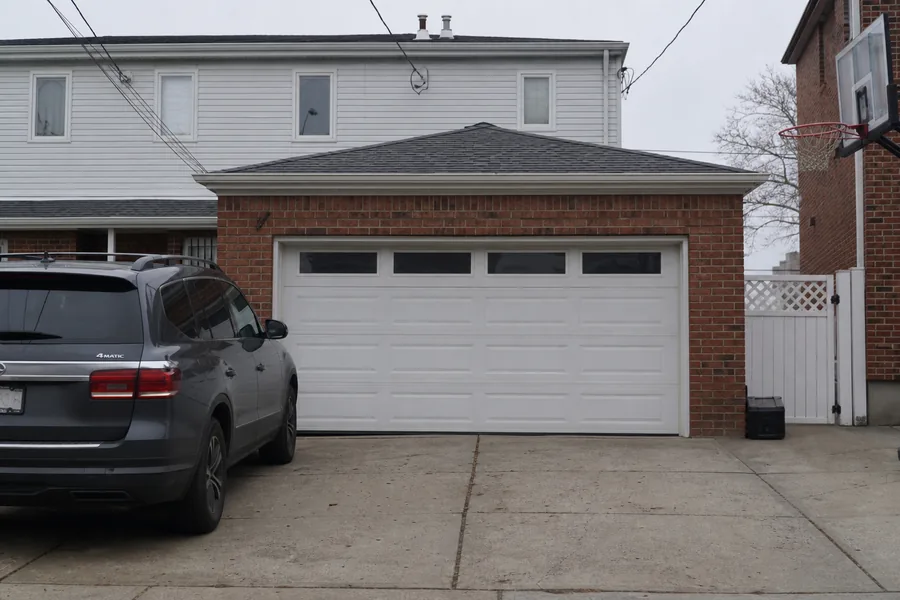
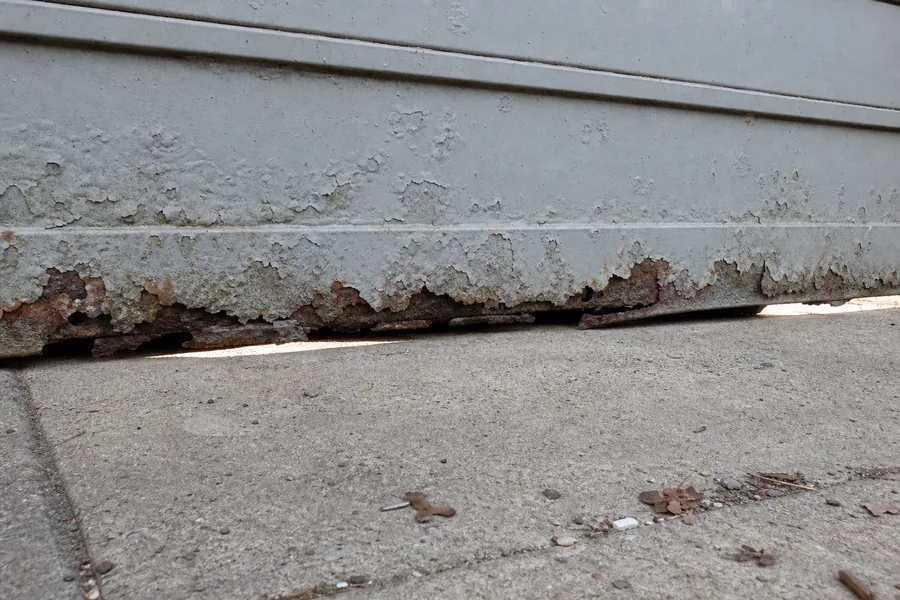
When a door at the end of its life happens in New York it happens without warning. Across Kings County, the parts that fail are the ones under constant load, and they go on an ordinary morning, not in a storm. Across Kings County the pattern is consistent: salt air off the water rusts cables and bottom brackets, and a hard freeze stiffens springs and old lubricant, and attached brick garages under rowhouses and semi-detached homes in the outer boroughs, detached garages behind Queens and Long Island houses, roll-up doors on storefronts take the worst of it.
Installing a door is four jobs. Four measurements: width, height, headroom, backroom. The old door, track and springs come out. The new track goes in plumb and square. Not the old track made to do. Build the door, hinge it, strut it, weigh it, then size the spring. Miss that final step and the opener suffers from week one.
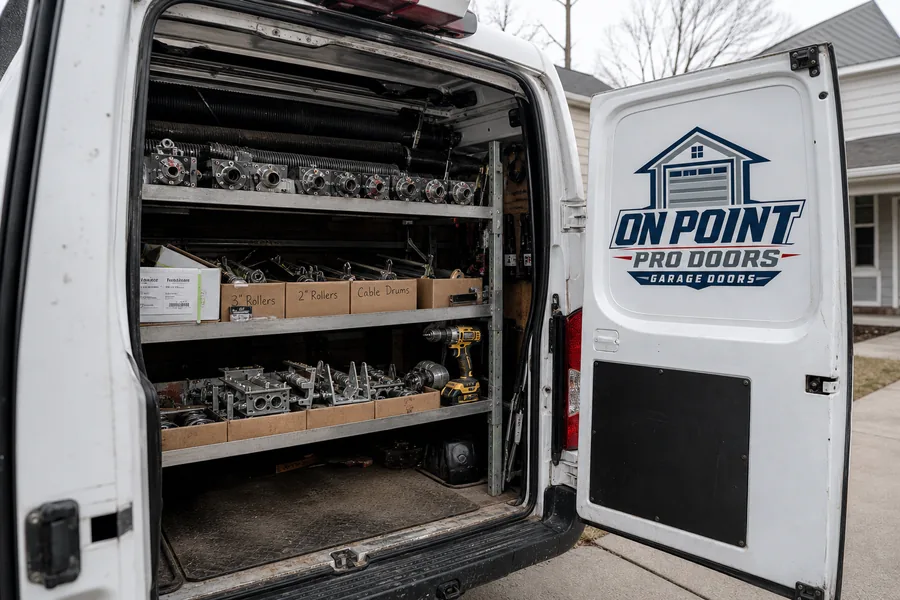
The van covers New York and Nassau County, Jersey City, Hoboken, Yonkers, Westchester, Hudson County daily. We give you a two-hour window rather than a day, a free estimate, and what you agreed on the driveway is what happens.

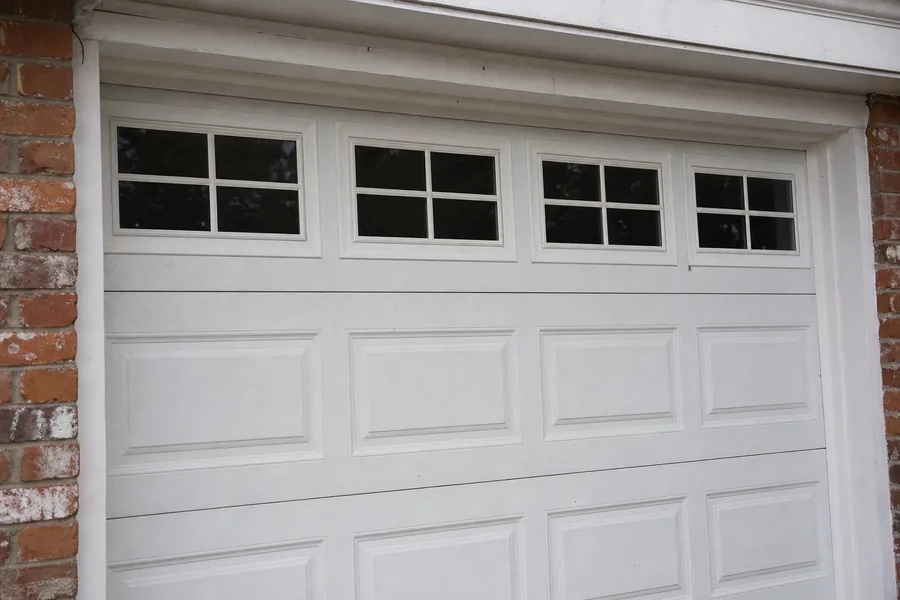
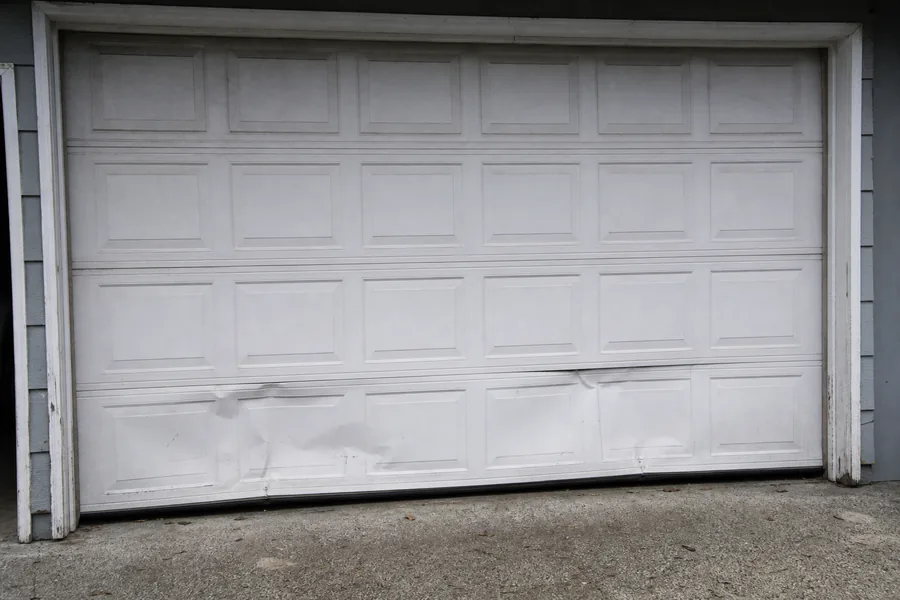
Replace rather than repair when the panels are rotted, rusted through or dented across more than one section; when the door is single-skin and the garage is a usable room; or when the repairs have started arriving faster than once a year.
If you're nodding along, the on-site diagnosis takes about ten minutes. No phone guesses. The estimate itself is free.


Insulation is the difference you actually feel. An uninsulated door sits around R-0 to R-2, a polystyrene core around R-6 to R-9, and a polyurethane door from R-12 up to R-18. The polyurethane option is stiffer and runs much quieter too.
Only when it is close to done or already acting up. If it has years left, it stays. Changing it while the door is off is almost no extra work, which is worth knowing before you choose.
Even when it can be done, it shouldn't be. We set the track plumb and square to the door being installed. Old track kept from the previous door is why new doors get complaints about noise.
None of that is unusual. That is what happens when a door gets judged over the phone by someone who has never seen it, and it is why we say nothing until a technician is standing in front of it.


People put this off. Here is what happens when they do. None of the following is unusual. Across Kings County, it's the ordinary sequence, and we see it every week.
The look-over is free, and so is the answer. You give up nothing by asking. That's the whole case for calling early.
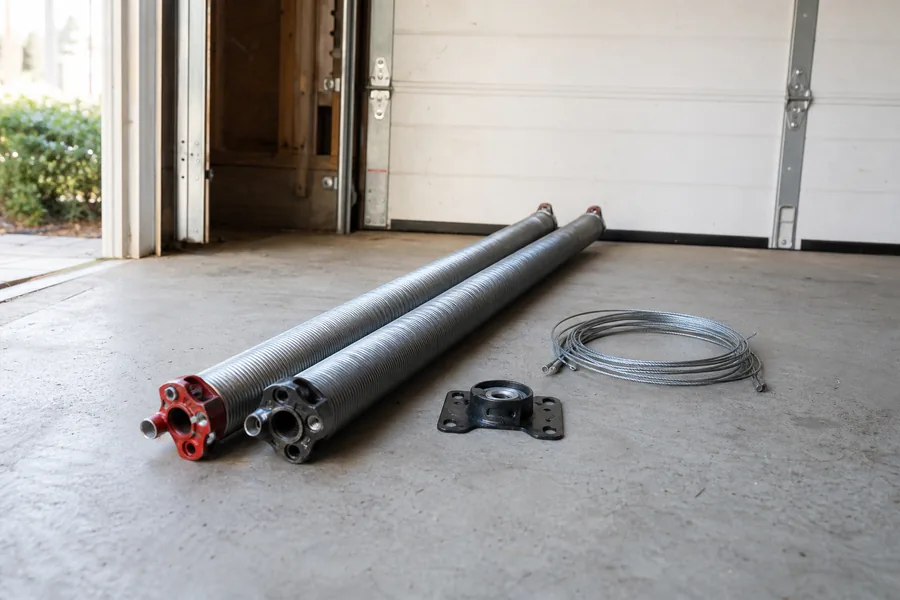
The door is a thirty-year object hung on ten-year parts. Springs, cables and rollers are consumables. Replacing them two or three times over a door's life is normal, not a sign the door was bad. What ends a door is the panels.
The R-value is the insulation rating, and of all the numbers it's the one you'll feel. As a guide, plain doors are R-0 to R-2, polystyrene R-6 to R-9, polyurethane R-12 to R-18. Polyurethane makes the door stiffer and quieter, worth having with a room above.
If the opener is old, swap it while the door is down. The labor overlaps almost entirely. If it has years left, it stays. Either way, a new door is the time to go to nylon rollers, since the whole thing is being built from parts anyway.
Headroom is the measurement that ambushes people. Standard torsion gear wants about a foot of headroom above the opening. There is low-headroom track for smaller gaps, and it works fine, provided it is ordered with the door. Not discovered by a fitter on the morning of the install.
The rule with a failed door is simple: stop using it. Every extra cycle on a door with a broken counterbalance pushes weight onto parts never meant to carry it, and the job grows with each try.
To get the car out first: door fully closed, red cord pulled, then lift with two hands and a straight back. If the door doesn't move easily, leave it. It's telling you the counterbalance is gone.
No, not when a spring or cable is the fault. Leave it down and don't force it. The counterbalance stores a lot of energy, and it can release it without any warning.
If the opener is close to ten years old, yes. With the door already down the two jobs overlap almost entirely, and a new unit is quieter and carries its own warranty.
We do. LiftMaster and Chamberlain are the same opener with different names on them, and Genie, Craftsman, Clopay, Amarr and Wayne Dalton are all standard work here.
Yes, genuinely. No answering service holding your message until 8am. Night calls go out the same way daytime ones do.
Free, across Kings County. The visit tells you what has failed and what it takes to put right, and no is a complete answer.
A door that keeps needing work, panels going in more than one place, or a bare single-skin door on a garage that's really a room. Each of those on its own is enough.
Describe the behavior, the sound, and the door's rough age. That is usually enough to tell what has failed and what parts need to be on the truck.
The estimate is free. New York, Nassau County, Jersey City, Hoboken, Yonkers, Westchester, Hudson County and the rest of Kings County.
You don't need to know what's broken. Say what the door does when you press the button, what it sounds like, and whether anything looks loose or snapped. The technician takes it from there and brings the parts that match.
We need three things: a name, a number, and what the door is doing. Everything before you agree to it asks nothing of you, across the whole of Kings County.
Easier to explain by phone? Call (929) 429-2429.
Tell us what the door is doing. The estimate is free either way.