Takes 30 seconds. We call you back to set a time.
Rolling steel doors are the workhorses of commercial buildings. They close loading bays, warehouse openings, auto shops, parking entrances and service areas, and many of them open and close all day. When one jams, a business can lose its loading area, its parking or its security in a single moment. Most failures come down to a handful of parts, and knowing which one has gone wrong is the fastest way to get the door working again. Free estimate at (929) 429-2429.
By Sean Cohen, owner, On Point Garage Doors · Updated
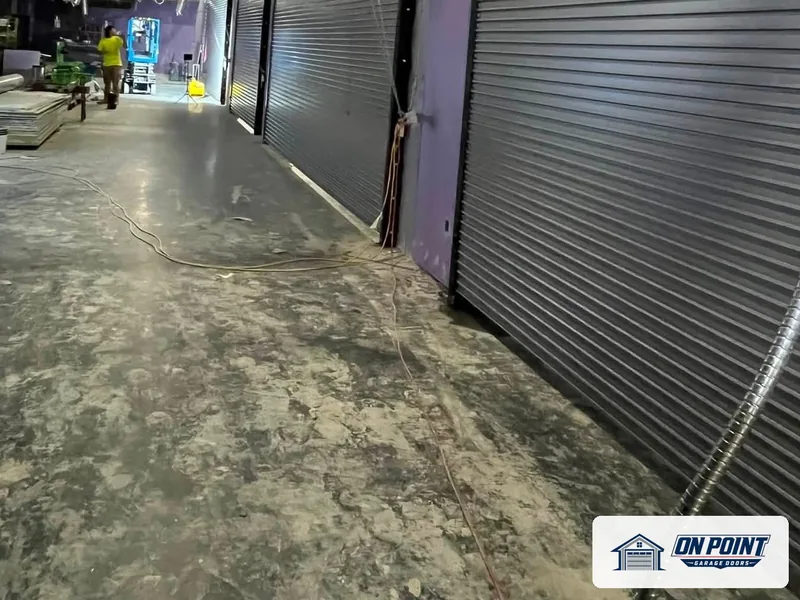
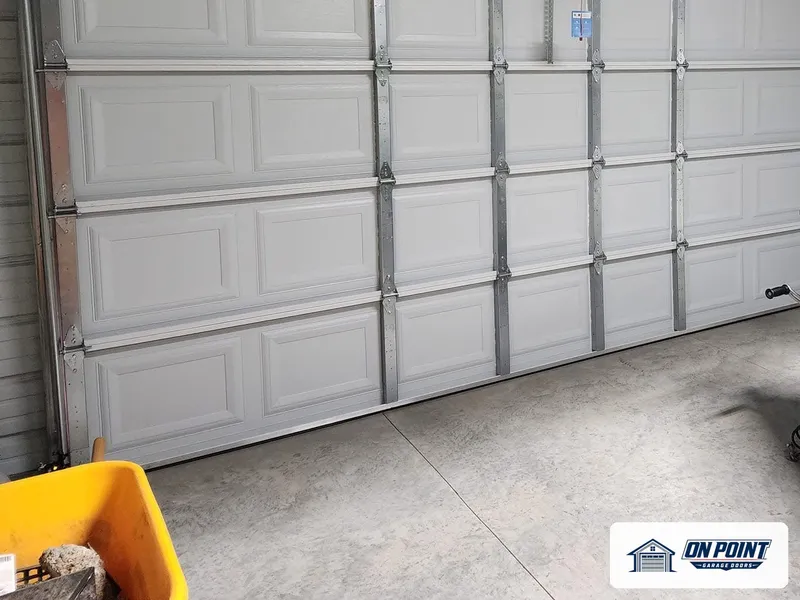
These photos are from our own jobs, with our logo on them.


The door is a curtain of interlocking steel slats that rolls up around a barrel above the opening. Inside the barrel, a heavy spring balances the curtain's weight. The ends of the slats ride in steel guides on each side, and a heavy bottom bar seals against the floor. The door is raised by hand, by a chain hoist or by a motor operator.
A rolling door that is suddenly very hard to lift, or that slides down on its own, almost always has a spring problem. The spring is under great tension inside the barrel and is dangerous to work on without the right tools and training. If the door has become hard to lift, stop using it hard and call. Forcing a door with a failed spring wears out the operator and can damage the curtain.
Guides take most of the hits in a busy loading area. A forklift mast, a truck backing in or a pallet jack can bend a guide inward, and the curtain then rubs or jams at that spot. Slats that are dented or have slid sideways can catch in the guides too.
We straighten or replace bent guides, replace damaged slats, and set the curtain back in line so it rolls evenly.
The bottom bar is the first thing a vehicle hits. A bent bar keeps the door from closing fully and from sealing at the floor, and the rubber astragal along it wears with every cycle. Replacing the bar and astragal restores a full close and keeps out weather and pests.
Many doors are raised with a hand chain that turns a gear on the barrel. When the chain slips, binds or breaks, the door cannot be raised. Worn gears and bent sprockets are common on older doors. We repair the hoist, or where the business wants it, add a motor operator so the door is easier to run all day.
A commercial operator that hums without moving, stops partway or will not answer its controls may have a failed limit, a burned control board, a worn brake or a problem with its safety devices. We test the operator and its controls first, so only the failed part is changed. If the operator is too old or too small for the door, we explain a replacement sized for the real weight and use.
If the operator itself is the problem, the page on commercial door operators covers it, and shop gates are on the storefront gate motor page. A door that is meant to drop in a fire is a different animal, covered under fire-rated rolling doors.
A loading door that cycles many times a day wears its spring, operator and bottom bar much faster than one used occasionally. For busy doors we can fit a spring built for more cycles, heavier bottom bars and an operator rated for continuous use. That turns frequent breakdowns into planned service.
The two hardest lives a door can have are a parking garage entrance and a loading dock, and each has its own page.
A rolling door stuck open leaves a building exposed. Tell us when you call. The technician secures the opening first and fixes the cause second, so the building is not left open overnight.
Buildings near the waterfront in Brooklyn, Queens and on Long Island see salt air that rusts springs, guides and slats. Corrosion-resistant parts and regular service extend the life of those doors.
The technician checks the curtain, guides, bottom bar, barrel and spring, the hoist or operator and the safety devices, then explains what is wrong. You get a free estimate before any work starts, and service can be scheduled around deliveries and business times.
Usually the spring inside the barrel has lost tension or broken. It needs a trained technician.
Most often a guide has been bent by a vehicle, or slats have shifted out of line.
In most cases yes. An operator sized to the door makes daily use far easier.
Yes. We service rolling steel doors for shops, warehouses, parking entrances and buildings across Brooklyn, Queens and Long Island.
Yes. You see what is wrong and the options before any work starts.
Across Brooklyn, Queens and Long Island, tell us what the door is doing and we set a visit that fits your day.
Free estimate, call (929) 429-2429.
Tell us what the door is doing and we will give you an honest arrival time. The estimate is free.
Easier to explain by phone? Call (929) 429-2429.
Tell us what the door is doing. The estimate is free either way.