Takes 30 seconds. We call you back to set a time.
Every photo here is from our own work, with our logo on it.


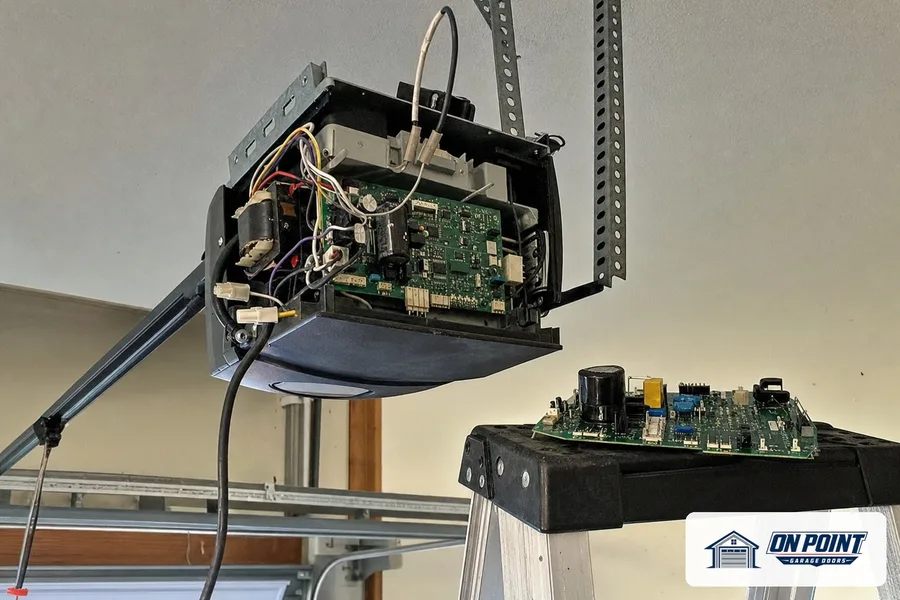
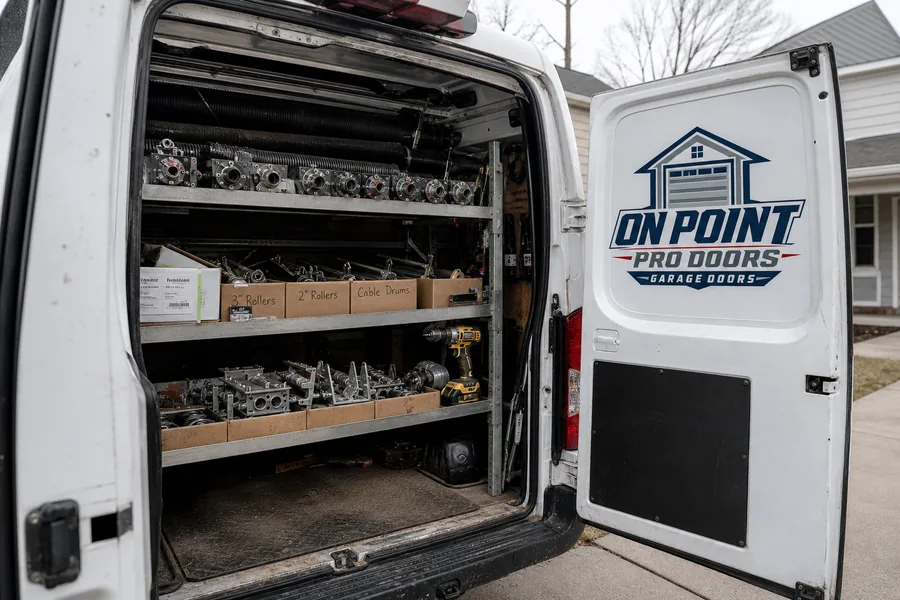
Most openers we're called to aren't finished. They've lost a board to a power surge, a gear to a heavy door, or their eyes to a bumped bracket, and the fix rides on the truck. Tell us what yours is doing; the estimate is free.
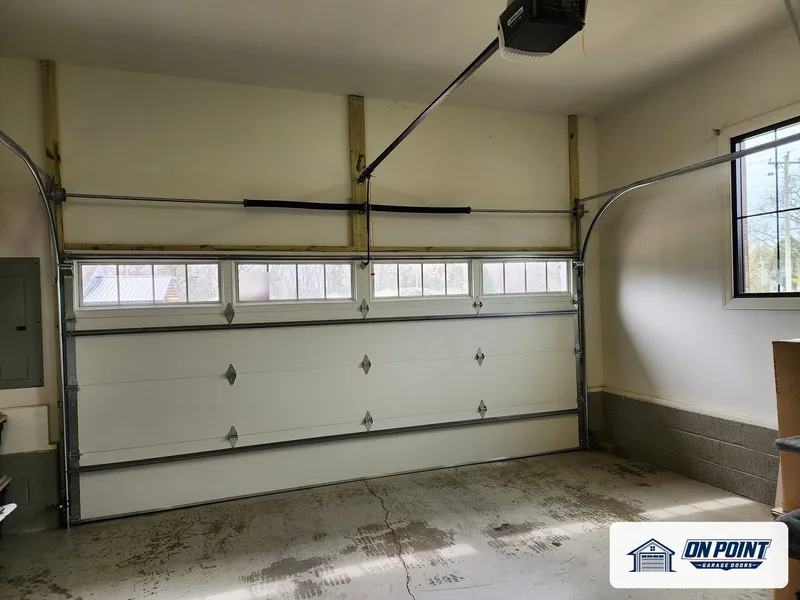
A garage under a house has little headroom and a door that opens straight onto a sloped driveway. A rail opener hangs low there and gets hit by roof racks, bikes and ladders, so a bent rail or a trolley knocked off the chain is a regular call. Where space is that tight, a jackshaft opener mounted on the wall next to the door, turning the spring bar itself, leaves the ceiling clear. It only suits doors on torsion springs in good balance, so those get checked first. If you would rather run the door from your phone, see smart garage door openers.
Detached garages at the back of a lot hit the other limit: distance. A remote that works in the driveway but not from the street usually points at the receiver or its antenna, and the wall-button wire that runs along a fence or across the yard is the part that corrodes. Both are short repairs.

The two eyes near the floor cause more opener calls than the opener does. In a garage that doubles as storage, a box, a bike or a bag of rock salt ends up in the beam. On a door under a house, water running down the driveway splashes the lenses and dries into a film. And any bracket that gets kicked drifts out of line. The opener then refuses to close, or reverses with the light blinking.
The two small lights on the eyes tell the technician which it is in a minute. Cleaning and realigning is often the whole job; a damaged wire is rerun in clips; a dead eye is replaced as a matched pair.


Summer thunderstorms and winter nor'easters knock the power out, and when it comes back, the surge often takes the opener's logic board with it. The symptom is an opener that does nothing at all, or one that runs from the wall button but ignores every remote. Boards for the common LiftMaster, Chamberlain and Genie units are carried on the truck.
A surge protector at the opener's outlet takes the hit next time instead of the board. Battery backup keeps the door running through the blackout itself, which matters most when the garage is the only way the car gets out.
The door always comes first; the opener only steers it.

Gears, eyes, remotes and settings are repairs at any age. A new unit starts to make sense on an opener from the early 2000s or before whose board has died and whose remotes are the old fixed-code kind: parts are getting hard to find, and something else fails soon after. A current belt-drive opener brings rolling-code remotes, quieter running and battery backup. You hear both options before deciding.
Under a bedroom, go quiet: a belt drive, or the wall-mounted kind. A detached garage at the back of the lot can live with a chain.
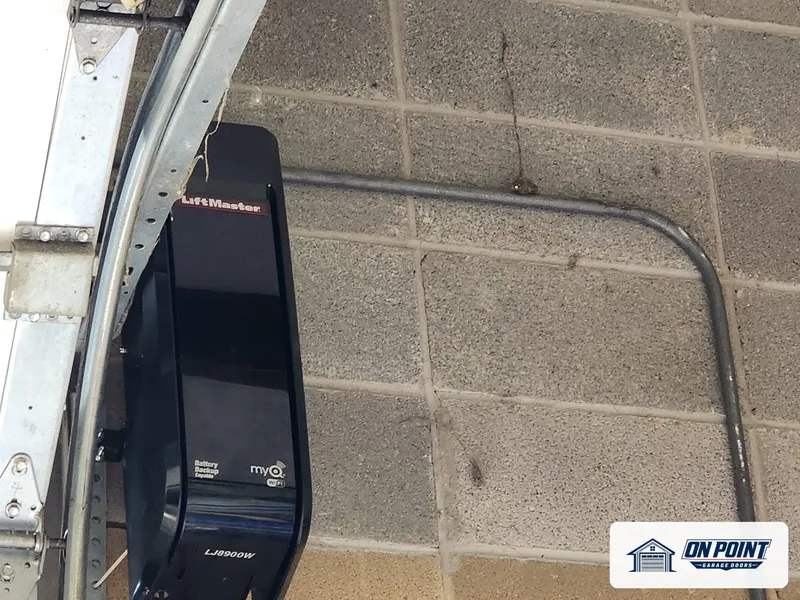
LiftMaster and Chamberlain in most houses, Genie in plenty of the older ones (there's a page just on Genie garage door opener repair, and one on LiftMaster vs Genie if you're choosing), and now and then a Craftsman, Linear or Marantec. Parts for the first three are carried every day; the others are repaired when parts exist, and you're told plainly when they don't.
The same truck covers every area we serve, so where you are changes the time window, not the visit.
Most openers can be repaired. Boards, gears, eyes and remotes are parts, not reasons to replace.
A straining opener usually means a door problem. Balance the door and the strain goes away.
Wall-mounted units suit low garages. They need torsion springs and a balanced door.
Every opener leaves with working safety eyes. Including the old detached garages.
The logic board most likely took the surge. We carry boards for LiftMaster, Chamberlain and Genie, and a surge protector at the outlet is worth adding while we're there.
The safety eyes near the floor can't see each other: something in the beam, a dirty lens, a bumped bracket or a wire. It's usually a short visit.
Yes. A wall-mounted unit beside the door works where a rail won't fit, as long as the door has torsion springs and is balanced.
A weak battery, an LED bulb interfering with the receiver, or the antenna. All three are checked on the visit.
Yes. Wi-Fi openers connect directly; older ones take a small add-on module. The remotes and car buttons are paired on the same visit.
Yes. Both the door and the opener get looked at, you get it in writing, and the decision is yours.
One call gets you a two-hour window and a call from the technician before pulling up, which on most blocks here means finding a spot too. Nobody on the phone names a fix for a door they can't see.
Free estimate, anywhere we work: Brooklyn, Queens and Long Island.
Describe the fault and we'll give you an honest arrival time. The visit and the estimate is free, anywhere in Kings County.
Easier to explain by phone? Call (929) 429-2429.
Tell us what the door is doing. The estimate is free either way.