Takes 30 seconds. We call you back to set a time.
A sliding garage door moves sideways rather than up. Instead of rolling into the ceiling, it travels along a track and parks against a side wall, either inside the garage or along the outside of the building. People look for sliding doors when the ceiling is low or crowded with storage, when the garage has beams or ducts right above the opening, or when they want a door that opens partway for a person without lifting the whole thing. Sliding doors are less common than overhead doors here, so choosing one takes a careful look at the space. Free estimate at (929) 429-2429.
By Sean Cohen, owner, On Point Garage Doors · Updated
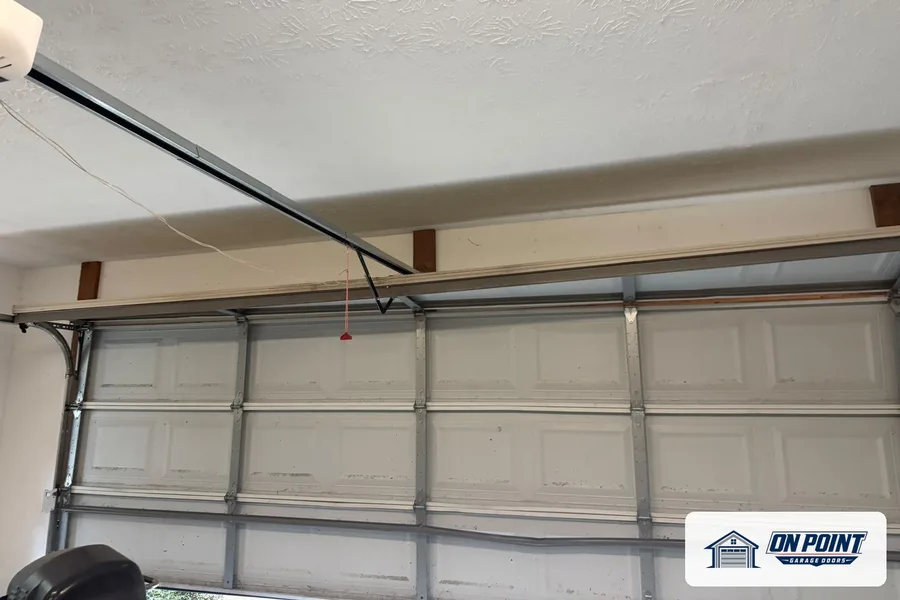
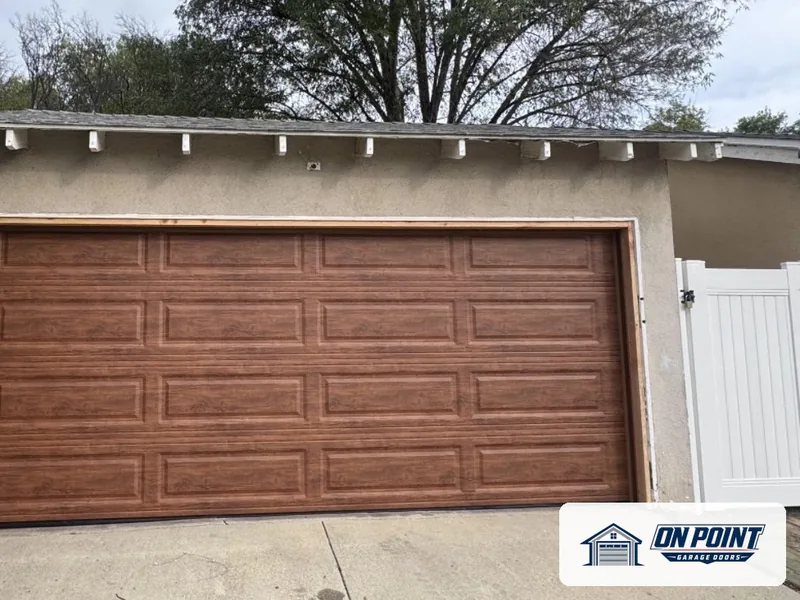
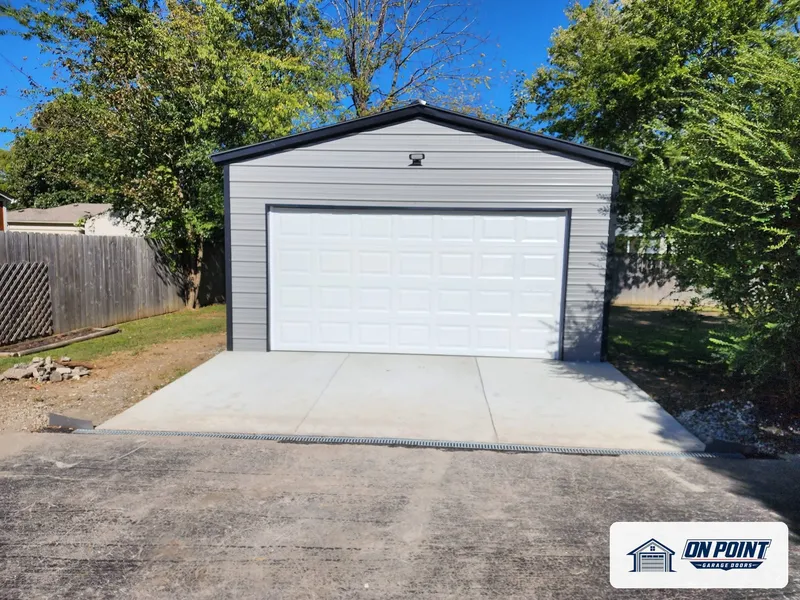
These photos are from our own jobs, with our logo on them.


A sliding door trades ceiling space for wall space. A side-sliding sectional door needs a clear inside wall about as long as the door is wide. A barn-type slider needs that much wall beside the opening, on the inside or the outside. Windows, an entry door, shelves or a water heater on that wall can rule a slider out.
Overhead doors need some room above the opening for the springs and the track curve. In some older garages, there is almost none, and even a low-headroom track will not fit. A side-sliding door needs very little room above the opening, because nothing goes up into the ceiling. That is the main reason people choose one.
One nice thing about a side-sliding door is that you can open it just far enough to walk in. On a cold day, that keeps most of the garage closed while you grab something. Many side-sliding openers have a setting for a partial opening, so one press gives you a walkway instead of the full width.
Sliding doors need openers made for them. A standard ceiling opener pulls a door up and back, not sideways. Side-sliding sectional doors use an operator that runs along the top track. Barn-type sliders can be automated with a gate-style operator, though many stay manual. The safety sensors and the reverse feature still apply.
Because a sliding door seals along its sides, top and floor in a different way from an overhead door, the details matter. Rubber seals on the frame, a good floor guide and a tight fit at the closed edge keep out wind and rain. A barn-type slider on the outside of a wall is harder to seal and suits sheds and workshops better than heated garages.
Side-sliding sectional doors come in many of the same finishes as overhead doors: smooth steel, raised panels, wood-look and doors with windows. Barn-type sliders lean toward the rustic look, with boards and crossbars. Either way, the door has to be stiff enough not to sag between its supports.
For most garages in Brooklyn, Queens and Long Island, an overhead sectional door is still the simplest choice, and low-headroom tracks or a wall-mounted opener solve many tight ceilings. A sliding door makes sense when the ceiling truly cannot take a track, or when the side wall is clear and you like the idea of a partial opening.
A side-sliding door runs along a guide at the floor as well as a track at the top. That guide needs a slab that is level and solid along the whole path of the door. A cracked or heaved floor makes the door catch and drag, so we look closely at the concrete along the side wall before recommending a slider.
Swing-out doors open outward on hinges like a pair of large gates, and folding doors fold into leaves at the side. Both need room in front of or beside the opening. A sliding door stays flat against the wall the whole time, so it needs no room in front of the garage at all.
The technician measures the opening, the headroom and every wall around it, and explains whether a slider, a low-headroom overhead door or another style fits best. You get a free estimate before anything is ordered.
A door that moves sideways along a track and parks against a side wall instead of rising into the ceiling.
Mostly when the ceiling is too low or crowded for an overhead door, or when you want to open the door partway to walk in.
About as much clear wall as the door is wide, on the side where it parks.
Yes, with an operator made for sliding doors. A standard ceiling opener will not work.
Yes. We measure and explain the options before anything is ordered.
Across Brooklyn, Queens and Long Island, tell us what the door is doing and we set a visit that fits your day.
Free estimate, call (929) 429-2429.
Tell us what the door is doing and we will give you an honest arrival time. The estimate is free.
Easier to explain by phone? Call (929) 429-2429.
Tell us what the door is doing. The estimate is free either way.