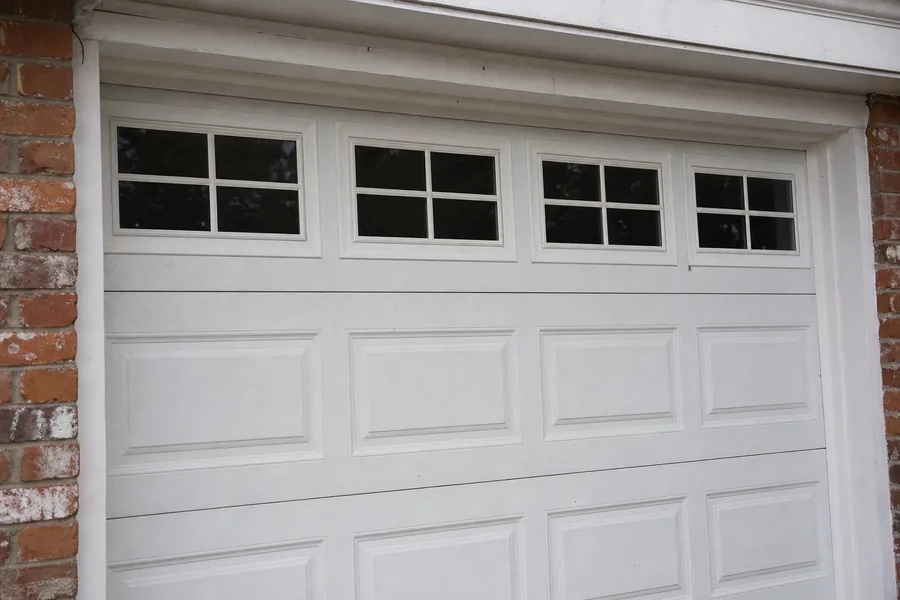
A single bang in the night, and the door stays down. The spring cancels the door's weight, and when it goes the opener can't take over.
Tell us what the door is doing. The estimate is free either way.
A broken torsion spring is the fault we're called out for most often in New York, and it is the one homeowners least expect. No visible wear, no noise, and then one ordinary morning the door stays down with the car inside. Around Brooklyn and Queens we see it concentrated in attached brick garages under rowhouses and semi-detached homes in the outer boroughs, detached garages behind Queens and Long Island houses, roll-up doors on storefronts, where salt air off the water rusts cables and bottom brackets, and a hard freeze stiffens springs and old lubricant.
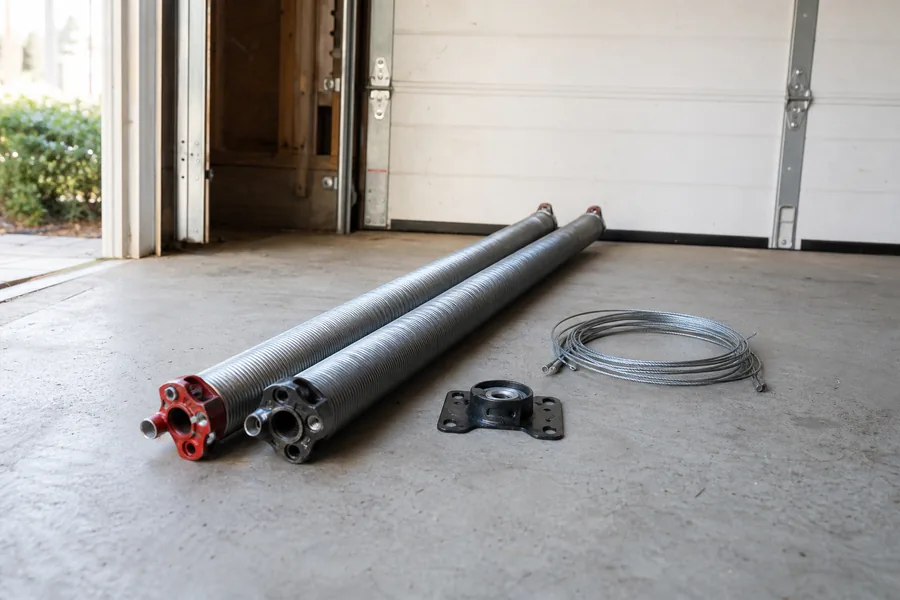
The spring isn't what lifts the door. It's what cancels the door's weight. A double steel door weighs 130 to 190 pounds, more if it's insulated. Under tension, the spring holds almost exactly that much energy, so the door acts as if it weighs nothing and a small motor can move it. A broken spring ends the balance at once, and the opener is left holding a weight it can't lift.
We cover New York and the towns around it - Nassau County, Jersey City, Hoboken, Yonkers, Westchester, Hudson County. No work starts without your go-ahead, and the estimate asks nothing of you whichever way you decide.

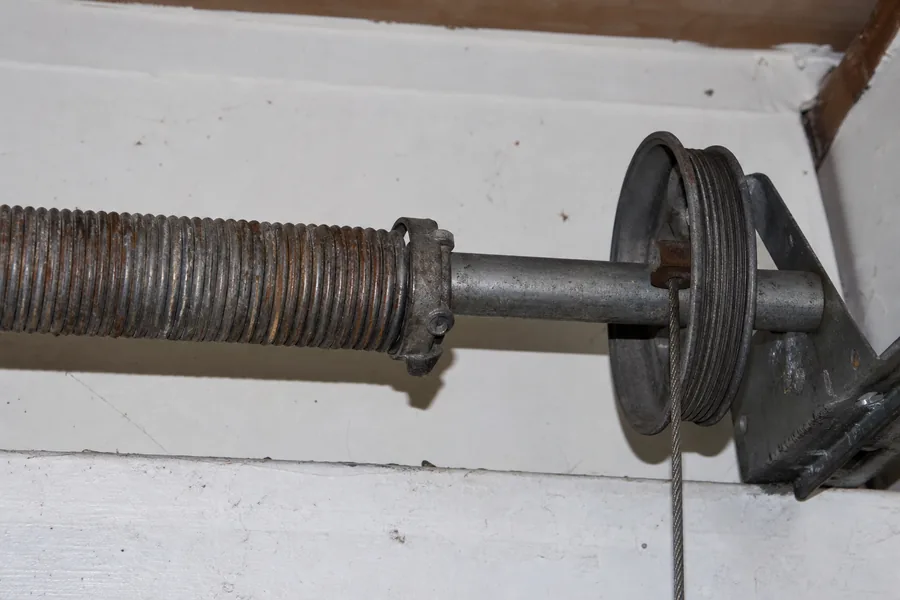
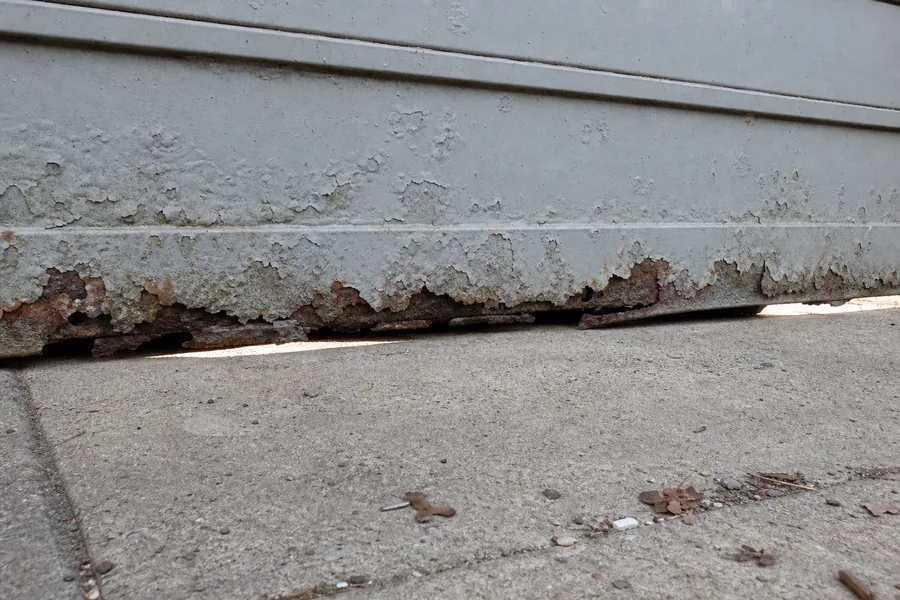
People next door say it sounded like a gunshot or a car door slammed hard. Here in New York, it usually happens with nobody in the garage, and often at three in the morning, because steel contracts as the space cools and a spring at the end of its life will choose the coldest hour to let go. Next press: strain, two inches of lift, stop.
Any of those symptoms and we can usually name the fault within ten minutes of arriving. We book on the call and diagnose at the door. The estimate is free.


It looks random until you count trips instead of years. One cycle is one trip up and down, and the spring most builders fit is rated for ten thousand. Four cycles for two cars going out and coming home, plus school drop-off, plus the trash cans. Call it six. Six a day adds up to 2,190 a year. A ten-thousand-cycle spring lasts under five years at that pace. Nothing has gone wrong when it breaks. It has simply been used up.
A spring is a wire gauge, an inside diameter and a length, and the combination must suit the door's weight. Close-enough springs fail early. We measure the old one and weigh the door before installing anything.
On a two-spring door both springs went up the same day and have done the same work since. When one breaks, the other isn't fine. Same age, same wear, typically a few weeks from the same failure. That is why we show you both. Around Queens and Long Island, one is fine if that's your choice, and the second visit is expected, not a surprise.


It gets postponed a lot, so it's worth saying plainly what postponing leads to. None of the following is unusual. It's the ordinary sequence, and we see it every week.
The estimate is free, so finding out where you stand asks nothing of you. Which is why early beats late every time.
Of everything on a home garage door, this is the job that puts people in the hospital. A broken spring is still a loaded spring: the intact half carries its tension, with very little holding it. Handled wrong, all of that energy leaves at once, and fingers are what it finds. Adjustable wrenches and screwdrivers are not proper tools.
For once, the best action is no action, which surprises most people. A failed door doesn't get worse sitting still. It gets worse each time somebody presses the button to check whether it's still broken.
The one exception is getting a car out. Release it closed, lift with your legs, and if it feels heavy, stop right there. Heavy in the hand means no counterbalance, and the door will fall on its own.
It almost never does. A spring is a consumable. The door itself lasts decades, and swapping the spring is an ordinary parts-and-labor job. Someone who recommends a new door before examining the panels is selling you something, not diagnosing anything.
A spring can be wrong in both directions. Too much lift is no better than too little. It opens on its own, the opener has to fight it shut, and the safety reversal misbehaves. The right spring is the one that matches the door's weight, not the one that beats it.
You can, and we will if that's what you want. The trouble is that both springs went in together and have the same mileage, so the survivor is weeks away, and the visit gets repeated. We put both in front of you and you make the call.
None of that is unusual. A door judged over the phone by a stranger goes that way every time, which is exactly why our opinion waits until a technician has seen the door.
No, not when a spring or cable is the fault. Leave it down and don't force it. The counterbalance stores a lot of energy, and it can release it without any warning.
Both springs have the same mileage. The unbroken one is usually weeks from failing, so we show you both and replace the pair rather than come back.
Yes. Twenty-four hours, every day. A door stuck open or a car shut in is handled the same night; the rest can book a daytime slot.
Because springs wear by cycles and fail at the limit, almost always on an ordinary day and almost never with a warning.
Free, across Kings County. The visit tells you what has failed and what it takes to put right, and no is a complete answer.
More often than not. The schedule keeps room for the calls that cannot wait, and a garage that will not shut is one of them.
Around Brooklyn and Hudson County, call once and you get a two-hour slot and a heads-up call before the van moves. We don't buy leads, we don't bid on them, and we don't let somebody on a phone judge a door they can't see.
Free estimate. Throughout New York and Nassau County, Jersey City, Hoboken, Yonkers, Westchester, Hudson County.
You don't need to know what's broken. Say what the door does when you press the button, what it sounds like, and whether anything looks loose or snapped. The technician takes it from there and brings the parts that match.
Describe the fault and we'll give you an honest arrival time. The visit and the estimate is free, anywhere in Kings County.
Easier to explain by phone? Call (929) 429-2429.
Tell us what the door is doing. The estimate is free either way.