Takes 30 seconds. We call you back to set a time.
Garage door repair is our main work. On Point Garage Doors repairs garage doors for homes and businesses across Brooklyn, Queens and Long Island: springs, openers, cables, rollers, tracks, panels, sensors and the hardware that ties them together. Most people who call do not know which part failed, and they should not have to. They know the door is stuck, crooked, loud or will not close. This page explains how a garage door works as one system, the repairs we do most, how we find the real cause before anything is replaced, and what happens on a repair visit. Free estimate at (929) 429-2429.
By Sean Cohen, owner, On Point Garage Doors · Updated
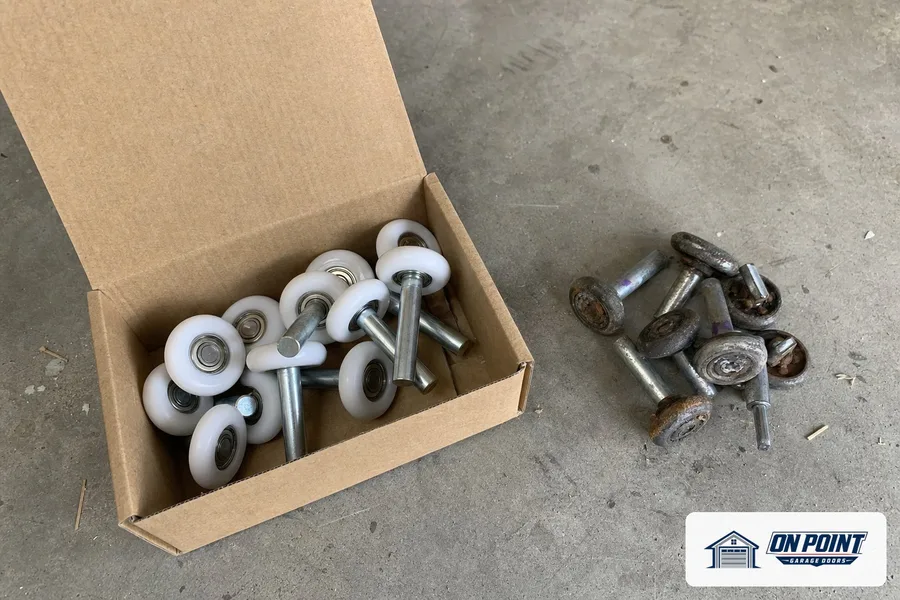
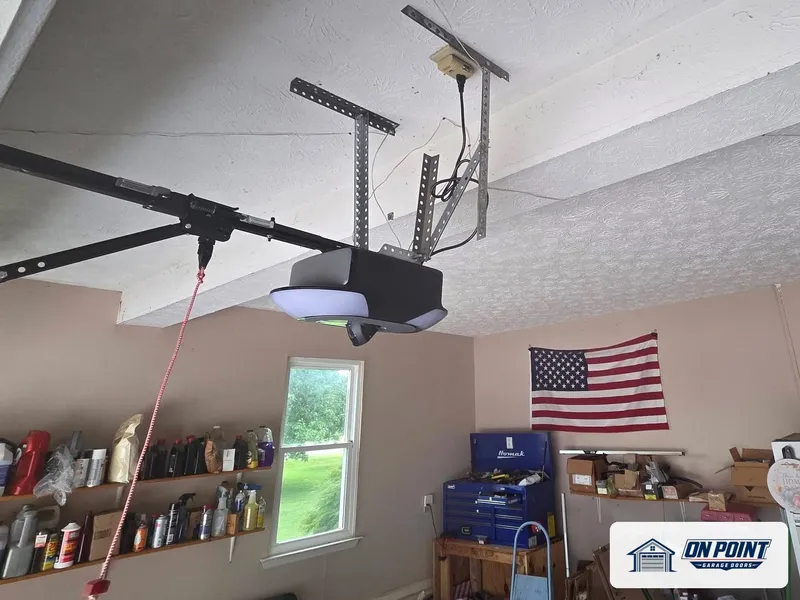
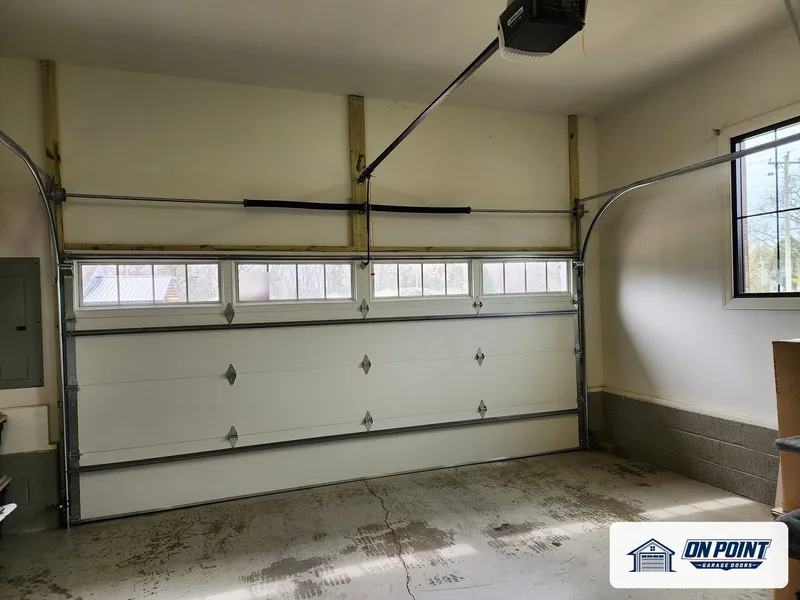
These photos are from our own jobs, with our logo on them.


A garage door looks simple from the driveway, but it is the largest moving thing in most buildings. The springs carry the weight of the door. The cables connect the springs to the bottom corners. The rollers guide each section along the tracks. The hinges let the sections bend through the curve. The opener only starts and stops the movement; it is not built to lift the full weight on its own. When one of these parts wears out, the others take on work they were never meant to do, and that is why a small problem left alone usually becomes a larger repair.
A broken spring is the repair we see most. The sign is hard to miss: a loud bang from the garage, then a door that will not lift or only rises a hand's width before the opener gives up. Torsion springs sit on a bar above the door, and extension springs run along the sides. Both wear out from use, not from age alone. We replace the springs, match them to the weight of the door, and balance the door so it stays where you leave it. Our broken spring repair page goes deeper into the signs and the work.
An opener that hums, clicks, blinks, reverses or ignores the remote is not always a dead opener. Often the cause is a stripped gear, a worn belt or chain, a failed circuit board, a safety sensor knocked out of line, or travel settings that have drifted. We work on LiftMaster, Chamberlain, Genie, Craftsman, Linear, Marantec and most other brands, and we tell you plainly when a repair makes sense and when the unit has reached the end of its life.
Frayed or snapped cables leave a door hanging lower on one side, and a door in that state should not be moved. Worn rollers make a door grind, shake and wander in the tracks. Both are common on doors that have gone years without a tune-up. Replacing cables and rollers together with a balance check often makes an older door run more quietly than it has in a long time.
A door comes off its tracks when a cable lets go, a roller breaks, something blocks the door on the way down or a car bumps it. The sections twist, the rollers pop out and the door jams at an angle. We secure the door, find what pushed it out, put it back on its tracks or replace the bent track, and check every roller and hinge before it runs again.
A dented or cracked section does not always mean a whole new door. When the maker still produces that model, a single section can often be replaced and the rest of the door kept. We also replace bottom seals and side seals that let in water, cold air and mice, and we reinforce sections that have started to bow where the opener arm attaches.
A door that starts down and comes right back up usually has a safety sensor problem: a lens out of line, a loose wire, sunlight in the eye or something small in the path. Remotes and keypads that stop working may need a battery, a fresh pairing or a new receiver. These are quick repairs when the cause is found correctly, and we check them on every visit.
Some problems cannot wait: a door stuck open at night, a car trapped inside, a door hanging by one cable, or a shop that cannot lock up. We take emergency calls and tell you honestly when a technician can be there. If the door is unsafe, leave it where it is, keep people and cars away from it, and call.
We repair doors on stores, warehouses, loading docks, parking garages and apartment buildings as well as homes. That includes sectional doors, rolling steel doors, roll-down gates and the operators that run them. A commercial door runs many more times a day than a house door, so the parts are heavier and the checks are different, but the approach is the same: find the cause, show it to you, fix it properly.
Replacing the part that looks broken is not the same as repairing the door. A snapped cable may be the result of a worn drum. An opener that keeps failing may be fighting a door with weak springs. Before any part is changed, the technician disconnects the opener and moves the door by hand to feel its weight and balance, then looks at the springs, cables, drums, rollers, hinges, tracks and opener in turn. You are shown what failed and why, often with a photo, before you decide anything.
Most doors we see are worth repairing. Springs, cables, rollers, openers and single sections can all be changed on a sound door. Replacement starts to make sense when several sections are rotted or crushed, when the maker no longer supplies parts, or when the repair list is long enough that a new door is the better use of your money. We give you both options with our honest opinion and leave the choice to you.
Our technicians cover Brooklyn, Queens and Long Island, including Nassau County and Suffolk County. We come to you; the truck carries the common springs, cables, rollers, hinges and opener parts so that most repairs are finished on the first visit. Call or use the form on this page to book a free estimate.
It covers the parts that move and hold the door: springs, cables, rollers, tracks, hinges, sections, seals, sensors and the opener. We inspect the whole door and repair what has failed.
You do not need to know. Tell us what the door is doing, such as stuck, crooked, loud or reversing, and the technician finds the cause during the inspection.
No. Leave the door where it is and keep people and cars away from it. Forcing it with the opener can damage the door and the opener.
Yes. We work on Clopay, Amarr, Wayne Dalton, Raynor and other doors, and on LiftMaster, Chamberlain, Genie, Craftsman, Linear, Marantec and most other openers.
Yes. We repair sectional doors, rolling steel doors, roll-down gates and their operators for stores, warehouses and apartment buildings.
Yes. You get a written estimate before any work starts, and nothing is replaced without your approval.

Across Brooklyn, Queens and Long Island, tell us what the door is doing and we set a visit that fits your day.
Free estimate, call (929) 429-2429.
Tell us what the door is doing and we will give you an honest arrival time. The estimate is free.
Easier to explain by phone? Call (929) 429-2429.
Tell us what the door is doing. The estimate is free either way.