Rollers back, hinges inspected, track trued against a level. Then we find what put it there.
Tell us what the door is doing. The estimate is free, and you hear the number before we start.
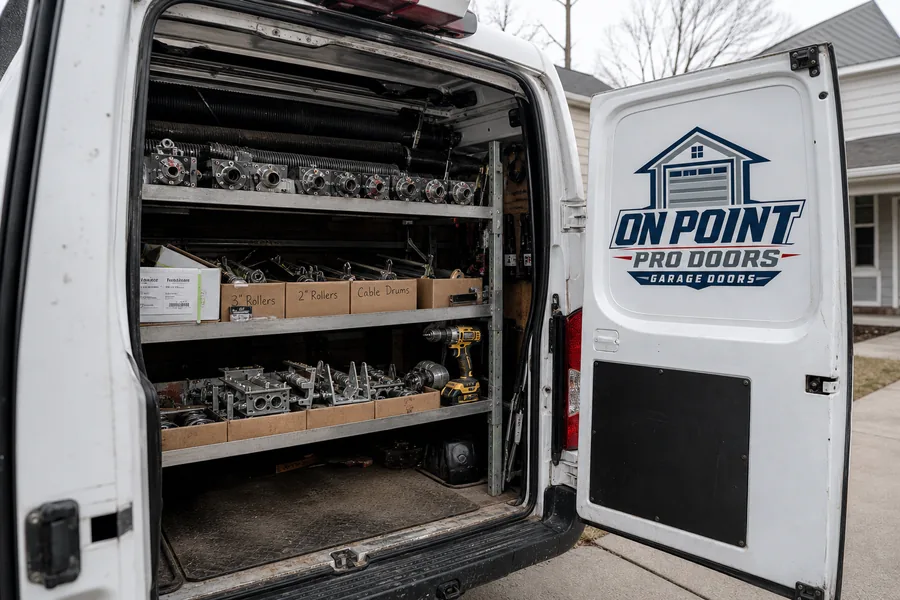
Most off-track garage door repair calls we take start the same way. The door moved fine yesterday. That is normal. The parts that fail here carry the door's weight, and parts under that kind of load go suddenly, not gradually. Salt air off the water rusts cables and bottom brackets, and a hard freeze stiffens springs and old lubricant, so we carry the parts for it on the van rather than ordering them in.
The door rides on ten or twelve rollers in a steel track that holds it flat to the opening. A single roller leaving the channel drops that corner of the door. The panel it sits in twists, levering out the rollers above and below, and the failure climbs the door faster than you can reach the button.
New York, Nassau County, Jersey City, Hoboken, Yonkers, Westchester, Hudson County and the rest of Kings County are all inside the normal radius. The visit asks nothing of you, and no work starts without your say.

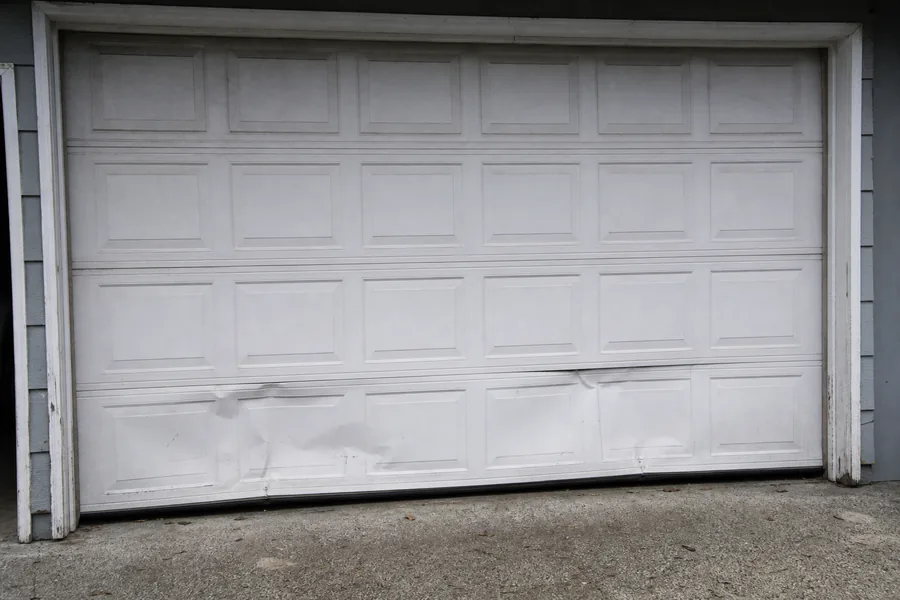
It's diagnosable from where you're standing. The door's two sides are no longer level. There's a strip of daylight down one side that's new. Part way up it catches, or it grinds along instead of rolling, and a roller is usually visible clear of its channel.
Recognize any of those? On site it takes a technician around ten minutes to pin it down. We do not guess over the phone, and looking at the door is free.


It can be made to look straight. It never runs true again, so the rollers keep finding their way out. If a vertical track section is bent, we install a new one. Straightened track never runs true again.
Off the track or not, that door is still tied to a counterbalance under full tension. The dangerous shortcut is levering the door back into its track with the counterbalance still wound. That is where injuries come from, and where a simple fix becomes a panel job.
Track doesn't fail with age. Something caused it. Usually one of four things: a roller that stopped turning, a cable that slipped its drum, a bracket that worked loose, or something hit the door. We don't just lift the rollers back in. Something put the door off its track, and until that's found it will do it again.
None of that is unusual. A door judged by phone gets judged wrong. Our rule is simple: nobody commits to anything until a technician has seen it.


This is a job people delay, and it always ends the same way. None of the following is unusual. It's the ordinary sequence, and we see it every week.
It is a free estimate. Knowing where you stand is free. It is the whole case for calling early.
Tracks don't wear out on their own. They come out of alignment because something happened to them. The causes: a car, a cable letting go, a roller seizing, or brackets loosened over years until the track wandered.
Done properly, the door's weight comes off the track first, with proper support. Rollers are seated from the bottom section up, every hinge is checked for the worn holes a derailment causes, and the track is trued with a level. We replace bent sections; hammered-straight track will derail the door again.
Most derailments have a root cause, and leaving it in place means a repeat. Three usual suspects: a roller that seized, a bracket that loosened, a drum that slipped. The visit ends when we've named the one that did it.
Don't run the opener to try to force it back. The motor keeps going and takes the track, hinges or a panel with it. Realignment becomes replacement. Release the opener and leave the door alone.
Leave it where it sits, and unplug the opener if you think you will be tempted. Big garage door repairs are usually small ones that got used a little longer.
Need the car? Pull the red cord only with the door fully down, never halfway, and lift steadily. Two hands and no movement means stop. Forcing it is where the injuries come from.
More often than not. The schedule keeps room for the calls that cannot wait, and a garage that will not shut is one of them.
We check both sides. A door that comes off on one side twists, and the other side's hinges and rollers take a load they weren't made for. Everything gets reseated and the track squared.
It was pushed by something, usually a seized roller, a slipped cable, a loose bracket or a car. We fix the door and then find the push.
No, not when a spring or cable is the fault. Leave it down and don't force it. The counterbalance stores a lot of energy, and it can release it without any warning.
Yes. The line is open around the clock, and an emergency puts a technician on the road the same night instead of on a calendar for next week.
Yes, card. Card is fine, and nothing gets decided on the doorstep.
If your garage door is doing any of the things on this page, the fastest route to an answer is a phone call. Say what's happening and we'll tell you straight whether it can wait for a normal slot.
No call center, and a free estimate. We cover New York and Nassau County, Jersey City, Hoboken, Yonkers, Westchester, Hudson County.
You don't need to know what's broken. Say what the door does when you press the button, what it sounds like, and whether anything looks loose or snapped. The technician takes it from there and brings the parts that match.
Tell us the symptoms and we'll give you a window, not a guess. The visit and the estimate is free, anywhere in Kings County.
Easier to explain by phone? Call (929) 429-2429.
Tell us what the door is doing. The estimate is free, and you hear the number before we start.