Serving Brooklyn, Queens and Long Island(929) 429-2429Open six days a weekFree estimateGuaranteed work
On Point Garage Doors
Open 24 hours Sun-Thu, Fri until 5 pm Free estimate Springs, openers, cables We come to you
Emergency?Call nowBook free estimate
New York, NY - open six days a week

Garage door track brackets pulling loose

Free estimateSame-day serviceCommon parts on board
  • Free estimate
  • Same-day service
  • Common parts on board
Emergency garage door repair★★★★★ 5.0 on Google · 42 reviews

Book your free estimate

Takes 30 seconds. We call you back to set a time.

Or just call (929) 429-2429 and talk it through.

Home › Garage Door Track Brackets

The vertical tracks on each side of a garage door do not hold themselves up. A short row of steel brackets ties each track to the wooden jamb or the wall, and at the top a bigger flag bracket joins the vertical and horizontal track. On many commercial doors a continuous steel angle runs the full height of the opening instead. When any of these pull loose, the track starts to move with the door, and a door that is held by a moving track is one bump away from coming out of it. This page covers what the brackets do, why they let go and what a sound repair involves. Free estimate at (929) 429-2429.

By Sean Cohen, owner, On Point Garage Doors · Updated

Real jobs. Real photos.

These photos are from our own jobs, with our logo on them.

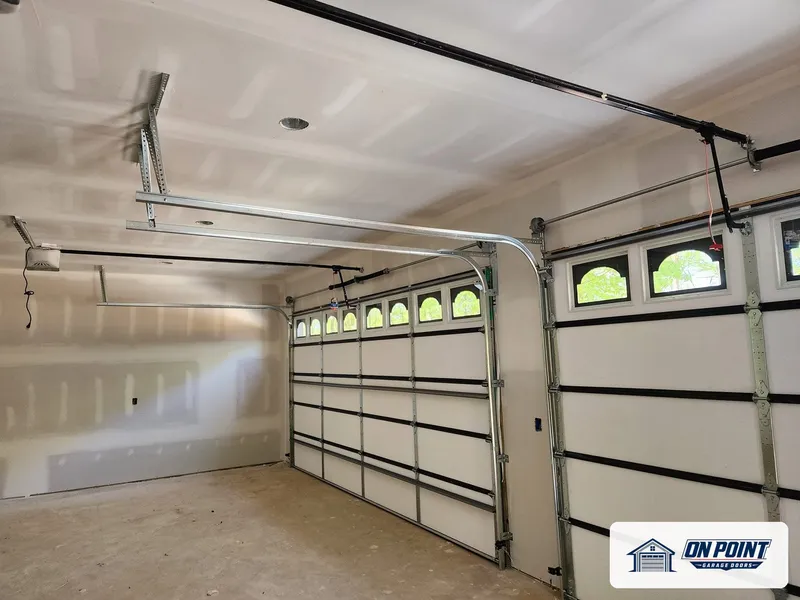
Vertical tracks, curves and ceiling hangers on two new doors, from one of our jobs
Vertical tracks, curves and ceiling hangers on two new doors
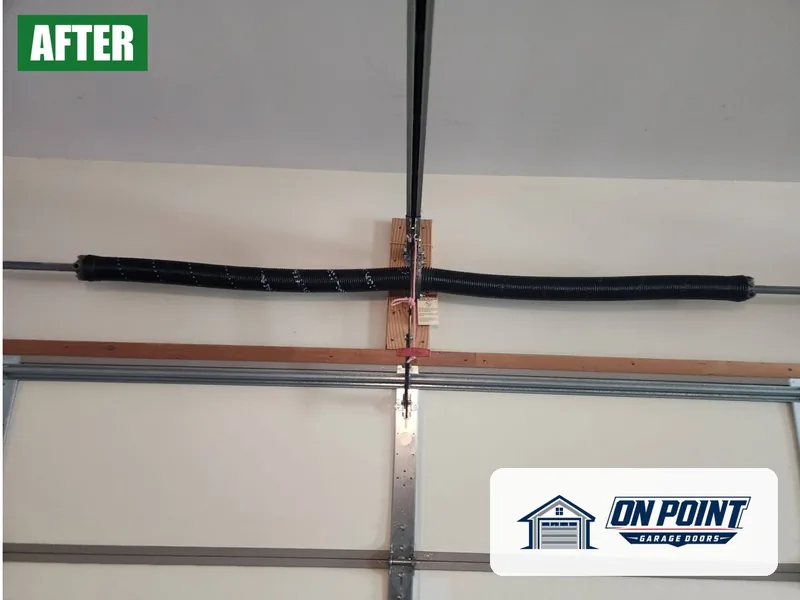
Torsion spring and center bracket above a door, from one of our jobs
Torsion spring and center bracket above a door
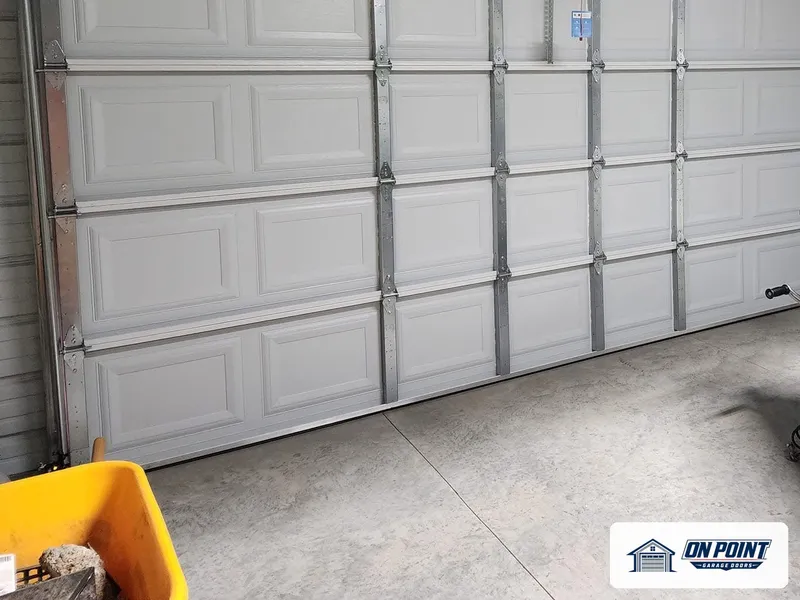
Steel sections and end stiles beside the track, from one of our jobs
Steel sections and end stiles beside the track

The brackets that hold a track

Why the spacing matters

Each track has to sit a set distance from the face of the door, straight up and down, and parallel to the other side. Too close and the door rubs and binds. Too far and the rollers ride near the edge of the track where they can slip out. The brackets fix that distance at several points, so when one lets go, the gap at that spot changes every time the door moves.

Signs a bracket is pulling loose

Rotted jambs behind the brackets

Most residential jamb brackets are fastened into the wood framing at the sides of the opening. Water that runs down the outside of the door, wicks up from a wet floor or leaks past old trim slowly rots that wood from the bottom up. A fastener in soft wood has almost no grip, and vibration from every trip works it out. When the jamb is rotted, a bracket fastened back into the same spot will pull loose again.

Brick, block and concrete openings

In garages with masonry around the opening, brackets or wall angles are held with anchors set into the brick, block or concrete. Old mortar crumbles, hollow block cracks around an anchor that was set too close to an edge, and anchors made for light loads work free under the steady pull of a moving door. The fix depends on what the wall is made of and what condition it is in, which is why a masonry opening is looked at closely before any bracket goes back.

Bumps from cars, bikes and storage

The lowest bracket on each side sits right where a bumper, a mower or a bike handlebar lands. A light knock can bend the track inward at that point and twist the bracket. Shelves, ladders and bins pushed against the track do the same over time. A bent bracket holds the track out of line even when its fasteners are tight.

The flag bracket at the top

The flag bracket takes load from two directions, the vertical track below and the horizontal track running back from the curve. On many torsion doors it also sits close to the end bearing plate that carries the spring shaft. A flag bracket pulling away from the jamb lets the curve sag and the horizontal track drop at the front. Because of what sits next to it, this is a spot for a technician, not for guesswork.

Wall angles on commercial doors

Heavy sectional doors on warehouses and shops often hang their tracks from a full-height steel angle bolted to the wall or the steel frame. The angle spreads the load along the whole height. When forklifts strike the track or the anchors lose their grip in old block, the angle twists or pulls away in a section. A twisted angle throws both the track and the door out of line, and the door can bind or come out of the track under load.

Why it should not wait

A track that moves gives the rollers less to hold. Sooner or later a roller slips out, often near the top where the door is changing direction. A door off its track can hang crooked, jam half open or drop at one corner, with the springs still pulling on the cables. Running it with the opener only makes the jolt worse. If a track is visibly loose, leave the door closed and keep people and cars clear.

What a bracket repair includes

With the door closed and held safely, damaged wood is cut out and replaced with sound jamb material, or masonry anchors are reset in solid stone or block. Bent brackets and twisted angle are replaced. The tracks are set plumb, the right distance from the door and parallel to each other, the rollers and hinges near the trouble spot are checked, and the door is run through full travel, balanced and tested for safe reversal.

Related problems we check at the same time

Loose brackets rarely travel alone. The same water that rots a jamb also rots the bottom of the trim and rusts the lower track. A track that has been moving can wear flat spots on rollers and bend hinges. The back hangers at the ceiling may be sagging too. We look at the whole path of the door so you are not calling again for the next weak point.

Questions we get asked

What holds a garage door track to the wall?

Jamb brackets spaced up each vertical track, a flag bracket at the top, and on many commercial doors a continuous steel wall angle.

Is it dangerous if a track bracket is loose?

It can be. A moving track lets rollers slip out, and a door off its track can hang crooked or drop at one corner. Leave it closed and call.

Why do my track brackets keep coming loose?

Usually because the wood behind them is rotted or the masonry anchors are failing. Fastening into the same weak spot again does not hold.

Can a bent track bracket be straightened?

A bent bracket is normally replaced. It is a small part, and a new one holds the track at the right distance.

Is the estimate free?

Yes. We look at the brackets, the jamb or wall behind them and the tracks, and tell you what needs doing before any work starts.

Booking takes a minute

Across Brooklyn, Queens and Long Island, tell us what the door is doing and we set a visit that fits your day.

Free estimate, call (929) 429-2429.

Track wobbling off the wall? Leave the door down and call

Tell us what the door is doing and we will give you an honest arrival time. The estimate is free.

Easier to explain by phone? Call (929) 429-2429.

Two minutes to a free estimate

Tell us what the door is doing. The estimate is free either way.

Or just call (929) 429-2429 and talk it through.

The other six things that go wrong