Serving Brooklyn, Queens and Long Island(929) 429-2429Open six days a weekFree estimateGuaranteed work
On Point Garage Doors
Open 24 hours Sun-Thu, Fri until 5 pm Free estimate Springs, openers, cables We come to you
Emergency?Call nowBook free estimate
New York, NY - open six days a week

Garage door back hangers

Free estimateSame-day serviceCommon parts on board
  • Free estimate
  • Same-day service
  • Common parts on board
Emergency garage door repair★★★★★ 5.0 on Google · 42 reviews

Book your free estimate

Takes 30 seconds. We call you back to set a time.

Or just call (929) 429-2429 and talk it through.

Home › Garage Door Back Hangers

When a garage door opens, it rolls back and rests overhead on two horizontal tracks. The front of those tracks is held by brackets at the door frame, but the back ends hang from the ceiling on short lengths of punched steel angle called back hangers. Nobody notices them until one sags, bends or pulls out of the ceiling, and then the whole weight of an open door is resting on a support that is giving way. This page explains what the hangers do, how they fail and what a proper repair looks like. Free estimate at (929) 429-2429.

By Sean Cohen, owner, On Point Garage Doors · Updated

Real jobs. Real photos.

These photos are from our own jobs, with our logo on them.

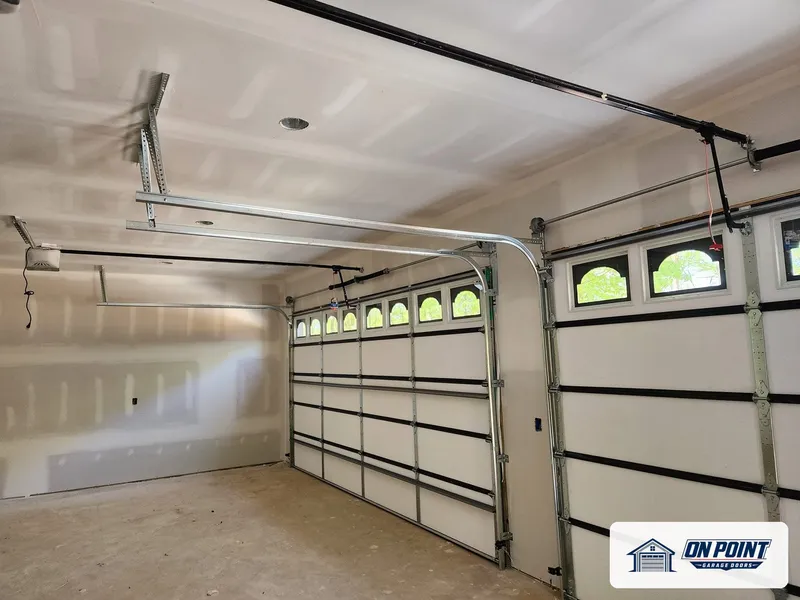
Track hangers and opener rails under a ceiling, from one of our jobs
Track hangers and opener rails under a ceiling
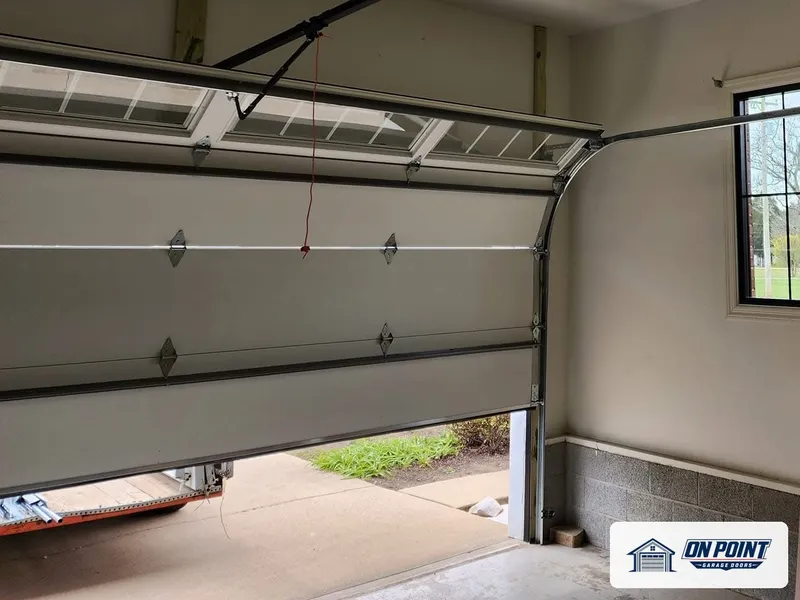
Horizontal track running back from the curve, from one of our jobs
Horizontal track running back from the curve
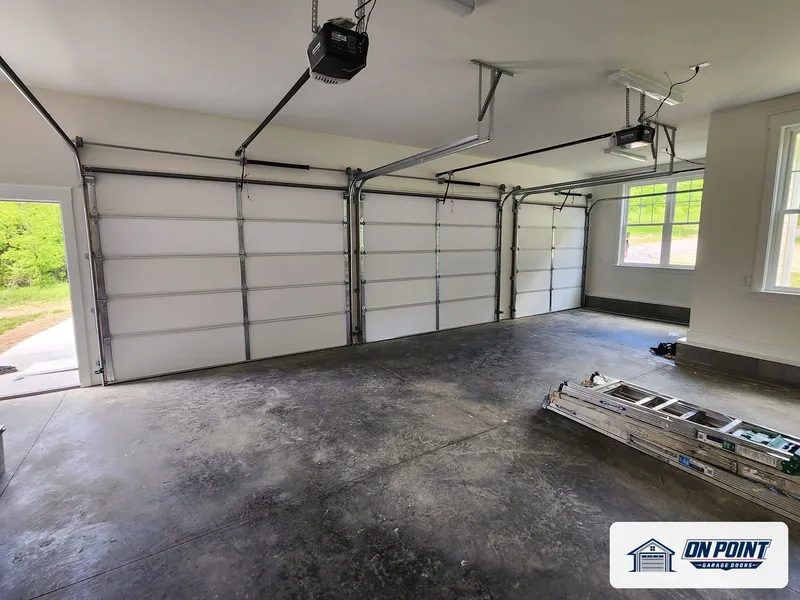
Openers and tracks hung over three doors, from one of our jobs
Openers and tracks hung over three doors

What the back hangers do

Each horizontal track needs support at its rear end, where nothing else holds it. The back hanger is a piece of perforated steel angle fastened to the ceiling framing, dropping down to the track, and usually braced with a second angle running diagonally so it cannot swing. With the door open, a large share of its weight sits on the rear of those tracks, so the hangers carry real load every time the door goes up.

Signs a hanger is failing

Why hangers pull loose

The most common cause is a weak attachment. Hangers fastened only into drywall, or into the edge of a joist, have very little grip. Years of vibration from the opener and the jolt of the door stopping at the top slowly work the fasteners out. Wood that has dried, split or rotted from a roof leak loses its hold. A ladder, a lumber rack or a car roof bumping the track can bend the angle in a single moment.

Why this is a safety problem

A sagging hanger puts the open door on a slope. If a hanger lets go entirely, the back of the track can drop, and an open door may roll off its track or come down at an angle. That is a heavy steel panel falling inside a space where people park and walk. Never stand or park beneath an open door whose tracks are hanging low.

The opener often hangs nearby

The motor unit of a ceiling-mounted opener is also hung on steel angle, often close to the track hangers or even sharing framing with them. A loose opener hanger lets the motor swing, which throws off its travel settings and can make the door reverse or stop short. When one support is loose, we look at every one under that ceiling.

Ceilings that make it harder

Each calls for a different way of attaching, and getting it wrong is how hangers come loose a second time.

Bracing against sway

A single straight drop of angle can swing like a pendulum. A diagonal brace back to the ceiling turns it into a triangle that holds its shape, and a cross piece tying the two tracks together keeps them parallel. Without that bracing, the tracks spread or pinch as the door moves, which leads to rollers binding or slipping out at the far end.

Heavier doors need sturdier support

A new insulated door, a door with added windows, or a wood door on an older garage can weigh far more than whatever the original hangers were sized for. Light angle and short fasteners that coped with a thin steel door may sag under a heavier one. When a door is replaced or upgraded, the hangers deserve the same attention as the springs.

What a hanger repair includes

The door is closed and the springs are left alone while the overhead support is rebuilt. Bent or rusted angle is replaced with new steel, hangers are moved to solid framing or anchored properly into concrete, and diagonal and cross bracing is added where it was missing. Then the tracks are set level and parallel, the rear stops are checked, and the door is run through its full travel and tested for balance and safe reversal.

How it connects to other track problems

A sagging rear track rarely travels alone. The extra strain can work the brackets at the curve free, wear rollers unevenly and twist the horizontal track itself. If the vertical tracks beside the opening are bent or loose too, the fix becomes a fuller track repair. We look at the whole path the door follows rather than only the support that caught your eye.

Until it is fixed

Leave the door closed if you can, and keep the car and people out from under the tracks. Avoid running the door with the opener while a hanger is hanging loose, because the jolt at the top of each trip makes the problem worse. Call and describe what you see, ideally with a photo, and a technician can tell you how urgent it looks.

Questions we get asked

What are back hangers on a garage door?

They are the steel angle supports that hang the back ends of the horizontal tracks from the ceiling. They carry much of the door's weight whenever it is open.

Is it safe to use the door if a back hanger is sagging?

It is better not to. A hanger that lets go can drop the back of the track, and an open door can roll off or come down crooked.

Why did my track hanger pull out of the ceiling?

Usually because it was fastened to drywall or weak wood, and vibration worked it loose over time. A knock from a car, ladder or storage rack can also bend it.

Can hangers be attached to a concrete ceiling?

Yes, with anchors made for masonry. Garages under houses often have concrete above, and the hangers need that kind of anchoring to stay put.

Is the estimate free?

Yes. We look at the hangers, tracks, opener supports and the balance of the door, and tell you what needs doing before any work starts.

Booking takes a minute

Across Brooklyn, Queens and Long Island, tell us what the door is doing and we set a visit that fits your day.

Free estimate, call (929) 429-2429.

Tracks drooping at the back? Leave the door down and call

Tell us what the door is doing and we will give you an honest arrival time. The estimate is free.

Easier to explain by phone? Call (929) 429-2429.

Two minutes to a free estimate

Tell us what the door is doing. The estimate is free either way.

Or just call (929) 429-2429 and talk it through.

The other six things that go wrong