Serving Brooklyn, Queens and Long Island(929) 429-2429Open six days a weekFree estimateGuaranteed work
On Point Garage Doors
Open 24 hours Sun-Thu, Fri until 5 pm Free estimate Springs, openers, cables We come to you
Emergency?Call nowBook free estimate
New York, NY - open six days a week

Garage door torsion shaft problems

Free estimateSame-day serviceCommon parts on board
  • Free estimate
  • Same-day service
  • Common parts on board
Emergency garage door repair★★★★★ 5.0 on Google · 42 reviews

Book your free estimate

Takes 30 seconds. We call you back to set a time.

Or just call (929) 429-2429 and talk it through.

Home › Garage Door Torsion Shaft

On a door with torsion springs, a steel bar runs across the top of the opening, just above the door. That bar is the torsion shaft. The springs slide over it, the cable drums sit at each end, and bearings hold it in place at the center and both sides. When the springs turn the shaft, the drums wind the cables and lift the door evenly. Because every part of the lift goes through the shaft, a bent or worn shaft causes trouble that often looks like a cable or spring problem at first. Free estimate at (929) 429-2429.

By Sean Cohen, owner, On Point Garage Doors · Updated

Real jobs. Real photos.

These photos are from our own jobs, with our logo on them.

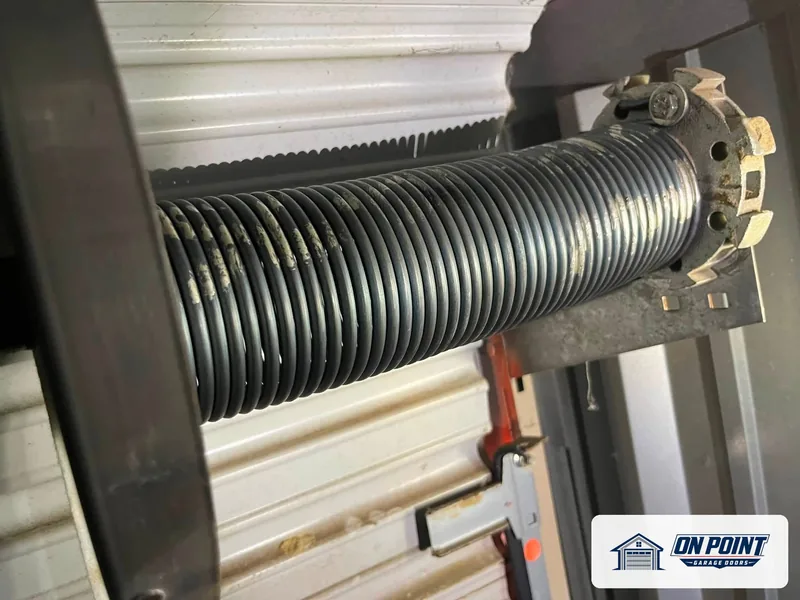
Close-up of a door spring and its end bracket, an On Point Garage Doors job
Torsion spring and cable drum
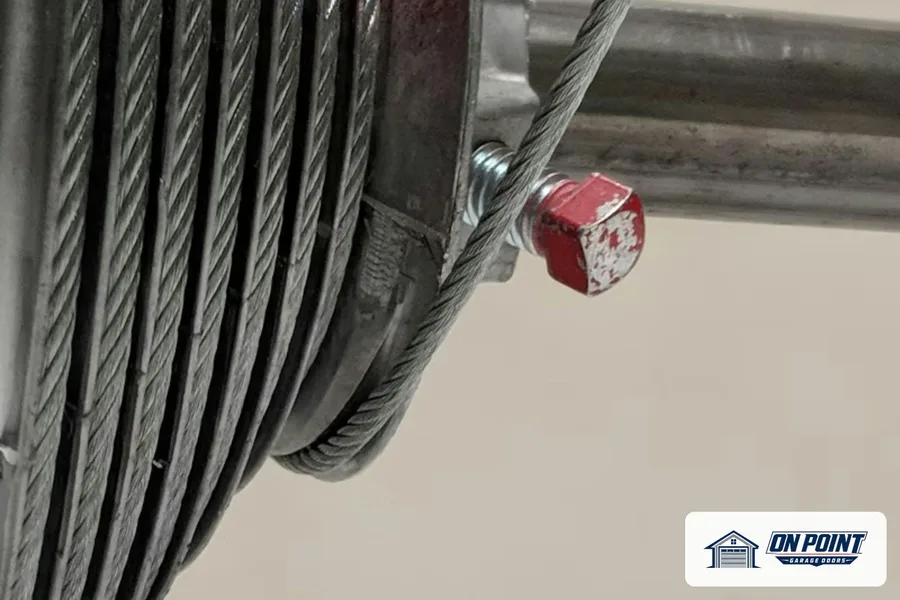
Close look at a cable drum on the shaft, from one of our jobs
Close look at a cable drum on the shaft
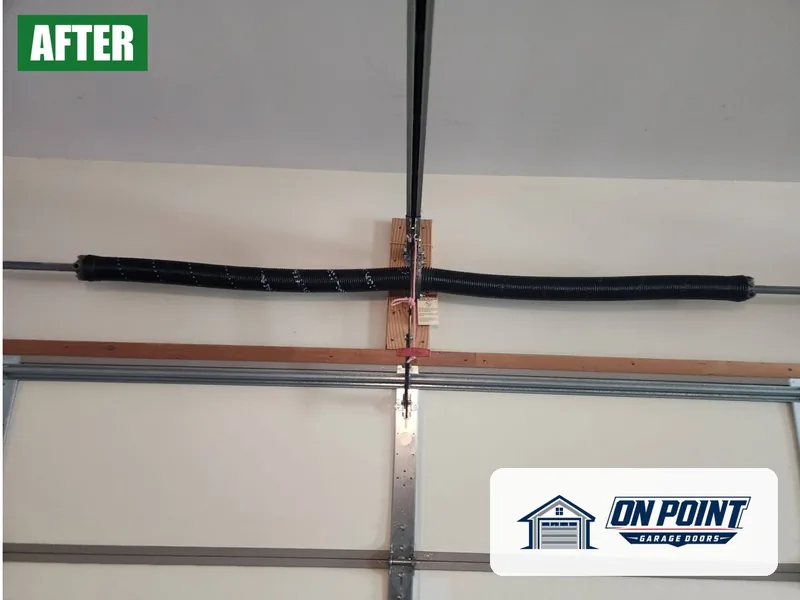
New garage door spring installed by On Point Garage Doors
Springs and cables on a door

What the shaft does

The shaft carries the twist of the springs to the drums on each side. If the shaft is straight and turns freely, both drums turn together and both cables lift at the same rate. That is what keeps a door level as it rises. Anything that stops the shaft turning smoothly shows up in how the door moves.

Signs of a bent shaft

How shafts get bent

The most common cause is a broken spring. When a spring snaps, the shaft can take a sudden jolt. A door hit by a car, a door that came off track and twisted, or an opener that kept pulling a stuck door can also bend it. Some older doors simply had a shaft too light for the weight they carry.

Solid or hollow shafts

Residential doors usually run on a hollow steel tube. Heavier doors, tall doors and many commercial doors use thicker tube or solid steel. A heavy wood or insulated door on a light shaft is more likely to flex, which is one reason doors that were upgraded over the years end up with shaft trouble.

Keyways and slipping drums

Some shafts have a groove cut along their length, and the drums and spring cones lock into it. Others rely on small locking bolts that bite into the tube. If one of those bolts works free or wears a smooth spot, a drum can slip on the shaft. The door then lifts crooked even though the shaft itself is straight.

Why the shaft is a job for a technician

The shaft is held under the full force of the springs. Freeing a drum or a cone without first removing that tension can make the shaft spin hard or send a tool flying. Changing a shaft means taking the tension off the springs, which is a job for a trained technician with the right tools. Our page on spring safety explains why.

Shaft, bearings and drums together

When a shaft is replaced, the end bearings and the center bearing are checked at the same time, and often replaced. Drums are looked at for cracks and worn grooves. Putting a new shaft into worn bearings only moves the problem along.

When springs are being changed

Many shaft problems are found during a spring repair. The technician has the tension off anyway, so it is the right moment to check the shaft for a bend and the drums for wear. If the shaft is bent, it is far better to replace it then than to come back for it later.

Doors with a single spring

On a door with one spring off to one side, the shaft takes more twist along its length. A long, wide door on a single spring can flex the shaft enough to lift unevenly. Changing to two springs spreads the load and is often recommended when a single spring breaks on a wide door.

Commercial doors and long shafts

On wide shop doors and rolling steel doors, the shaft or the barrel spans a long opening and carries far heavier springs. A bend there shows up fast, as a door that lifts crooked or rattles in its guides. Commercial shafts are often in several pieces joined with couplers, and a worn coupler can slip in the same way as a loose drum. We check couplers and center supports on every long shaft we work on.

Other parts that cause similar signs

An uneven door can also come from a frayed cable, a worn drum, a broken roller or a track out of line. The technician checks each part rather than guessing, since the fix for each one is different. Our page on an uneven garage door covers those causes.

What a visit includes

The technician checks the shaft for a bend, looks at the bearings, drums, cables and springs, and explains what needs replacing. You get a free estimate before any work starts.

Questions we get asked

What is a garage door torsion shaft?

The steel bar above the door that carries the torsion springs and the cable drums.

How can I tell if my torsion shaft is bent?

It wobbles when the door moves, one side lifts first, or a cable keeps coming off one drum.

What bends a torsion shaft?

Usually a spring breaking, a car hitting the door, or a door that came off track and twisted.

Can I replace a torsion shaft myself?

No. The shaft is under full spring tension. A trained technician should do it.

Is the estimate free?

Yes. We check the shaft and the parts around it before any work starts.

Booking takes a minute

Across Brooklyn, Queens and Long Island, tell us what the door is doing and we set a visit that fits your day.

Free estimate, call (929) 429-2429.

Door lifting crooked or wobbling at the top? Book a check

Tell us what the door is doing and we will give you an honest arrival time. The estimate is free.

Easier to explain by phone? Call (929) 429-2429.

Two minutes to a free estimate

Tell us what the door is doing. The estimate is free either way.

Or just call (929) 429-2429 and talk it through.

The other six things that go wrong