Takes 30 seconds. We call you back to set a time.
Look up at the bar above a garage door and you may see paint: a dab on the coils, a long stripe, a red or black fitting at the end. People search those colors hoping to order the right spring, which is understandable and a little risky. The colors mean something, but they mean different things on different kinds of spring, and several of them can be wrong. Here is what each mark is for and how far to trust it. Free estimate at (929) 429-2429.
By Sean Cohen, owner, On Point Garage Doors · Updated
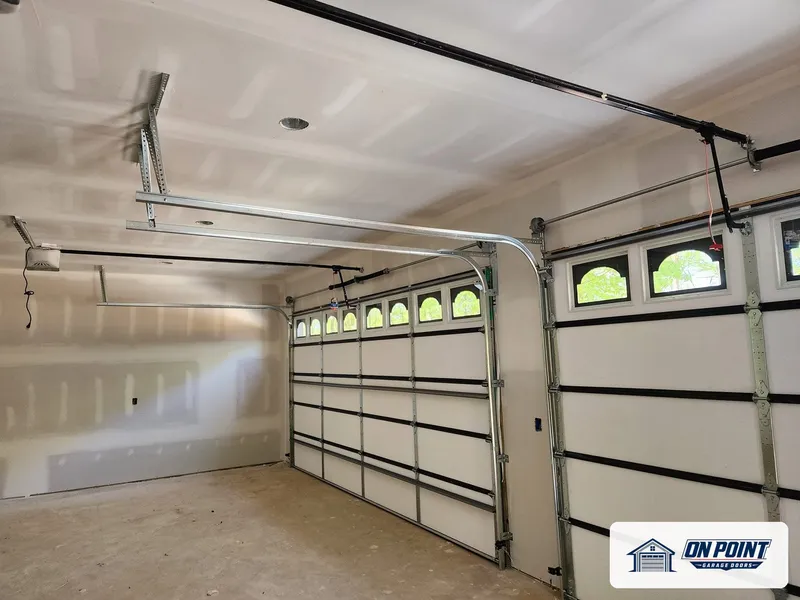
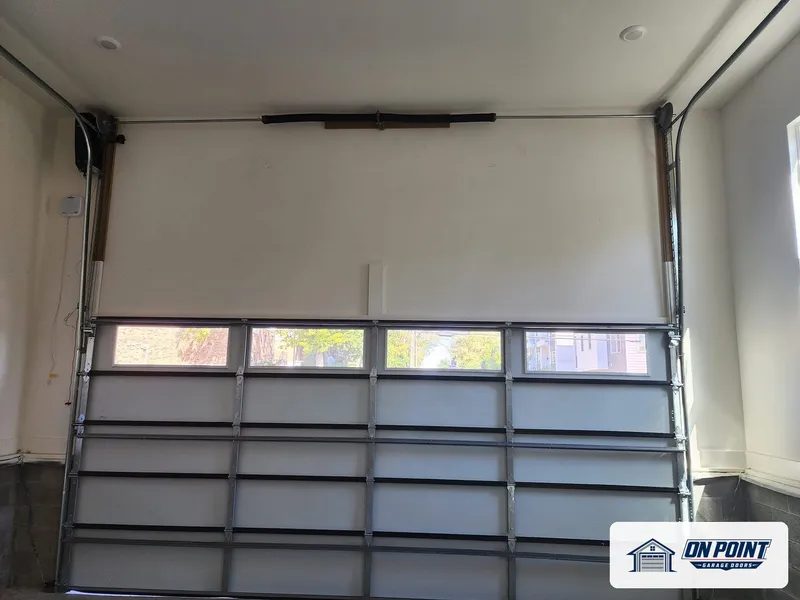
These photos are from our own jobs, with our logo on them.


Mixing these up is the most common mistake. A red mark on an extension spring and a red cone on a torsion spring have nothing to do with each other.
The door industry's trade association publishes a color chart for torsion spring wire. Each wire thickness has a color, and because there are more thicknesses than easy colors, the palette repeats. One color therefore stands for more than one wire size. It can confirm a measurement, but it cannot replace one, and two springs wearing the same paint may lift very different doors.
Some spring makers and door brands have used codes of their own, older springs may predate the chart, and a replacement may have been cut from longer stock that carried somebody else's mark. Paint also gets added in the field. A technician treats the color as a clue from an unknown witness: worth noting, never enough on its own.
Torsion springs come left-wound and right-wound, and a pair on one door normally uses one of each. The cones are often painted in two colors, commonly red and black, to separate the hands at a glance. Cones get reused, swapped and repainted, so the reliable evidence is the direction in which the wire itself ends. A spring of the wrong hand cannot do the job on that side of the bracket.
Extension springs, the long ones that stretch beside the tracks, use color more directly. The paint on the end coils or loops indicates the weight of door the spring is rated for, and the chart for these is more widely followed. Even so, the rating only helps if it was right for your door to begin with. Doors gain weight from paint, insulation, struts and windows, and a faithful copy of the old spring copies the old error.
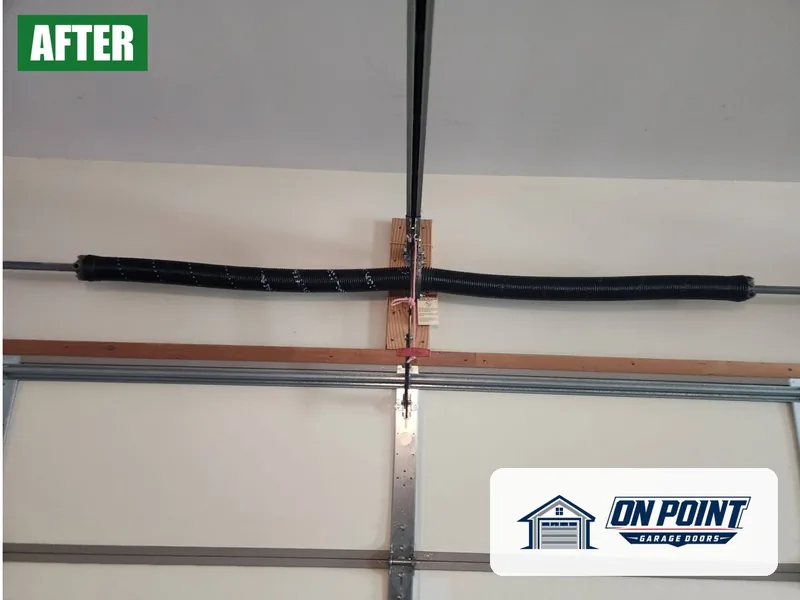
A straight stripe painted from end to end of a new torsion spring becomes a spiral once the spring is under tension, like the stripe on a candy cane. It lets a technician see that tension is present and roughly how much. An owner can learn one useful thing from it: a spiral means the spring is holding a great deal of force, so hands and tools stay away from it.
A torsion spring is defined by four things together: wire thickness, inside diameter, coil length and the hand it is wound. The paint speaks to one of them at best. Change the length alone and both the lift and the number of cycles the spring will live for change with it. This is how a spring ordered by color arrives looking identical and leaves the door drifting down or shooting up.
On a visit the wire is gauged across a run of coils, the diameter is read from the cone or measured, and the length is taken with allowance for a spring that has stretched or broken. Then the part that matters most: the door itself is weighed or its balance is tested, and the drum and track type are noted. The new springs are chosen from the door, with the old ones as supporting evidence.
Garage damp, road salt and plain age take the color off long before the steel gives out, and orange-red rust is easily mistaken for red paint. None of that stops a replacement. A bare, rusty spring can be sized as accurately as a bright new one. Heavy rust is worth acting on for another reason, since pitted wire breaks sooner.
Different paint on the two springs of one door is not automatically wrong. The pair may be deliberately mismatched in wire and length while adding up to the right lift, or it may be the trace of a single spring changed in a hurry. If the door hangs level and holds at waist height, it is probably balanced. If it creeps or jumps, have both checked together.
Photograph the springs, the cones and any tag hanging from the center bracket from the floor, with the door down. The tag is often more use than the paint. Send nothing up there but your eyes. Springs and their fittings hold enough energy to cause serious injury, and reading a color is never a reason to put a hand on one.
Usually it marks the wind direction of that spring, not its strength. Because cones are reused and repainted, a technician confirms the hand from the wire end.
Not safely. The color covers one property at most and repeats across sizes. The wire, diameter, length, hand and the weight of the door all have to be known.
It may have worn off, rusted over or never been there. It makes no difference to a proper replacement, which is sized by measurement.
No. There is an industry chart, but makers have varied from it and older springs may follow other systems. That is why the code is only a cross-check.
The estimate is free. The technician measures the springs, tests the balance and writes down what the door needs before any spring is changed.

Across Brooklyn, Queens and Long Island, tell us what the door is doing and we set a visit that fits your day.
Free estimate, call (929) 429-2429.
Tell us what the door is doing and we will give you an honest arrival time. The estimate is free.
Easier to explain by phone? Call (929) 429-2429.
Tell us what the door is doing. The estimate is free either way.