Takes 30 seconds. We call you back to set a time.
Every torsion spring has a cone at each end. They look like small parts next to the spring itself, but they are the pieces that hold all of the spring's force. One end is fixed to the bracket on the wall, and the other grips the bar that turns the cable drums. When a cone cracks, slips or wears, the door can lose its balance or the spring can let go. This page explains what the cones do, what a failing one looks like from the floor and why a cone problem always means a careful spring visit. Free estimate at (929) 429-2429.
By Sean Cohen, owner, On Point Garage Doors · Updated
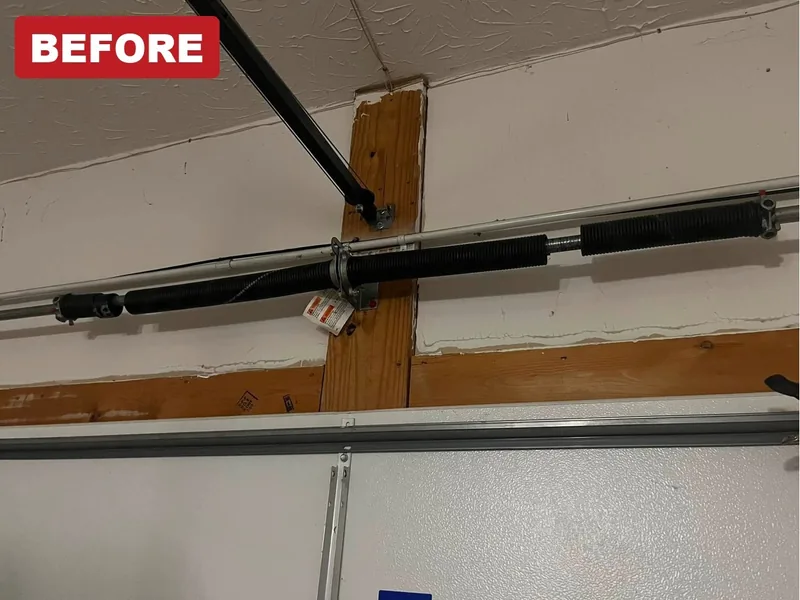
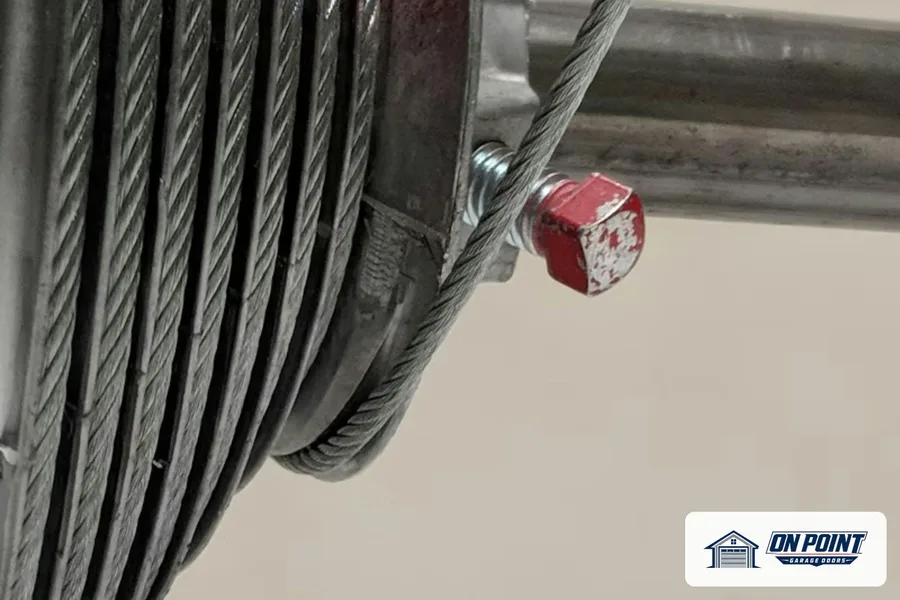
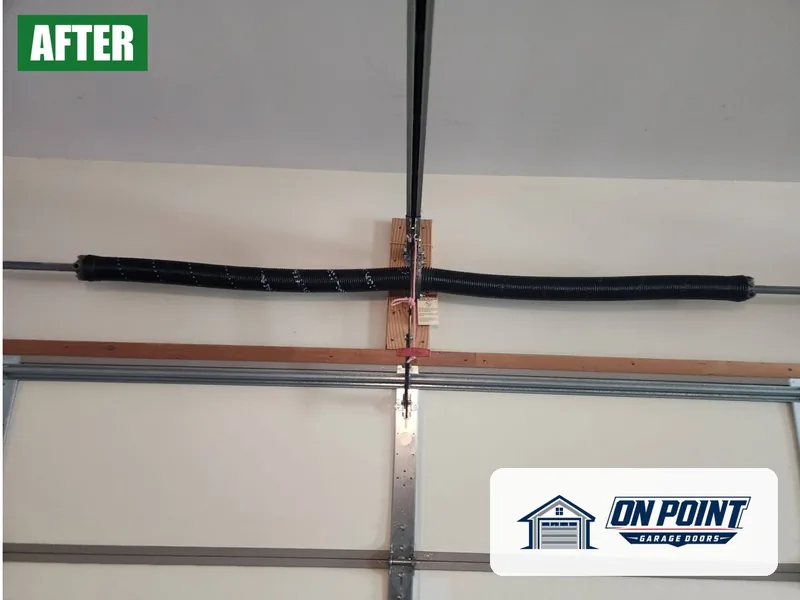
These photos are from our own jobs, with our logo on them.


Cones are made of cast metal and carry the full force of the spring every time the door moves. Over many years they can crack from that strain, from rust, or from being forced during an old repair. Low-grade replacement springs sometimes come with weak cones that crack early. A spring that breaks hard can also crack the cone it was fixed to.
The winding cone grips the bar with small bolts. If those bolts were left short of snug, or the bar is worn where they bite, the cone can creep around the bar. Each slip lets out a bit of tension, so the door grows heavier over time with no broken part in sight. A cone that slips all at once can let the door drop or spin the bar.
The fixed cone is bolted to the center bracket, and the bracket is screwed into the wall above the door. If the bolts work free or the wood behind the bracket is soft, the cone and bracket can twist away from the wall. That is a serious problem, because the spring is held by that bracket. Old garages with soft headers are where we see it most.
Any work on a cone releases the spring's force through the bar and the tools in someone's hands. That is how most spring injuries happen. There is no safe way for a homeowner to work on a cone. If something at the end of the spring looks wrong, leave the door closed, stay out from under it and call.
Good replacement springs arrive with cones already in place, matched to the spring wire. We do not move old cones onto new springs. When a door gets new springs, the cones, the bolts that hold them and the center bracket are all part of the job, and the bar is checked where the cones grip it.
Salt air along the bays and the Sound rusts cones and their bolts faster than inland. Rust at the cone can hide a crack and can seize the bolts to the bar. On garages near the water, we look closely at both ends of each spring and point out rust before it turns into a break.
The center bracket holds the stationary cones and a bearing for the bar. A cracked bracket, a worn bearing or a bracket screwed into soft wood puts uneven strain on the cones. When we see wear at the cone, we look at the bracket and the wall behind it as well, so the new parts sit on something solid.
On a two-spring door, there are four cones: two fixed to the center bracket and one at the outer end of each spring. Each spring has to be set the same so the bar turns evenly. If one cone has slipped, that side of the door lifts differently from the other, and the door may rise crooked.
The technician checks both ends of each spring, the cone bolts, the center bracket, the bearings, the drums and the cables, then shows you anything cracked or worn. You get a written estimate before work starts, and the door is balanced and tested with you watching.
A cast metal end piece on a torsion spring. One is fixed to the wall bracket and the other grips the bar.
The spring can lose tension or let go, and the door may become heavy or drop. Keep the door closed and call.
We put new springs on with their own matched cones rather than mixing old and new parts.
A cone that has slipped on the bar lets out tension a little at a time.
Yes. We check the springs and cones before any work starts.
Across Brooklyn, Queens and Long Island, tell us what the door is doing and we set a visit that fits your day.
Free estimate, call (929) 429-2429.
Tell us what the door is doing and we will give you an honest arrival time. The estimate is free.
Easier to explain by phone? Call (929) 429-2429.
Tell us what the door is doing. The estimate is free either way.