Takes 30 seconds. We call you back to set a time.
Every garage door that opens overhead has springs that carry most of its weight. There are two kinds. Torsion springs sit on a steel bar right above the door and twist to lift it. Extension springs run along the horizontal tracks on each side and stretch as the door closes. Both store enough energy to cause serious injury, and both are a job for a technician. Free estimate at (929) 429-2429.
By Sean Cohen, owner, On Point Garage Doors · Updated
These photos are from our own jobs, with our logo on them.


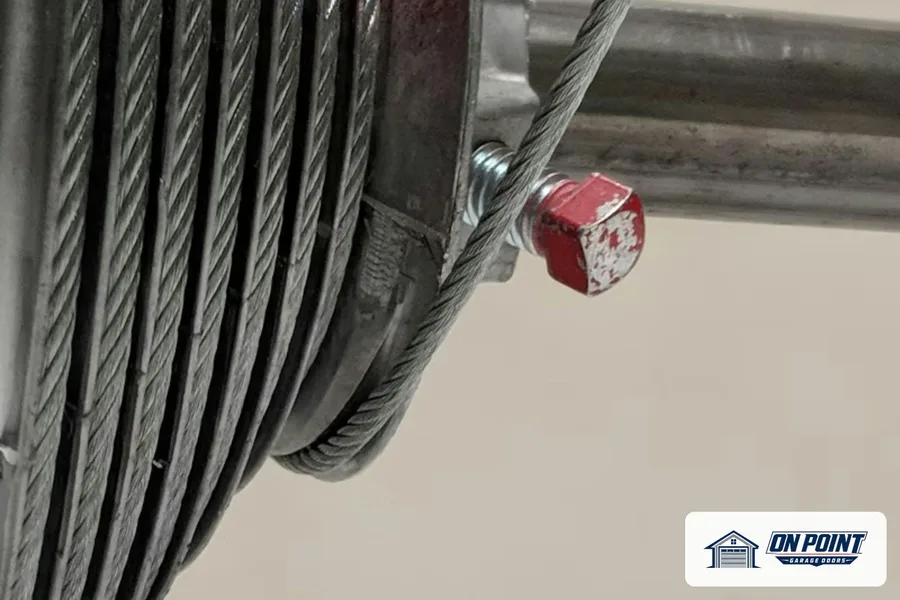
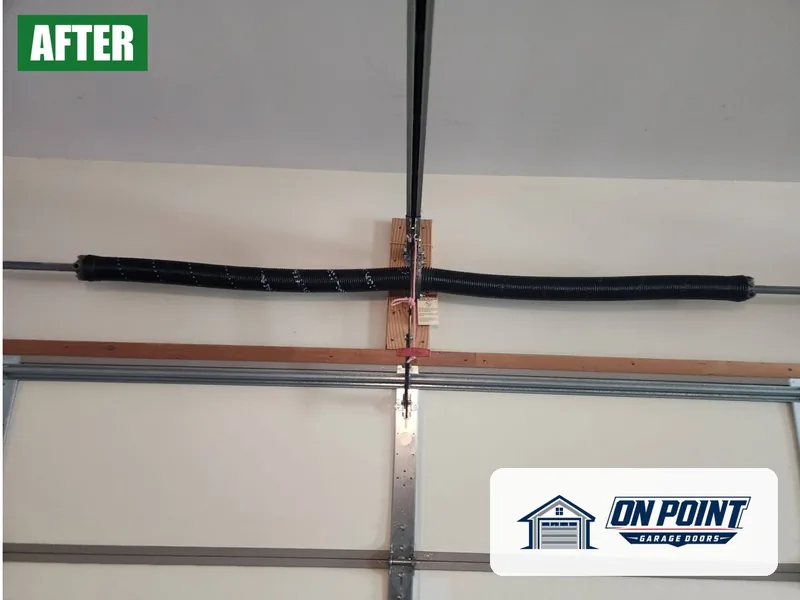
A torsion spring is wound tight when the door is closed. As the door opens, the spring unwinds and turns the bar, which winds the cables onto the drums and lifts the door. The weight is shared evenly across the door.
Extension springs stretch as the door closes and pull it back up as they contract, working through pulleys and cables. Each side lifts its own half of the door, so a weak spring on one side makes the door lift unevenly.
Torsion springs generally give smoother, more balanced lifting, last longer and are safer when they break because they stay on the bar. Extension springs are common on older and lighter doors.
Converting from extension to torsion springs is possible on many doors and is often done when the springs need replacing anyway. Whether it makes sense depends on the door, the headroom and the opener.
A spring that is winding or stretching holds enough force to break bones or worse if it slips. Winding a torsion spring or unhooking an extension spring needs the right tools, the right spring size and training. If a spring is broken or looks gapped, leave the door down and call.
Springs are rated by cycles, one open and one close. A household that uses the garage as its main entrance can go through a spring years sooner than one that rarely opens the door.
High-cycle springs are available for busy doors. They last much longer, and the technician explains whether they make sense for how you use the door.
A spring has to match the door's actual weight. If a door gets heavier, with added insulation, windows, a new wood finish or water soaked into old wood, the old springs can no longer balance it.
An unbalanced door works the opener harder and wears every other part faster. Matching the spring to the door is the first thing checked.
A weak spring is far easier and safer to replace before it breaks than after.
Near the water and in damp detached garages, springs rust. Rust on the coils weakens them and makes them break sooner.
Coated springs hold up better in those conditions, and the technician explains the options when a spring is replaced.
A torsion spring that broke usually shows a visible gap in the coil and makes a loud bang when it goes. The door then will not lift or feels extremely heavy.
Usually. They lift more evenly, tend to last longer and are safer when they break. Extension springs are still common on older and lighter doors.
On many doors, yes. It is often done when the springs need replacing. The technician checks the headroom and the door first.
On a two-spring door, yes. They wear at the same rate, and replacing both keeps the door balanced.
Yes. You hear which springs your door needs and why before any work starts.
Across Brooklyn, Queens and Long Island, tell us what the door is doing and we set a visit that fits your day.
Free estimate, call (929) 429-2429.
Tell us what the door is doing and we will give you an honest arrival time. The estimate is free.
Easier to explain by phone? Call (929) 429-2429.
Tell us what the door is doing. The estimate is free either way.