Serving Brooklyn, Queens and Long Island(929) 429-2429Open six days a weekFree estimateGuaranteed work
On Point Garage Doors
Open 24 hours Sun-Thu, Fri until 5 pm Free estimate Springs, openers, cables We come to you
Emergency?Call nowBook free estimate
New York, NY - open six days a week

Garage door sections separating

Free estimateSame-day serviceCommon parts on board
  • Free estimate
  • Same-day service
  • Common parts on board
Emergency garage door repair★★★★★ 5.0 on Google · 42 reviews

Book your free estimate

Takes 30 seconds. We call you back to set a time.

Or just call (929) 429-2429 and talk it through.

Home › Door Sections Separating

A sectional garage door is a stack of panels joined by hinges, and each joint is meant to stay snug as the door rolls up and over the curve. When a gap starts to open between two sections, or one section hangs crooked from the one above it, something that holds the stack together has let go. It may be a few screws, a cracked hinge or a stile that has split. This page explains where those gaps come from, what is normal and what is not, and why a separating door should be looked at before it is run again. Free estimate at (929) 429-2429.

By Sean Cohen, owner, On Point Garage Doors · Updated

Real jobs. Real photos.

These photos are from our own jobs, with our logo on them.

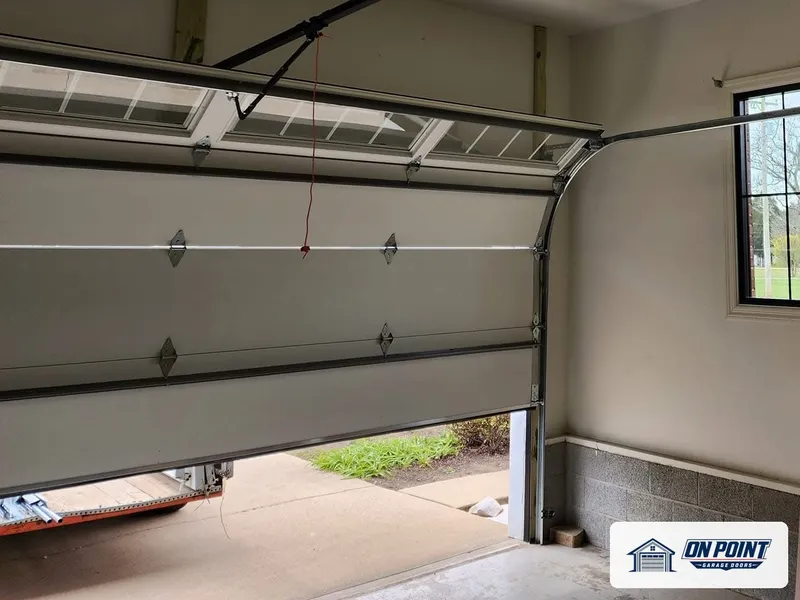
Door partly open, seen from inside, with a window row and the opener arm, from one of our jobs
Door partly open, seen from inside, with a window row and the opener arm
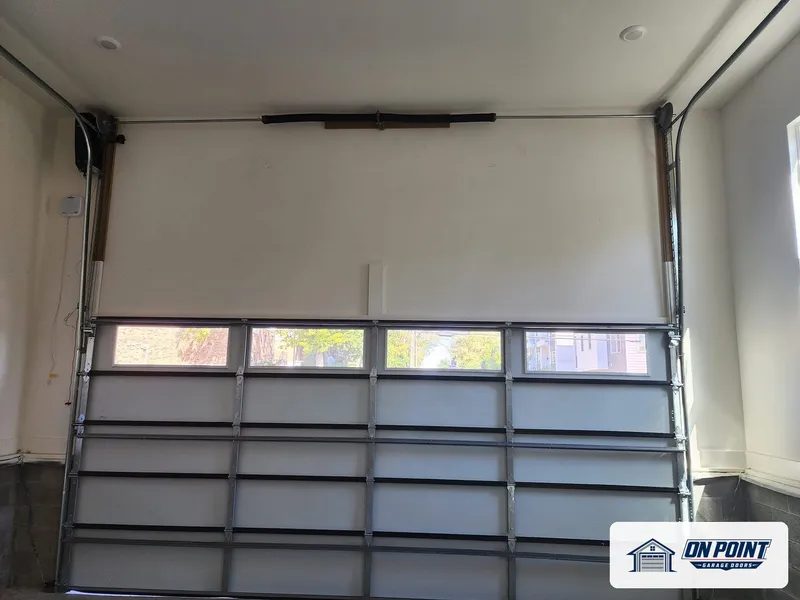
Inside of a wide door with a glass row, struts and springs above, from one of our jobs
Inside of a wide door with a glass row, struts and springs above
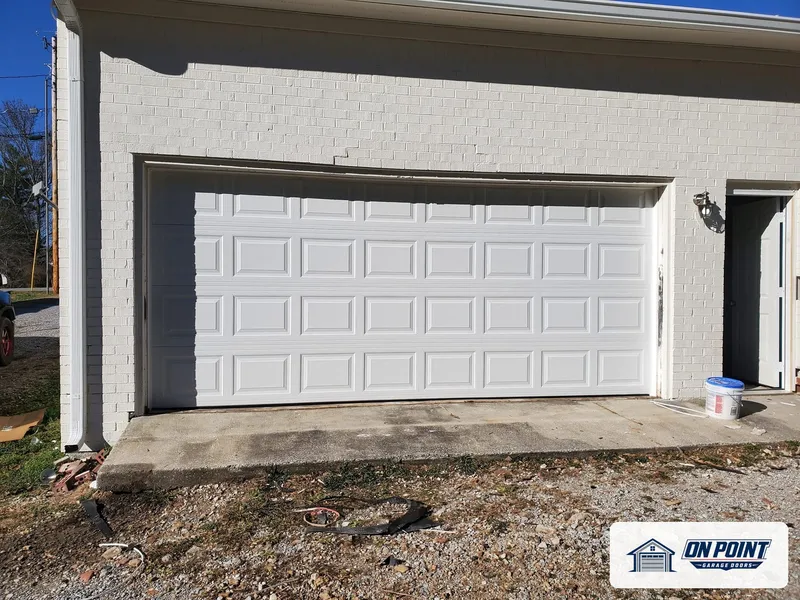
Wide white raised panel door in a painted brick wall, from one of our jobs
Wide white raised panel door in a painted brick wall

What holds the sections together

Each joint between sections is bridged by a row of hinges, one at each end and one or more across the middle on wider doors. The hinges are screwed into the vertical stiles on the back of each section, and the end hinges also carry the rollers. As long as the screws grip, the hinges are whole and the stiles are sound, the sections move as one door. A gap means one of those three has failed.

Where the gap shows

Note where and when the gap appears. It tells the technician which part to look at first.

Hinge screws pulling out of the stiles

The most common way sections come apart is screws tearing out of thin steel. Each trip flexes the joint a little, and a screw that was loose to begin with wallows out its hole until it no longer holds. On older doors the stile may be thin and rusted around the holes. Fresh rust streaks or a hinge leaf that wiggles by hand from inside are early signs. The fix is to reinforce the stile so the new fasteners have solid metal to bite.

Cracked and broken hinges

Hinges are stamped steel and they fatigue. A crack usually starts at the knuckle or near a screw hole, and once it runs across the leaf, the joint is held by whatever is left. Top hinges take the opener's pull and tend to go first, but a door that was struck or is out of balance can crack hinges anywhere. Hinges are replaced to match their numbered position, so the rollers still sit at the right distance from the track.

End stiles that have split or rusted

The end stiles carry the end hinges and the rollers, so they take more load than the middle of the section. On a door that sits in water at the bottom, or one near salt air, the lower stiles can rust thin. Wood doors can split along the grain at the stile ends. Once a stile is gone, a new hinge has nothing to grip, and the section usually needs repair plates or replacement.

A section that has twisted

A car bumper, a gust of wind or a door forced while one side was jammed can twist a single section. A twisted section pulls its hinges unevenly, opening a gap at one end and pinching at the other. It may still roll, but it rides crooked in the tracks and loads the hinges above and below it. A twist that does not come out with the hinges replaced points to a new section.

An unbalanced door pulls itself apart

When the springs no longer carry the door's weight, the opener drags the door up by the top section and pushes it down the same way. The pull runs through every joint, and the weakest one starts to open. A door that separates soon after a spring was changed, or one that feels heavy when moved by hand, needs its balance checked along with the hinges, or the new hinges will tear out too.

The bottom joint and the cable bracket

The lowest corners of the door hold the brackets where the lift cables attach, and those brackets are under spring tension all the time. If the bottom section is separating from the one above it near a corner, or the bottom bracket has pulled away from a rusted section, do not touch it and do not run the door. That corner can let go suddenly, and it is work for a technician with the tension off.

Gaps that are normal

Not every line between sections is a problem. Many doors have a tongue and groove or a shaped joint that shows as a thin dark line when closed. Pinch-resistant designs push the sections apart slightly as they turn, so fingers are not caught. Insulated doors may have a seal strip in the joint. What is not normal is a gap that grows, daylight that comes and goes as the door moves, or a section that sits out of line with the rest.

Repair, new section or new door

Loose or cracked hinges and torn screw holes are usually repaired at the joint with new hinges and stile reinforcement. A section that is twisted, rusted through at the stiles or split can often be swapped for a matching one if the design is still made. When several joints are failing at once on an old, thin door, a new door is often the better choice, and we lay out both paths side by side.

What the visit covers

We check every hinge, stile and roller, the struts, the bottom brackets and cables, and the door's balance with the opener disconnected. If the door is unsafe to run, we secure it first. You get a written estimate that says what failed and what it takes to hold the sections together again, before the work starts.

Questions we get asked

Why is there a gap between my garage door sections?

Usually loose or torn hinge screws, a cracked hinge or a stile that has split or rusted. An unbalanced door speeds all of these up.

Is it safe to use a door with separating sections?

It is best not to. A joint that is letting go can bind in the tracks or fail at a corner. Stop using it and call.

Can separated sections be repaired?

Often, yes. New hinges and reinforced stiles fix most joints. A twisted or rusted-through section may need replacing.

Is a thin line between sections normal?

Yes, on many doors. The joint shape or a seal shows as a line. A gap that grows or lets daylight in when the door moves is not normal.

Is the estimate free?

Yes. We check the joints, hinges and balance and give you a written estimate before work begins.

Booking takes a minute

Across Brooklyn, Queens and Long Island, tell us what the door is doing and we set a visit that fits your day.

Free estimate, call (929) 429-2429.

Gap opening between the sections? Stop using the door and call

Tell us what the door is doing and we will give you an honest arrival time. The estimate is free.

Easier to explain by phone? Call (929) 429-2429.

Two minutes to a free estimate

Tell us what the door is doing. The estimate is free either way.

Or just call (929) 429-2429 and talk it through.

The other six things that go wrong