Serving Brooklyn, Queens and Long Island(929) 429-2429Open six days a weekFree estimateGuaranteed work
On Point Garage Doors
Open 24 hours Sun-Thu, Fri until 5 pm Free estimate Springs, openers, cables We come to you
Emergency?Call nowBook free estimate
New York, NY - open six days a week

Garage door sagging in the middle

Free estimateSame-day serviceCommon parts on board
  • Free estimate
  • Same-day service
  • Common parts on board
Emergency garage door repair★★★★★ 5.0 on Google · 42 reviews

Book your free estimate

Takes 30 seconds. We call you back to set a time.

Or just call (929) 429-2429 and talk it through.

Home › Door Sagging in the Middle

A wide garage door has support only at its two edges, where the rollers ride in the tracks. Everything in between has to hold its own shape. When it cannot, the middle sags, and it can show in several different ways: a door that droops toward the car when it lies open under the ceiling, a door that bows when it is closed, or an opening whose beam above has dropped so the door no longer fits. Each has a different cause and a different fix, and this page helps you tell them apart. Free estimate at (929) 429-2429.

By Sean Cohen, owner, On Point Garage Doors · Updated

Real jobs. Real photos.

These photos are from our own jobs, with our logo on them.

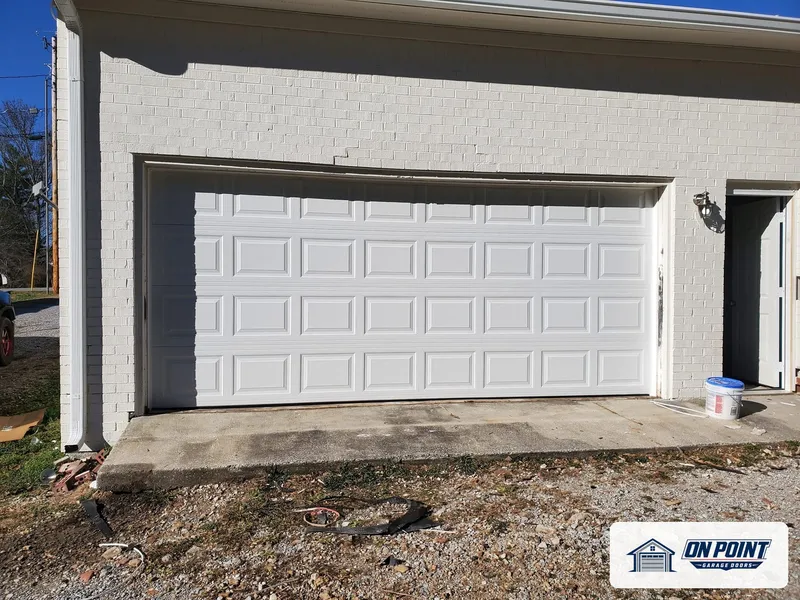
Wide white raised panel door in a painted brick wall, from one of our jobs
Wide white raised panel door in a painted brick wall
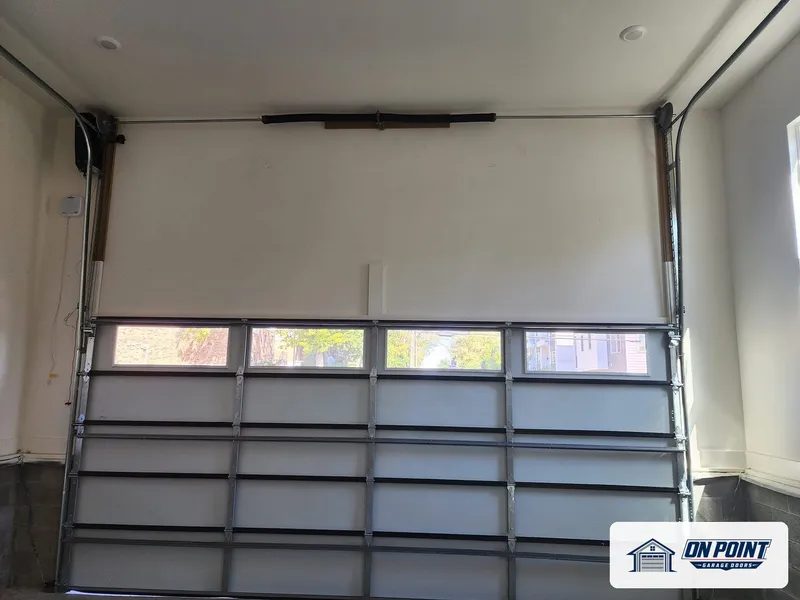
Inside of a wide door with a glass row, struts and springs above, from one of our jobs
Inside of a wide door with a glass row, struts and springs above
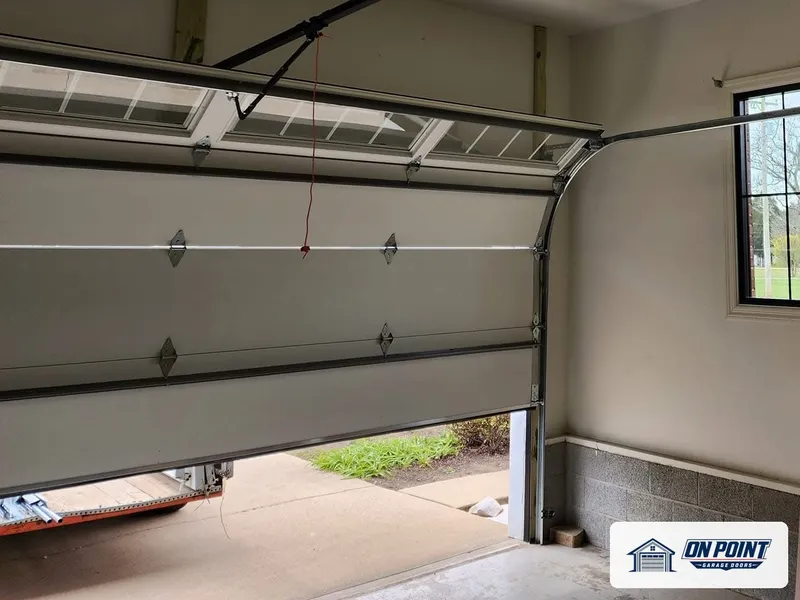
Door partly open, seen from inside, with a window row and the opener arm, from one of our jobs
Door partly open, seen from inside, with a window row and the opener arm

First, where does it sag

Look at the door in both positions before calling. Where and when it sags points to the part that has given up.

A door that droops when it lies open

When the door rolls up, each section lies flat under the ceiling, held only at its ends. A thin single-skin steel door on a two-car opening has very little to keep it straight in that position, and gravity bends it a little every time it opens. Over time the bend stays. A strong droop can bring the door close to a tall vehicle, and a door that sags open is also stressing its hinges and rollers each time it turns the curve.

A door that bows while closed

A closed door that curves in or out along its width, or that leaves a gap at the bottom center while touching the floor at the ends, has usually bent at one or more sections. Wind pressure, a push from a car bumper, or years of drooping when open can all leave it that way. The bottom seal cannot close a gap like that for long, so light, water and cold come in at the center.

When the header is the one sagging

Sometimes the door is fine and the opening is not. The beam over a wide garage opening carries the wall and sometimes a floor above it. If it was undersized, has rotted from a leak or has crushed at its ends, it can sag in the middle. The door then rubs the stop at the top center, binds at the end of its travel, or leaves a gap above. Fixing that beam is framing work, and we will tell you when a builder needs to go first.

Why wide doors give first

A single-car door spans a short distance, so even a thin one stays fairly straight. A two-car door spans roughly twice as far with the same thin skin, and stiffness falls quickly as the span grows. That is why wide doors carry steel struts across some sections, and why the same door model that holds up well on a single opening can sag on a double one. Our page on struts covers that part in detail.

Hinges and center stiles

The center hinges and the vertical stiles behind them help the sections stay flat. A cracked center hinge or a stile torn at its screws lets the middle of the door fold slightly at the joints, and the sag grows each time the door moves. Fresh rust trails or small cracks around the hinge screws at the center of the door are worth pointing out when you call.

Weight that was added later

Glass inserts, decorative overlays, a pet door, extra hardware or a heavy coat of paint all add weight to the middle of the door. So does a wood door that has soaked up water. More weight means more droop when open and a heavier load on the springs. A door that started to sag after a change like that may need struts, a spring adjustment or both.

Wood doors that have taken on water

Wood and wood-composite doors swell, soften and get heavier as moisture gets in, often from a finish that has worn through at the bottom or the joints. A soft section can sag and lose its grip on hinge screws at the same time. The wood is checked for rot before anything is added to it, because a strut fastened to soft wood will not hold.

What sagging does to the rest of the door

A door that will not stay straight works against itself. The rollers twist in the tracks, the hinges flex at every turn, and the opener feels resistance it was never meant to handle. The middle of the bottom seal wears fastest, and a bowed top section can catch the header on the way down. Left alone, a sagging door tends to spread its damage to parts that were fine to begin with.

Fixes from small to large

A door that only droops a little can often be stiffened with struts and brought back into balance with a spring adjustment. Cracked center hinges are replaced and torn screw holes are reinforced. A section that is bent for good may be replaced if a match is still made. A thin door that keeps bowing after all of that, or a wood door that has gone soft, is usually better replaced with a stiffer insulated door.

Not the same as a cracked top section

A sag runs across the whole width of the door. A sharp crease or crack across the top section, right where the opener arm attaches, is a different problem with different causes. If that is what you see, our page on a cracked top section explains it.

What the visit covers

We look at the door open and closed, sight along the sections, check the struts, hinges, stiles, rollers and tracks, test the springs and balance with the opener disconnected and look at the beam above the opening. The written estimate lays out the fix that suits the door you have, before any work begins.

Questions we get asked

Why does my garage door sag in the middle when it is open?

Wide, thin doors have support only at the edges, so they droop between the tracks overhead. Missing or bent struts and cracked center hinges make it worse.

Can a sagging garage door be fixed?

Often, yes. Struts, new center hinges and a spring adjustment can straighten many doors. Sections that are bent for good may need replacing.

Why is there a gap at the bottom center of my door?

The door may be bowed, or the floor may have settled in the middle. Both are checked, because the fix is different for each.

Could the problem be the beam above the door?

Yes. If the header has sagged, the door can rub or gap at the top. That beam is framing work and is checked first.

Is the estimate free?

Yes. We find out where and why the door sags and give you a written estimate before work begins.

Booking takes a minute

Across Brooklyn, Queens and Long Island, tell us what the door is doing and we set a visit that fits your day.

Free estimate, call (929) 429-2429.

Wide door bowing or dipping? Tell us when it sags

Tell us what the door is doing and we will give you an honest arrival time. The estimate is free.

Easier to explain by phone? Call (929) 429-2429.

Two minutes to a free estimate

Tell us what the door is doing. The estimate is free either way.

Or just call (929) 429-2429 and talk it through.

The other six things that go wrong