Takes 30 seconds. We call you back to set a time.
Most garage doors are made of sections joined by hinges. As the door moves, each section folds against the next one where the track bends, and the gap between them opens and closes. On an older door, that joint can catch a finger that happens to be resting there. Pinch-resistant panels are designed so the joint pushes fingers out of the way instead of closing on them. For families with young children, it is one of the most practical features a new door can have. Free estimate at (929) 429-2429.
By Sean Cohen, owner, On Point Garage Doors · Updated
These photos are from our own jobs, with our logo on them.


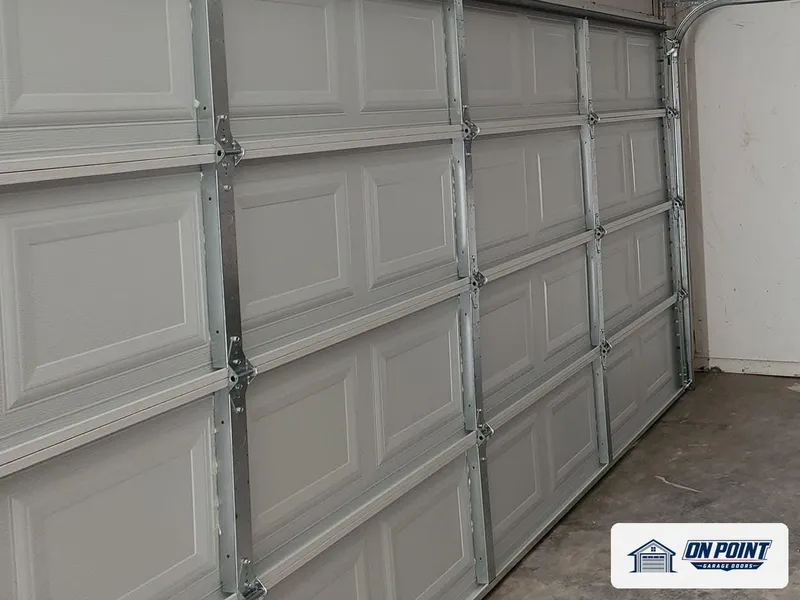
The risk is at the joints between sections. When the door is closed, those joints are tight. As the door opens and each section rolls over the curve of the track, the joint opens up on the inside. When the door closes again, the joint snaps shut. A child pushing the door, or an adult grabbing a section to pull it down, can have fingers in that gap at the wrong moment.
On a pinch-resistant door, the edges of the sections are shaped so they meet without leaving a gap a finger can slide into, or so that the closing joint pushes anything in it outward. The joint still bends as the door moves, but there is no open slot waiting to close.
Many makers offer this as a standard part of their better steel door lines. The shape is built into the panel itself, so there is nothing to maintain. Doors with these joints need matching hinges, as our Wayne Dalton repair page explains.
Older doors often have handles bolted right next to a joint, which invites a hand into exactly the wrong place. Newer doors put lift handles and grip points away from the joints, or use recessed grips on the bottom section. If you open your door by hand, using only those points is the safest habit.
The section joints are not the only place a hand can get hurt. Tracks, rollers, the bottom brackets, and the springs and cables above the door all move under heavy force. Pinch-resistant panels do nothing about those parts.
That is why we tell every family the same thing: the door is not a toy, nobody should ride it or hang from it, and hands should stay off the tracks and hardware.
Not really. The shape of the joint is part of the panel, so an old door cannot be changed after the fact. What can be done is to check that the safety sensors and the opener's reverse work well, move handles away from the joints, and make sure the door is balanced so it does not drop when someone lets go of it.
If your door is old, worn and has open joints, a new door with pinch-resistant sections is often the cleanest answer, and we can show you the options.
When we help you pick a new door, we point out which models have pinch-resistant sections, along with insulation, window options and colors. Steel insulated doors with this feature are common and come in plain, raised panel and carriage styles, so safety does not mean giving up the look you want for the front of the house.
Even the best door works better with a few house rules. Children should never play under a moving door, never race it, and never touch the remote or the wall button. Keep remotes out of reach and in the car. Show older kids how the safety sensors work so they understand why they should never be blocked or moved.
If you want a safety check on your current door, the technician looks at the joints, handles, tracks, springs and cables, tests the sensors and the opener's reverse, and checks the balance of the door. If you are shopping for a new door, he measures the opening and shows you pinch-resistant models that fit. Either way, you get a free estimate before any work starts.
Door sections shaped so the joints between them push fingers out instead of closing on them as the door moves.
No. Many better steel doors do, but not every model. We point out which ones have it when you choose a door.
The joint shape cannot be changed on an existing door. Sensors, opener reverse and handle placement can still be improved.
No. The feature is part of the panel shape and does not weaken the door.
Yes. You see the options before any work starts.
Across Brooklyn, Queens and Long Island, tell us what the door is doing and we set a visit that fits your day.
Free estimate, call (929) 429-2429.
Tell us what the door is doing and we will give you an honest arrival time. The estimate is free.
Easier to explain by phone? Call (929) 429-2429.
Tell us what the door is doing. The estimate is free either way.