Takes 30 seconds. We call you back to set a time.
Rollers are the small wheels that carry your garage door up and down the tracks. Most doors have one at every hinge on each side. They take a beating every time the door moves, and when they wear out, the door gets loud, shaky and harder on the opener. New rollers are one of the simplest upgrades that make a door feel new again. Free estimate at (929) 429-2429.
By Sean Cohen, owner, On Point Garage Doors · Updated
These photos are from our own jobs, with our logo on them.


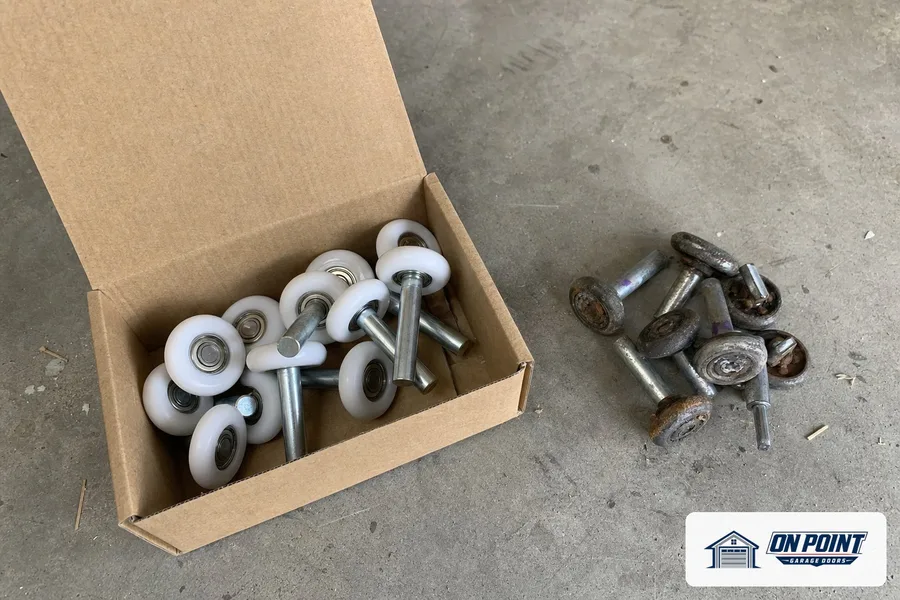
Plain steel rollers are strong but loud, and their open bearings rust. Basic plastic rollers are quiet at first but wear quickly. Sealed nylon rollers with ball bearings are the upgrade we fit most: quiet, smooth and long lasting.
For heavy doors and commercial doors, sealed steel rollers with heavy bearings are the better choice.
A door on worn rollers drags and bounces. That strains the hinges, the opener and the springs, and it is one of the most common reasons doors come off track. Replacing rollers early protects every other part of the door.
The bottom roller on each side sits in the bottom bracket, which is attached to the lift cable and holds the full force of the springs. That bracket and roller must only be handled by a trained technician. We replace them with the cable tension safely released.
If there is a bedroom over the garage, new sealed rollers combined with a quiet belt-drive or wall-mounted opener make a huge difference. Many owners tell us they did not know their door could be that quiet.
The technician checks every roller, hinge and track, replaces the rollers with the type that fits your door, checks the hinges and replaces any that are cracked, adjusts the tracks, balances the door and tests the opener and the safety reverse.
Each roller sits in a hinge or a bracket. When the hinge holes wear oval, the roller sits crooked and wears unevenly. Worn hinges are replaced at the same time so the new rollers run straight.
Cold makes worn rollers and dry bearings stiffer, and many doors that ran fine in the fall start to grind and shake on the first freezing morning. A roller replacement before winter keeps the door smooth through the cold.
Sectional doors on shops, warehouses and auto businesses run many more cycles than home doors. Heavier rollers rated for that use last much longer there. We replace rollers on commercial doors of all sizes.
On doors that have run for many years, it is common to find a mix of roller types from past repairs: a few steel, a few plastic, one or two new nylon ones. A mixed set runs unevenly and wears the tracks. Replacing the whole set at once makes the door run evenly again.
Older doors may also have rollers with short stems that sit too shallow in the hinge. The right stem length keeps the roller centered in the track.
New rollers will not fix a bent or loose track. If a track is dented, rusted at the bottom or out of line, the rollers keep catching on it. The tracks are checked with the rollers, straightened or replaced where needed, and the brackets secured to the wall.
In garages near the bay, the canals or with damp floors, open steel bearings rust and seize. A seized roller slides instead of turning and grinds a groove into the track. Sealed rollers resist moisture far better and are the right choice for these garages.
Roller replacement is usually done during a single visit and changes how the door sounds and feels from the first run. It is often done together with a tune-up, so the springs, cables and opener are checked at the same time.
It depends on the rollers and on how often the door moves. Basic plastic and open steel rollers on a busy family door wear out much sooner than sealed nylon rollers on a door used a few times a week. When we replace rollers, we fit the kind that suits how your door is used, so you are not doing this again soon.
Grinding, shaking, wobbly or cracked rollers, or a door that jumps the track, are the usual signs.
Sealed nylon rollers with ball bearings are quieter and smoother for most home doors. Heavy and commercial doors do well with sealed steel rollers.
Yes. A badly worn roller can jump out of the track, especially at the curve.
No. The bottom brackets hold the force of the springs and must be handled by a trained technician.
Yes. You see what is worn and the options before any work starts.
Across Brooklyn, Queens and Long Island, tell us what the door is doing and we set a visit that fits your day.
Free estimate, call (929) 429-2429.
Tell us what the door is doing and we will give you an honest arrival time. The estimate is free.
Easier to explain by phone? Call (929) 429-2429.
Tell us what the door is doing. The estimate is free either way.