Takes 30 seconds. We call you back to set a time.
A ceiling-mounted opener hangs from the garage ceiling on strips of steel, usually perforated angle bent and fastened to the framing above. That hanger is a plain part nobody thinks about until the motor starts to wobble, tilt or bounce every time the door moves. A loose hanger is easy to ignore because the door may still open and close. This page explains what the hanger does, why it works loose, what a sagging motor does to the rest of the system and how it is mounted again so it stays put. Free estimate at (929) 429-2429.
By Sean Cohen, owner, On Point Garage Doors · Updated
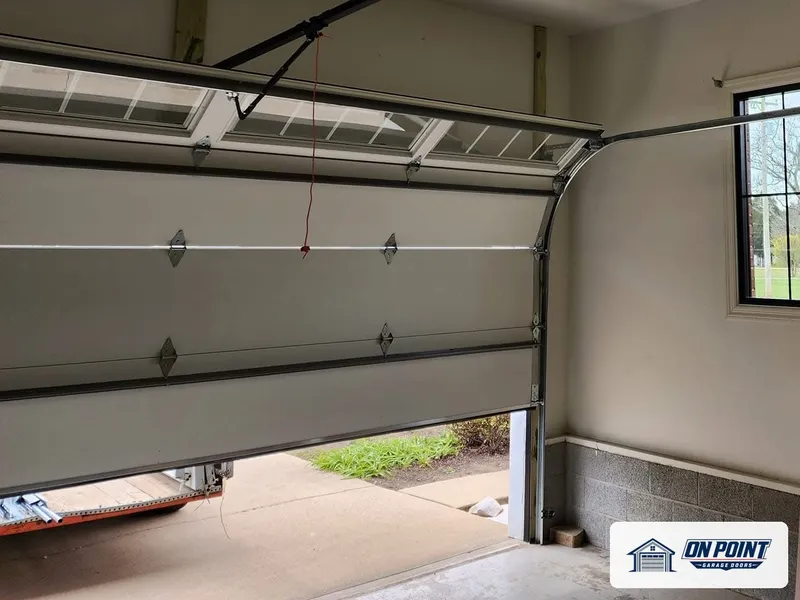
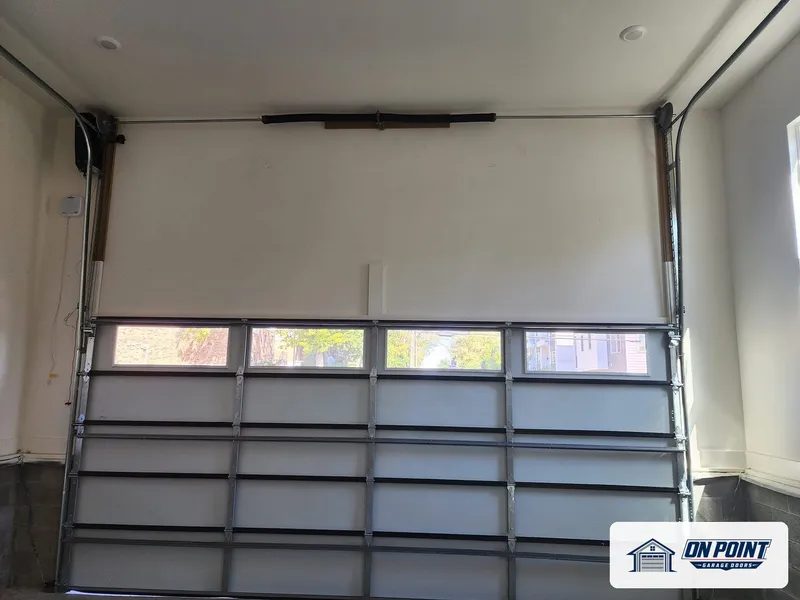
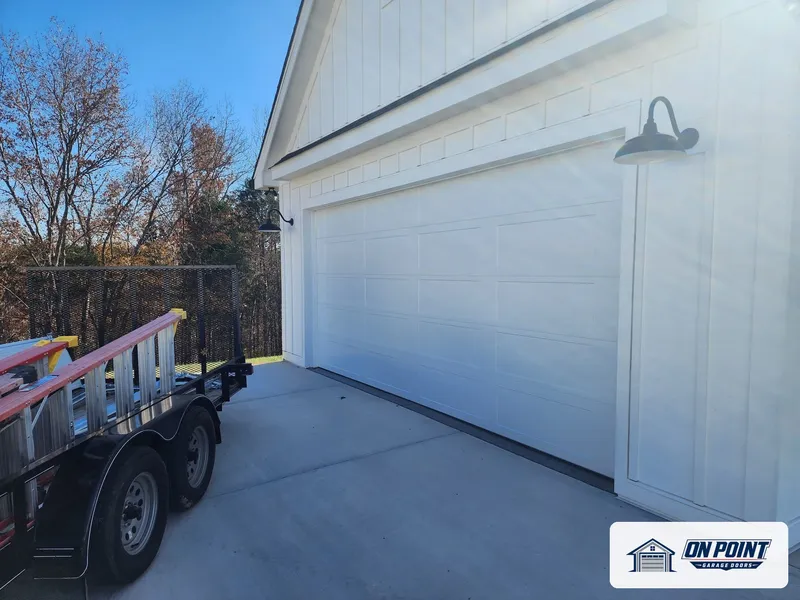
These photos are from our own jobs, with our logo on them.


The opener has two anchor points. At the door end, the rail is bolted to a bracket on the wall above the opening. At the back, the motor unit hangs from the ceiling on one or two steel straps, often with a cross piece under the motor. The hanger keeps the motor level and in line with the door, so the rail stays straight and the trolley pulls along the center of the door instead of at an angle.
A hanger rarely fails all at once. It warns first, and these are the usual warnings.
Every trip puts a push and a pull on the motor. When the door starts up, the motor wants to slide toward the door; when it starts down, it wants to slide back. Over years, that back and forth works on every fastener. Hangers driven only into drywall, into the thin edge of a joist or into a soft old plank have little grip and give up first. Light angle that was bent to length on site can also flex until it fatigues at the bend.
Not every garage ceiling has wood where the motor needs to hang. Finished ceilings hide the joists, so the hanger may have been placed for convenience instead of strength. Garages tucked under a house can have a concrete ceiling that needs masonry anchors. Truss ceilings have members that are not meant to carry extra load in every spot. In each case the cure is to reach solid structure, sometimes by adding a cross piece of wood that spans two joists.
When the motor can move, the rail stops being a straight line from the motor to the door. The trolley binds, the drive works harder and the opener reads that extra effort as a problem, so the door may stop or reverse for no clear reason. A belt or chain can slap and wear faster. In the worst case, a hanger that tears out lets the back of the opener drop toward the car or whoever is standing below it.
The opener is meant to guide a balanced door, not lift dead weight. If a spring is weak or broken, the opener strains against the door and that strain goes straight into the hanger and the header bracket. A hanger that suddenly works loose is sometimes the first sign that the door has become heavy. That is why the springs and the balance of the door are checked whenever an opener mount is looked at.
The front of the rail hangs on a bracket fastened above the door. If that bracket pulls out of soft wood or crumbling masonry, the rail can drop at the front while the motor stays up at the back, and the two problems look alike from below. Both ends are checked together, because fixing only the back leaves the door end free to move, and the rail goes out of line again.
The technician supports the motor, removes the bent or loose angle and finds solid framing or concrete for new fasteners. Heavier angle replaces light strap where needed, and a diagonal brace may be added so the hanger cannot swing like a pendulum. The motor is set level and square to the door, the rail is checked for a straight line, and the door is run through full travel with the force, limits and safety reverse tested at the end.
When a new opener replaces an old one, the old hanger is sometimes reused as is. The new unit may be heavier, longer or shaped differently, and holes in old angle may no longer line up with sound wood. A new opener deserves a hanger made for it. If yours started to shake soon after an opener change, the mount is a likely cause.
A jackshaft or wall-mounted opener sits beside the door on the wall and drives the spring bar directly. It has no rail and no ceiling hanger, which suits garages with low ceilings, high-lift track or storage overhead. Its own mounting still has to be solid, since it carries the turning force of the bar, but the ceiling problems on this page do not apply to it.
We look at the hanger, the ceiling it is fastened to, the header bracket, the rail, the trolley and the drive, then check the door's springs and balance with the opener disconnected. If the motor is at risk of dropping, we say so and secure it first. You get a written estimate for the remount and any worn parts before the work starts.
The hanger that holds it to the ceiling has usually worked loose or bent, so the motor moves with every start and stop. A heavy door can make it worse.
It can be. A hanger that tears out can drop the back of the opener, and a moving motor throws the rail out of line. Stop using the opener and call.
No. Drywall cannot hold a moving motor. The hanger has to reach the joists, a wood cross piece or concrete with the right anchors.
The old hanger may have been reused without being matched to the new unit, or the fasteners never reached solid framing.
Yes. We check the hanger, the rail and the door and give you a written estimate before work begins.
Across Brooklyn, Queens and Long Island, tell us what the door is doing and we set a visit that fits your day.
Free estimate, call (929) 429-2429.
Tell us what the door is doing and we will give you an honest arrival time. The estimate is free.
Easier to explain by phone? Call (929) 429-2429.
Tell us what the door is doing. The estimate is free either way.