Takes 30 seconds. We call you back to set a time.
The light on a garage door opener is easy to take for granted until it goes dark and you are walking into a black garage with your hands full. When the opener light stops working, flickers, or will not turn off, the cause is usually small: the bulb, the socket, a setting on the wall control or a part of the opener's light circuit. Free estimate at (929) 429-2429.
By Sean Cohen, owner, On Point Garage Doors · Updated
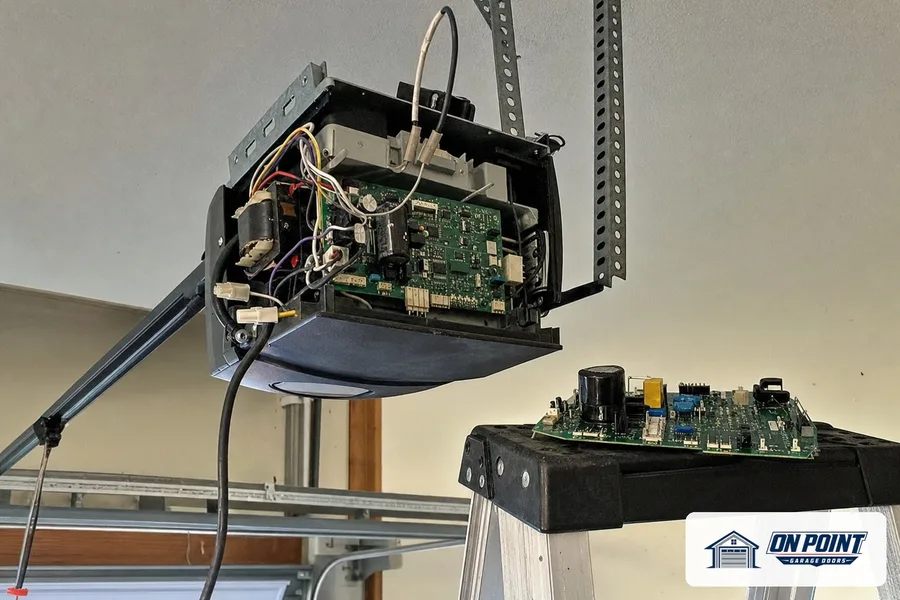
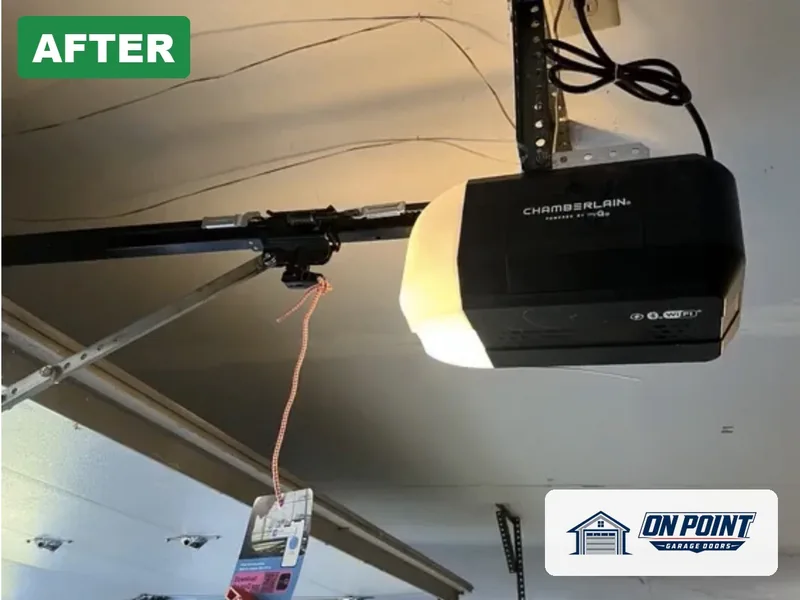
These photos are from our own jobs, with our logo on them.


If the door moves normally but the light stays dark, the motor and drive are fine. The cause is in the light circuit: the bulb, the socket, the light board or a setting.
Many people switch to LED bulbs in the opener, and some low-grade LEDs cause trouble: they flicker, burn out from vibration, or give off radio noise that stops the remotes from working at a distance. Bulbs made for garage door openers avoid those problems.
Most openers turn their light off on their own a while after the door moves. A light that never goes off can mean a wall control stuck in light mode, a motion sensor that keeps triggering, or a stuck relay on the board. Each is checked and fixed.
A flicker can come from a loose bulb, a worn socket, a failing board or an LED bulb that does not suit the opener. Flickering that comes with odd opener behavior, such as clicking or random movement, points more toward the board.
Many newer openers have bright LED lights built into the unit instead of a bulb. When those fail, the light module or board is replaced rather than a bulb. They are much brighter than old bulbs and usually last far longer.
A surge can damage the light board or the logic board. If the light went out right after a storm, and especially if the remotes or the door act up too, the board is the first thing checked.
A dark garage is where people trip over bikes and bins. The opener light also comes on when the door moves, which helps anyone in the garage see the door is moving. Getting it working again is a small but real safety fix.
On old openers where the light board or logic board is no longer made, a repair may not be possible. A new opener with a bright built-in light, quiet operation, phone control and battery backup is often the better choice. You get a free estimate on both.
The technician checks the bulb, socket, light board, wall control settings and motion sensor, fits the right bulb or replaces the failed part, and tests the light and the remotes together. While there, the door's springs, rollers and safety reverse are checked too.
In garages with two openers, one light may work while the other does not, or one wall control may switch both. Each opener's light is checked separately, and the wall controls are set so each button controls the door and light you expect.
Many openers can turn their light on when someone walks into the garage. If that stopped, the motion sensor may be switched off at the wall control, aimed wrong or failed. Turning it back on is often all it takes, and it makes walking into a dark garage much safer.
Old openers often have a single dim bulb behind a yellowed cover. Many newer openers have bright built-in lights that light the whole garage. If the opener is old and the light circuit is failing, a new opener can solve both problems at once, and you get a free estimate on it.
The opener light also flashes on many units when something is wrong with the sensors or the door. A light that never comes on hides those warnings. Getting it working again means you see when the opener is trying to tell you something.
Usually a bulb the opener does not like, a failed socket, a light board or relay, or a wall control setting.
Some can. Low-grade LEDs may flicker, burn out from vibration or interfere with the remotes.
A wall control in light mode, a motion sensor that keeps triggering or a stuck relay are common causes.
Usually yes. On very old units, a new opener may be the better choice.
Yes. You see the cause and the fix before any work starts.
Across Brooklyn, Queens and Long Island, tell us what the door is doing and we set a visit that fits your day.
Free estimate, call (929) 429-2429.
Tell us what the door is doing and we will give you an honest arrival time. The estimate is free.
Easier to explain by phone? Call (929) 429-2429.
Tell us what the door is doing. The estimate is free either way.