Serving Brooklyn, Queens and Long Island(929) 429-2429Open six days a weekFree estimateGuaranteed work
On Point Garage Doors
Open 24 hours Sun-Thu, Fri until 5 pm Free estimate Springs, openers, cables We come to you
Emergency?Call nowBook free estimate
New York, NY - open six days a week

Garage door cracked at the top section

Free estimateSame-day serviceCommon parts on board
  • Free estimate
  • Same-day service
  • Common parts on board
Emergency garage door repair★★★★★ 5.0 on Google · 42 reviews

Book your free estimate

Takes 30 seconds. We call you back to set a time.

Or just call (929) 429-2429 and talk it through.

Home › Cracked Top Section

The top section of a garage door is where the opener does its work. The opener arm bolts to a bracket near the top center, and every pull and push passes through that small area of steel. On a door that is thin, heavy or out of balance, that spot can give: first a faint crease across the panel, then a fold that makes the section look like a shallow V, and sometimes a crack or a torn bracket. This page explains why it happens, what it means and how it is put right. Free estimate at (929) 429-2429.

By Sean Cohen, owner, On Point Garage Doors · Updated

Real jobs. Real photos.

These photos are from our own jobs, with our logo on them.

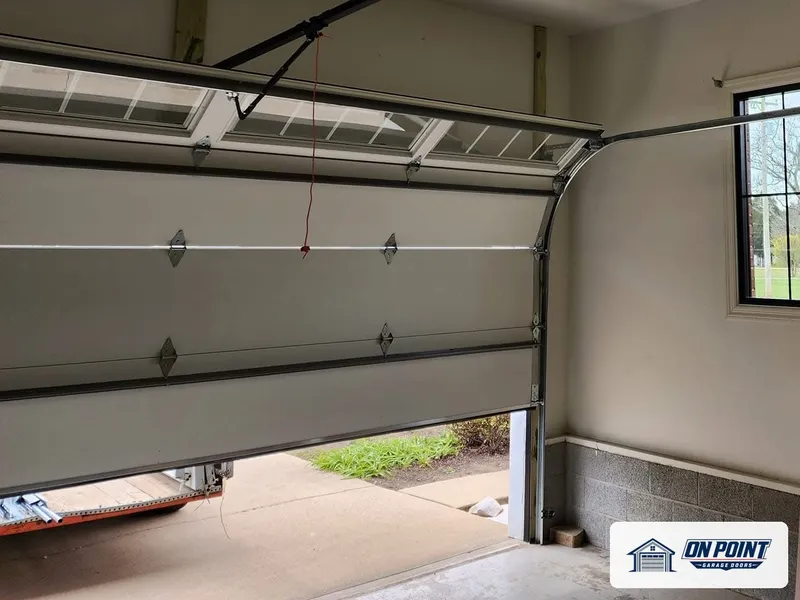
Door partly open, seen from inside, with a window row and the opener arm, from one of our jobs
Door partly open, seen from inside, with a window row and the opener arm
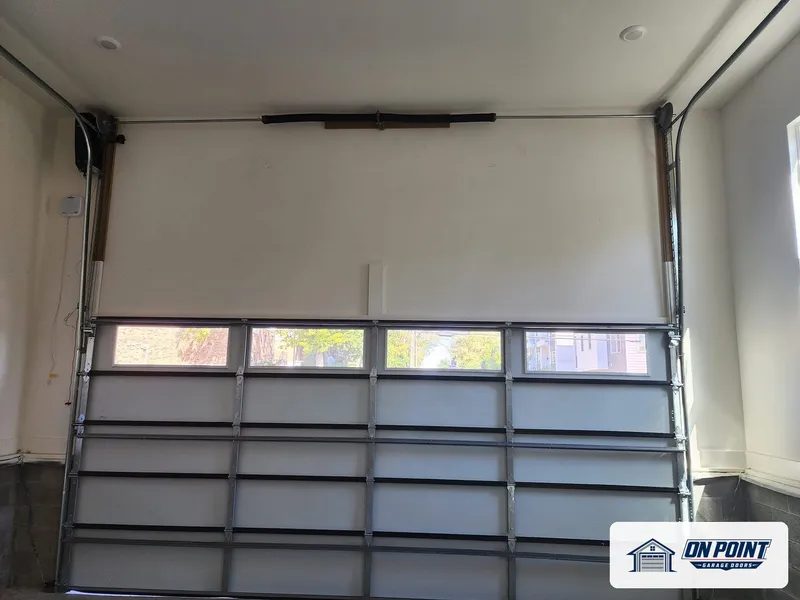
Inside of a wide door with a glass row, struts and springs above, from one of our jobs
Inside of a wide door with a glass row, struts and springs above
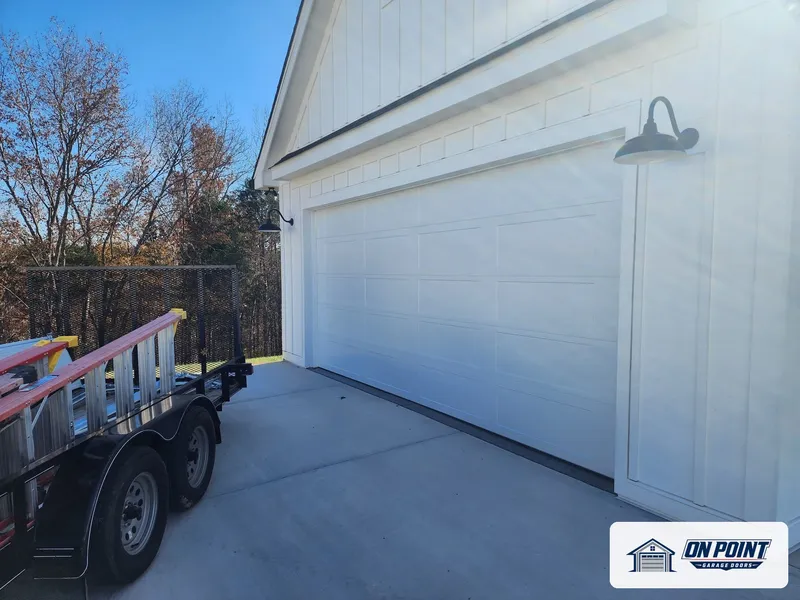
White door on the side of a white house, from one of our jobs
White door on the side of a white house

What the damage looks like

Top section damage starts small and grows with every trip. These are the usual stages.

The door was pulled while locked

One of the quickest ways to fold a top section is to run the opener while the door is locked with its manual slide lock or a padlock. The door cannot move, the opener keeps pulling, and all of that force lands on the bracket at the top. Many doors with openers have their manual locks removed or disabled for that reason. If the damage appeared right after the door was locked by hand, that is the likely cause.

Springs that no longer carry the door

The opener is meant to move a door the springs already balance. When a spring weakens or breaks, the door becomes heavy, and the opener ends up lifting dead weight through one bracket on a thin panel. A crease that grows slowly over months often points to springs that have been losing strength. Fixing the panel without fixing the balance only resets the clock.

Force settings set too high

Openers have a force setting that limits how hard they push and pull before they stop. Set too high, often to get a stiff or heavy door moving, the opener will keep driving into a door that is stuck, frozen at the bottom or binding in the track. The top section absorbs what the opener should have stopped for. Force is checked and set as part of any top section repair.

A thin top section with no strut

Many doors come with a reinforcing strut across the top section, or a reinforced plate behind the opener bracket. Older doors that were hung for hand use, and some light doors, have neither. When an opener is added later, that top section takes a pull it was never built for. A strut and a proper opener bracket spread the load across the width of the section.

A bracket in the wrong place

The opener bracket belongs on solid structure: a strut, a reinforced spot or the center stile. Fastened into thin skin alone, it can tear through or dent the panel around it. A bracket set too low, or an arm at the wrong angle, also pushes the top of the door out of shape as it closes. These details are easy to miss and are checked whenever this damage shows up.

Hits from inside and out

A roof box, a ladder on a truck rack or a car pulled in before the door finished opening can strike the top section from below. From outside, wind pushing on a wide door or a branch falling against it can fold the top section inward. Impact damage tends to show dents and scuffs as well as a crease, which helps tell it apart from damage caused by the opener.

Why not keep running it

A creased top section is weaker each time it moves. The fold can grow into a crack, the bracket can tear free, and the top hinges and rollers start to bind because the section no longer sits flat. A door with a torn bracket can also drop out of the opener's control. If you see a fresh crease or crack, stop using the opener and leave the door closed until it is checked.

How it is fixed

A light crease on an otherwise sound section can often be stabilized with a strut across the top and a reinforced bracket mount, after the springs are put back in balance. A section that is folded, cracked or torn around the bracket is usually replaced with a matching one, if the design is still made. On an old, thin door, replacing the whole door may make more sense, and both options are laid out side by side.

Not the same as a sagging door

A crease at the top center, near the opener arm, is local damage from force at one spot. A door that sags or bows across its whole width is a stiffness problem spread over the span. They can happen on the same door, but the fixes differ. Our page on a door sagging in the middle covers the wider problem.

What the visit covers

We look at the top section, the bracket, the strut, the top hinges and rollers, test the springs and balance with the opener disconnected and check the opener's force and travel settings. You get a written estimate for the section and anything that caused the damage, so it does not come back, before work begins.

Questions we get asked

Why is my garage door top section bent?

The opener pulls on that section. A locked door, weak springs, a force setting set too high or a missing strut can let that pull fold the panel.

Can a creased top section be repaired?

A light crease on a sound section can often be stabilized with a strut once the springs are balanced. A cracked or folded section is usually replaced.

Is it safe to keep using the opener?

It is best not to. A creased section weakens with every trip and the bracket can tear free. Leave the door closed and call.

Will a new top section match my door?

If the maker still builds that design and color, yes. On an older faded door, the new section can look brighter for a while.

Is the estimate free?

Yes. We find out what bent the section and give you a written estimate before work begins.

Booking takes a minute

Across Brooklyn, Queens and Long Island, tell us what the door is doing and we set a visit that fits your day.

Free estimate, call (929) 429-2429.

Top section creased or cracked? Leave the opener off and call

Tell us what the door is doing and we will give you an honest arrival time. The estimate is free.

Easier to explain by phone? Call (929) 429-2429.

Two minutes to a free estimate

Tell us what the door is doing. The estimate is free either way.

Or just call (929) 429-2429 and talk it through.

The other six things that go wrong