Takes 30 seconds. We call you back to set a time.
Fiberglass garage doors come in two generations that share little besides the name. There is the light, ribbed, glowing door on many postwar garages, and there is the molded door made to imitate stained wood. Both solve the rust problem and bring problems of their own, mostly from sunlight, cold and impact. If you have one, or have been offered one for a house near the water, this is what to expect from the material. Free estimate at (929) 429-2429.
By Sean Cohen, owner, On Point Garage Doors · Updated
These photos are from our own jobs, with our logo on them.


The classic version is a thin corrugated or ribbed fiberglass sheet held in an aluminum or wood frame. It let daylight into the garage without a single window, weighed next to nothing and was popular for decades. You can still spot one at dusk when the garage light is on and the whole door glows. Most that remain are well into old age, and the sheet is usually in worse shape than the frame.
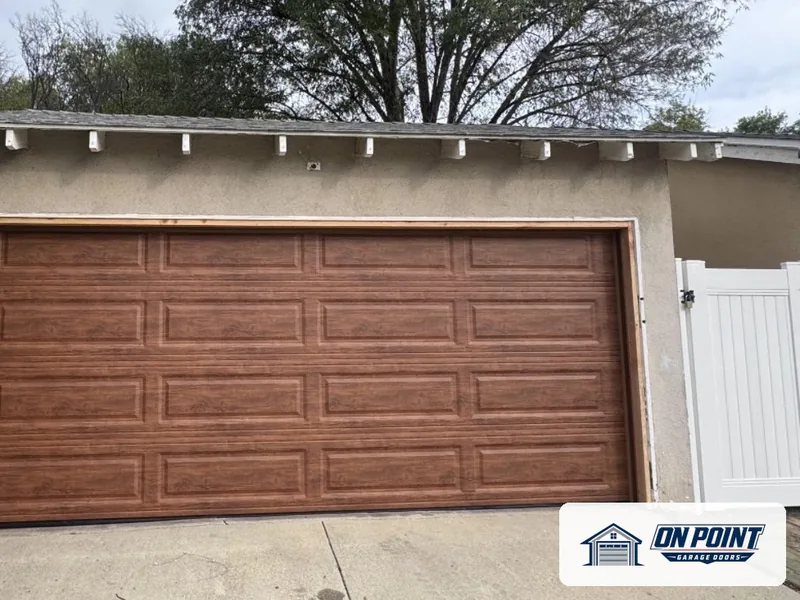
Newer fiberglass doors use a molded skin over a steel or composite frame, often with foam inside. The mold captures a deep, convincing grain that can be stained, which is something stamped steel cannot copy. Fewer makers offer them than offer steel or composite overlays, so colors, sizes and especially replacement sections take more hunting.
Ultraviolet light is the main enemy. It breaks down the resin at the surface, so color fades, the sheen turns chalky and translucent panels go amber. Leave it long enough and the glass fibers work up through the surface, which is the furry, itchy texture on very old doors. Doors facing south and west age noticeably ahead of identical doors in shade.
Aged fiberglass gets brittle, and cold makes it more so. A knock that would have bounced off in July can star or split the panel in January. Cracks often begin at screws and hinge holes, where the sheet is already stressed every time the door bends around the curve of the track. If cracking clusters around the hardware, the material is telling you it is tired.
Fiberglass does not rust and does not rot, which explains its appeal in beach and bay neighborhoods. The warning is in the small print of the door: frames, hinges, rollers, springs and cables are metal, and on a steel-framed model the rust simply starts where you cannot see it. Check the back of the door and the bottom rail before judging it by its clean face.
The material does not dent. It flexes and springs back until it reaches its limit, and then it breaks. Small cracks and holes in a molded skin can be patched with resin and refinished, with a visible difference up close. A split ribbed sheet is seldom worth patching. It either gets a new sheet, where a matching profile can still be found, or the door moves toward replacement.
Old fiberglass doors are among the lightest doors around, so they run on small springs and flex in the middle. An opener pulling on an unbraced top rail can bow or crack it, and a strut or a reinforcing bracket is a common remedy. Molded doors weigh much closer to steel. In either direction, replacing the door means replacing the springs, because the weight will not be the same.
A single translucent sheet gives almost no insulation and drums in the wind. It does give soft light all day, which owners of workshops miss badly after switching to solid steel. If that light is the reason you kept the old door, plan for a window row or a full-view door with frosted panels. A molded door with a foam core performs more like other insulated doors.
A glowing door shows silhouettes at night and can be pushed in or cut more easily than steel. That matters most on a garage with a door into the house. Good latches help, along with a solid connecting door and sensible care about what is stored against the panels, but a brittle sheet will never be the strong point of the building.
Often, when the surface is still sound. Stained molded skins can take a fresh coat with products made for fiberglass, and chalky panels can sometimes be painted, at the loss of their glow. Coatings do not restore strength. A sheet that crackles when flexed will keep cracking beneath new paint, so look at the structure before spending effort on the finish.
We check the frame, skin, balance and opener on the visit and put the realistic choices in writing.
Yes, though by fewer companies and mostly in molded wood-look styles. The thin translucent type is much less common, which makes matching an old one difficult.
Sunlight breaks down the resin near the surface. The yellowing cannot be reversed in the sheet, though a sound door can sometimes be coated.
Sometimes, if the profile or the model is still available. On older doors the match is often gone, and then the choice is a patch or a new door.
The skin handles salt very well. The metal frame and hardware still corrode, so those parts decide how long the whole door lasts.
Yes, the estimate is free, whether the answer turns out to be new hardware, a repair to the panel or a different door.

Across Brooklyn, Queens and Long Island, tell us what the door is doing and we set a visit that fits your day.
Free estimate, call (929) 429-2429.
Tell us what the door is doing and we will give you an honest arrival time. The estimate is free.
Easier to explain by phone? Call (929) 429-2429.
Tell us what the door is doing. The estimate is free either way.