Takes 30 seconds. We call you back to set a time.
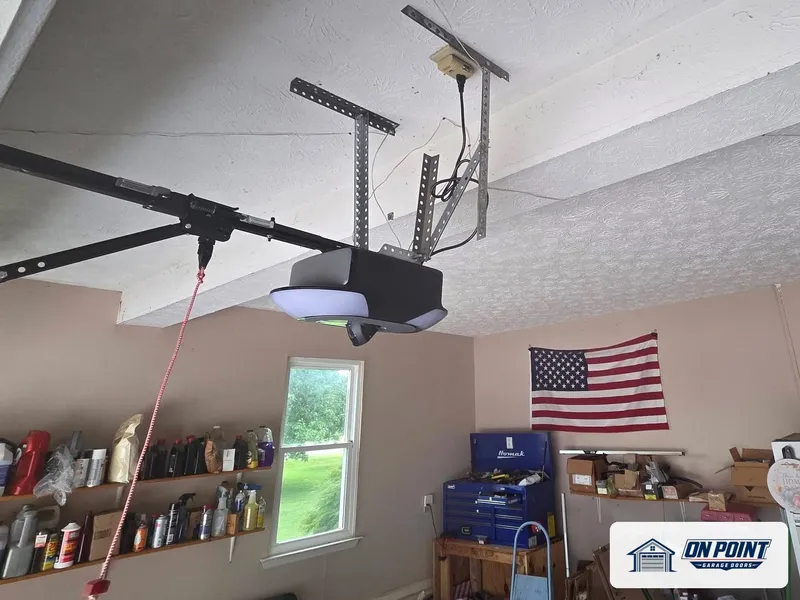
Craftsman openers were sold for decades, and plenty of them are still working in garages across Long Island, Queens and Brooklyn. Many of the Craftsman openers we see were built by the same company that makes LiftMaster and Chamberlain, so their parts and their problems are familiar to us. When a Craftsman acts up, the fix is often a single part rather than a whole new opener. Free estimate at (929) 429-2429.
By Sean Cohen, owner, On Point Garage Doors · Updated
These photos are from our own jobs, with our logo on them.


On many older Craftsman openers, the motor drives a plastic gear inside the unit. After years of use, and especially after lifting a door with weak springs, its teeth wear away. You hear the motor run or hum, and the trolley never moves. A new gear set brings the opener back, and the door's springs are checked so it does not happen again.
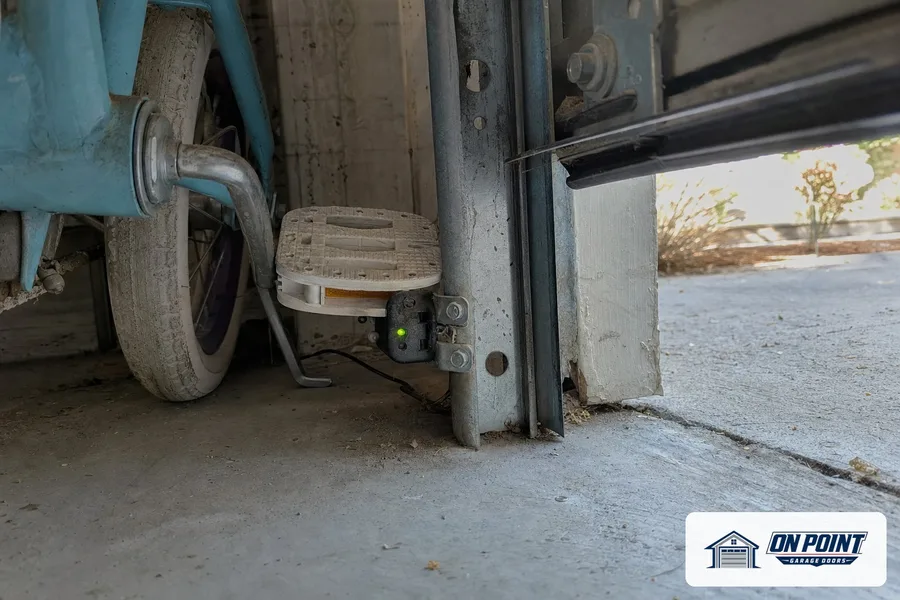
If the door goes up but will not come down, and the opener light flashes, the safety sensors are usually the reason. They may be knocked out of line, blinded by sun, dirty, or have a cut wire. We mount them solidly, protect the wiring and replace failed sensors.
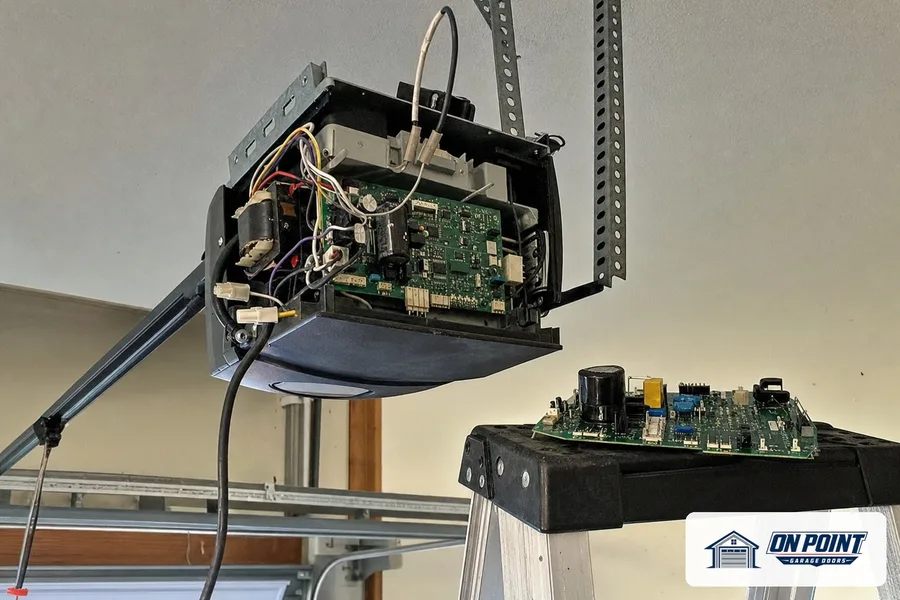
Power surges and age can damage the logic board, causing clicking, random behavior, lost remotes or a dead opener. Boards for many Craftsman models are still available. If yours is no longer made, a new opener is the better choice.
Older Craftsman remotes, especially very old ones with small switches inside, use fixed codes that can be copied. Newer ones use rolling codes. If your remotes are old or lost, we can pair new compatible remotes or, on very old units, recommend a new opener for security.
A Craftsman that strains, slows down or reverses may be fighting a heavy door with tired springs. Before any opener part is replaced, the door is disconnected and its balance tested. Fixing the springs often fixes the opener's behavior too.
Gears, sensors, capacitors, boards, wall controls and remotes are common repairs. If the opener is very old, lacks safety sensors, has a failed motor or needs several parts at once, a new opener usually makes more sense. You get a free estimate on both.
If you do replace it, a quiet belt drive suits attached garages, a wall-mounted unit suits low ceilings and overhead storage, and a chain drive suits detached garages. Many new openers add phone control, battery backup and soft start and stop.
Many cars with built-in opener buttons pair with Craftsman openers of the same family as LiftMaster and Chamberlain. Very old Craftsman units with switch-coded remotes do not pair with modern car buttons at all. The technician checks which remotes and car buttons your unit accepts and sets them up.
The technician identifies your Craftsman model, tests the door's balance, checks the sensors, drive, gear, board, remotes and wall control, and explains what is wrong with a free estimate. After the repair, the travel and force are set and the safety reverse is tested.
Along with Craftsman, we repair LiftMaster, Chamberlain, Genie, Linear, Stanley, Allister and other older openers, and we install new ones. If parts for your opener are gone, you hear that plainly, with options.
Many Craftsman units we find are in detached garages, where damp air corrodes the board, the wiring and the rail over the years. A unit that acts up after rainy weeks, or stops after a storm, often has moisture damage. A dry mount, a protected outlet and a sealed wall control help the next opener last longer.
Older chain-drive Craftsman openers are loud, and the noise travels into any room over the garage. A slack chain, worn sprockets, a loose rail and worn rollers on the door all add to it. Setting the drive back to the right tension and fitting sealed rollers helps; for real quiet, a belt-drive or wall-mounted opener is the upgrade.
A Craftsman whose light stays on, flickers or never comes on may have a failed socket, a worn light board or a bulb that the opener does not like. Some bright LED bulbs interfere with remote signals too. The technician checks the light circuit with the rest of the opener.
Most often a stripped drive gear inside the unit, or a broken spring making the door too heavy.
Usually. Gears, sensors, capacitors, boards and remotes are common repairs. Very old units may be better replaced.
The safety sensors are usually blocked, out of line or wired badly.
Often yes. Very old fixed-code units may need a new receiver or opener.
Yes. You see what is wrong and the options before any work starts.
Across Brooklyn, Queens and Long Island, tell us what the door is doing and we set a visit that fits your day.
Free estimate, call (929) 429-2429.
Tell us what the door is doing and we will give you an honest arrival time. The estimate is free.
Easier to explain by phone? Call (929) 429-2429.
Tell us what the door is doing. The estimate is free either way.