Takes 30 seconds. We call you back to set a time.
Steel and wood fail in opposite ways. Steel takes a hit and keeps the mark, while wood shrugs off a bump and loses slowly to water. Choosing between them is mostly a decision about which of those problems you would prefer to live with, how often you are willing to refinish a door, and how much weight the garage can carry. Here is how the two materials compare after the showroom shine is gone, including when an old wood door deserves to stay. Free estimate at (929) 429-2429.
By Sean Cohen, owner, On Point Garage Doors · Updated
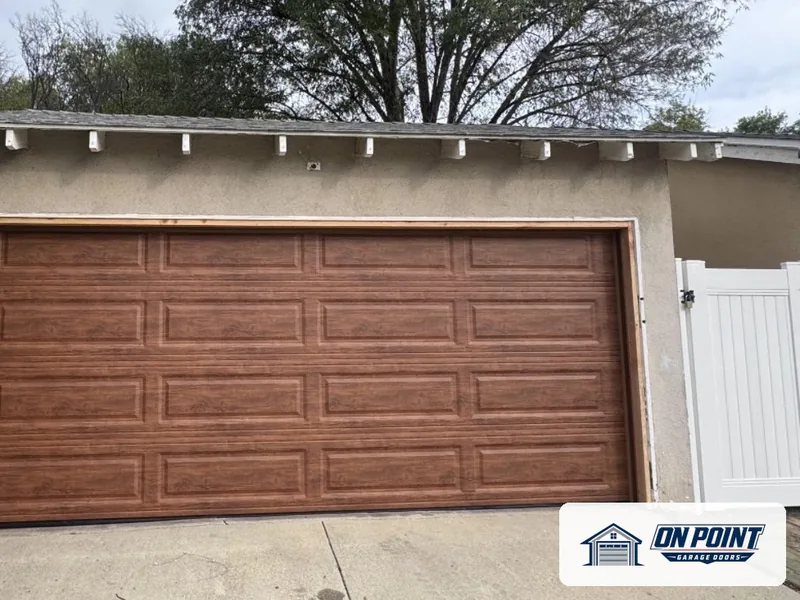
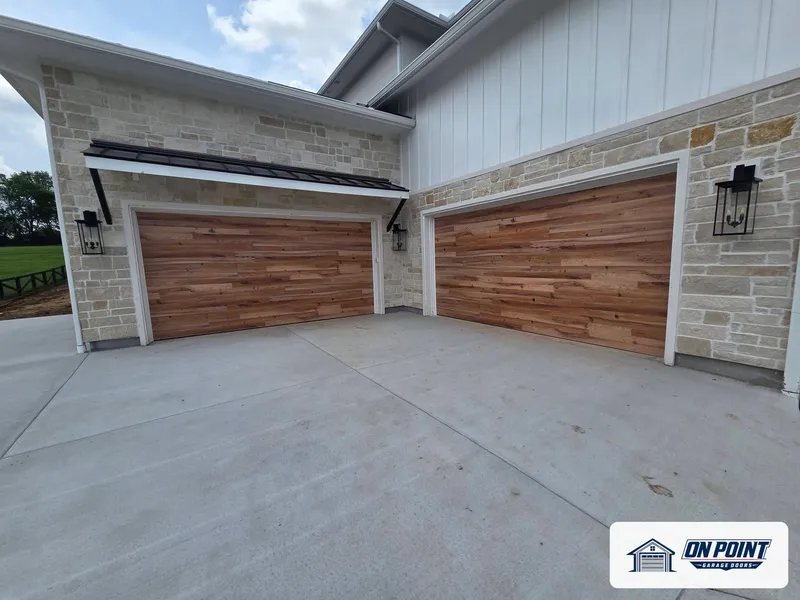
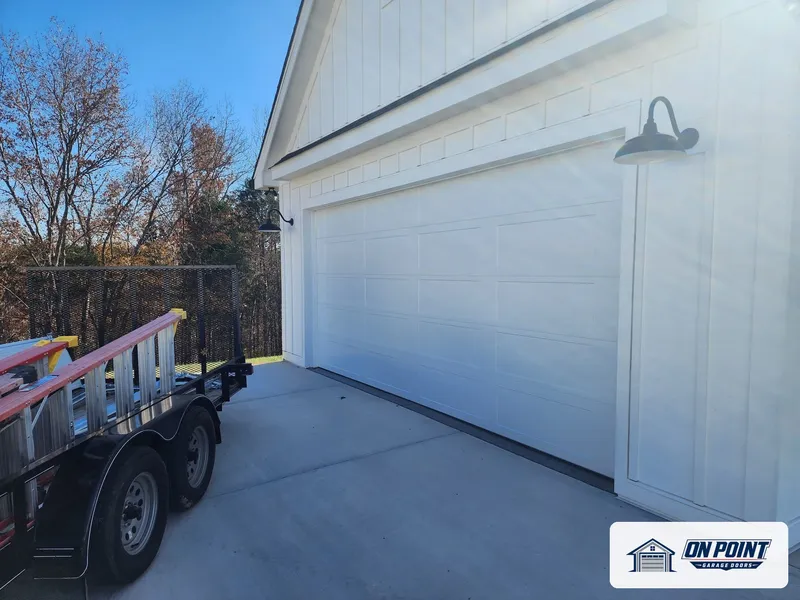
These photos are from our own jobs, with our logo on them.


A basketball, a trash barrel or a bumper at walking speed can crease a thin steel section, and creases do not pull out cleanly. Thicker skins and foam cores resist it better.
Wood absorbs the same knock with a scuff or a small gouge that filler and paint can hide. A hard hit is another matter, because it can split a rail or push a panel out of its groove, and then the joinery has to be repaired.
Wood drinks through end grain, so trouble starts along the bottom rail, at the joints and behind trim where paint has cracked. Once the bottom rail is soft, the brackets that hold the lift cables lose their grip, and that becomes a safety problem and no longer a cosmetic one.
Steel rusts where the coating is broken: the bottom edge sitting in road salt, scratches and fastener holes. Rust travels more slowly and gives more warning, but a rusted-through bottom section cannot be sanded back to health.
A stained wood door facing south or west can look tired within a few seasons, and letting it go makes the next refinishing a bigger job because bare wood turns gray. Painted wood stretches that interval but still peels at the joints. Every coat also adds weight, which slowly pulls the door out of balance with its springs.
Steel asks for very little: a rinse now and then, touch-up on scratches and a look at the bottom edge after a salty winter.
A solid wood two-car door can weigh far more than an insulated steel door of the same size. That means larger springs, stout track and hinges, and an opener with the strength and braking to handle it. It also means a wood door with a broken spring is dangerous to lift. Moving from wood to steel therefore calls for new springs every time. Springs left over from the heavy door would throw a light one open.
Solid wood has a little natural insulation and a pleasant dull sound as it moves. It does not match a steel sandwich door filled with foam, which is the better choice under a bedroom or beside a heated room. A single skin of steel with nothing behind it loses to wood on both counts, so the comparison depends on which steel door you mean.
Wood grows in humid months and shrinks in dry ones. A door that glides in January can rub the stops in August, and joints open and close along with it. Steel moves so little that the fit you get at installation is close to the fit you keep, which helps in older garages where the frame is already slightly out of square.
On an older Tudor, a shingled colonial or a brick garage with original carriage doors, real wood can be the detail that makes the front of the house. Steel suits most ranches, capes, split levels and newer homes without drawing attention to itself. Woodgrain steel sits between the two and is convincing from the sidewalk, less so at arm's length. Our page on faux wood doors covers that middle road.
If the rails are firm when probed, the joints are closed and the door hangs straight, a wood door can go on for a long time with fresh hardware, balanced springs and a sound finish. A single rotten bottom rail can sometimes be rebuilt. When softness has reached several joints, or the sections sag between hinges, the frame of the door is gone and more repair only delays the decision.
The swap is more than hanging a lighter door. Wood doors are often thicker, so track position, stops and seals move. Old one-piece wood doors need a complete track system, and the opener's force and travel are set again for the new weight. We check the jambs as well, since a door that rotted at the bottom often shared that water with the framing beside it.
Choose steel if you want to think about the door as little as possible. Choose wood if the look matters enough that refinishing feels like care and not a chore, and the garage has the headroom and structure for the weight. On the estimate we tell you the condition of the door you have before we talk about a new one.
It depends on care. Neglected wood usually fails first, through rot. Wood that is kept painted and dry can outlast a thin steel door that has been dented and left to rust.
It may be. The opener should match the weight and, above all, the springs must carry the door. A door that will not stay halfway up by itself is asking too much of any opener.
No. The materials differ in thickness, weight and the way hinges attach. Changing material means a new door with its own track and springs.
Both need attention there. Steel needs an intact coating and galvanized hardware, while wood needs a sealed finish on every edge. Aluminum and vinyl are also worth a look close to salt water.
Yes, when both are reasonable. You get the repair and the new steel or wood option in writing, free, and choose between them.
Across Brooklyn, Queens and Long Island, tell us what the door is doing and we set a visit that fits your day.
Free estimate, call (929) 429-2429.
Tell us what the door is doing and we will give you an honest arrival time. The estimate is free.
Easier to explain by phone? Call (929) 429-2429.
Tell us what the door is doing. The estimate is free either way.