Takes 30 seconds. We call you back to set a time.
Every garage door opener does the same job, but they do it in different ways, and the differences matter: how loud it is, how much ceiling space it takes, how well it handles a heavy door and how long it lasts. Here are the main types we install and repair across Brooklyn, Queens and Long Island, and how to tell which one suits your garage. Free estimate at (929) 429-2429.
By Sean Cohen, owner, On Point Garage Doors · Updated
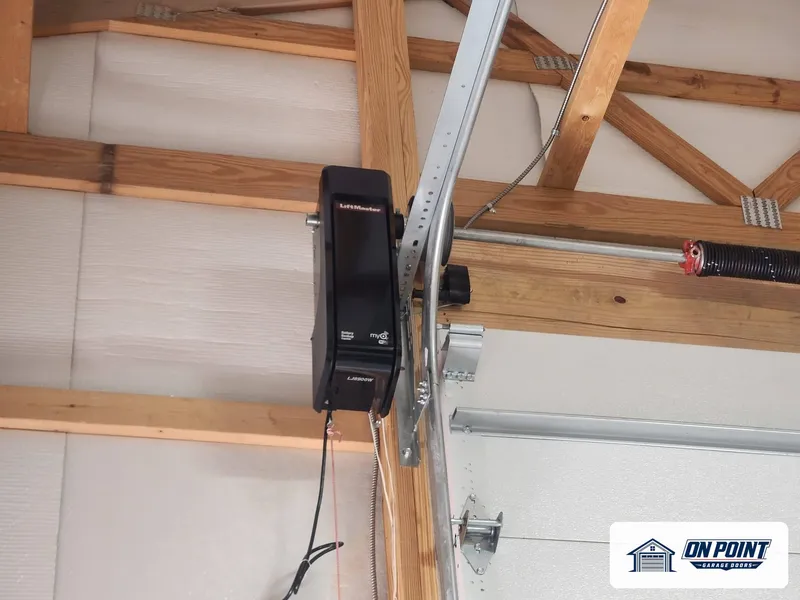
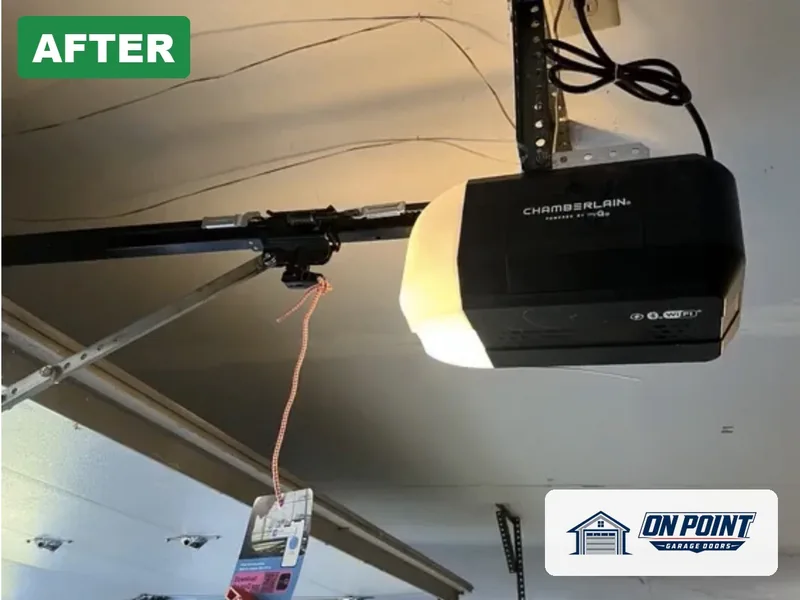
These photos are from our own jobs, with our logo on them.


Chain drives have been around longest. They are strong, simple and handle heavy doors well. Their weakness is noise: the chain rattles along the rail. They suit detached garages and garages where nobody is sleeping above.
Belt drives use a steel-reinforced belt instead of a chain. They are much quieter and smoother, which makes them the most popular choice for attached garages and garages under bedrooms. Good belt drives handle heavy and double doors well.
Screw drives move the trolley along a long threaded rod. They have fewer moving parts and can be fast. They are louder than belt drives and need the right grease on the rod. Many older Genie openers are screw drives.
Wall-mounted openers sit beside the door and drive the torsion spring bar directly. They free the whole ceiling for storage, a car lift or headroom, and they are among the quietest openers. They need a torsion spring system, which most doors here have.
Opener power is matched to the door. A light single steel door needs less than a heavy insulated double door or a wood door. But no opener should be lifting the door's weight on its own: the springs do that. An opener on a balanced door lasts far longer.
Most new openers can connect to Wi-Fi and be controlled from a phone app. Others add a built-in camera, bright lights, motion sensing, battery backup and soft start and stop. Older openers can often be connected with an add-on.
Battery backup keeps the door working during a power outage. It is especially useful where storms bring outages and where the garage is the main way in and out of the house.
The old opener is removed, the door is balanced, the new opener is mounted solidly, sensors and the wall control are wired, travel and force are set, remotes and the app are set up, and the safety reverse is tested. You get a free estimate before any work starts.
Heavy doors need an opener with enough power and a smooth start and stop, so the door is not jolted at the start of every trip. Belt drives and wall-mounted openers with soft start handle heavy doors gently. The springs are still sized to carry the weight, so the opener only guides it.
Openers last longest on balanced doors that are maintained once a year. Openers on doors with tired springs, worn rollers or a bent track wear out much sooner, whatever their type. A busy family door also puts more trips on the opener than a door opened a few times a week.
Every opener type works with remotes, outside keypads and the opener buttons built into many cars. Some newer openers need a small bridge to talk to older car buttons. During an install, every remote, keypad and car button is paired and tested.
Shops, warehouses and parking garages use commercial operators built for many more trips a day than a home opener. They come in trolley, jackshaft and hoist designs and are sized to the door's weight and how often it runs. We install and repair those too.
When an old opener is replaced, the rail, sensors, wall control and wiring are replaced too, so nothing worn is left in the safety circuit. The old unit is taken away. A new opener on a balanced door usually feels like a different garage.
Belt drive and wall-mounted openers are the quietest, especially on a balanced door with sealed rollers.
No. It is strong and reliable, just louder. It suits detached garages.
A wall-mounted opener, which needs nothing on the ceiling.
The opener is matched to the door, but the springs should carry the weight. A balanced door matters most.
Yes. You see the opener types that fit before any work starts.
Across Brooklyn, Queens and Long Island, tell us what the door is doing and we set a visit that fits your day.
Free estimate, call (929) 429-2429.
Tell us what the door is doing and we will give you an honest arrival time. The estimate is free.
Easier to explain by phone? Call (929) 429-2429.
Tell us what the door is doing. The estimate is free either way.