Takes 30 seconds. We call you back to set a time.
Stanley openers were installed in a great many garages over the years, and plenty of them are still working on Long Island and in Queens and Brooklyn. They were sturdy units. The challenge now is age: when an older Stanley opener stops, the parts it needs can be hard to find, and many of these openers were built before today's safety and security features. Free estimate at (929) 429-2429.
By Sean Cohen, owner, On Point Garage Doors · Updated
These photos are from our own jobs, with our logo on them.


Some problems on a Stanley opener are outside the opener: the door's springs, rollers, tracks or the safety sensors. Those are fixed with standard parts. The wall control, the wiring and the sensors can often be replaced too.
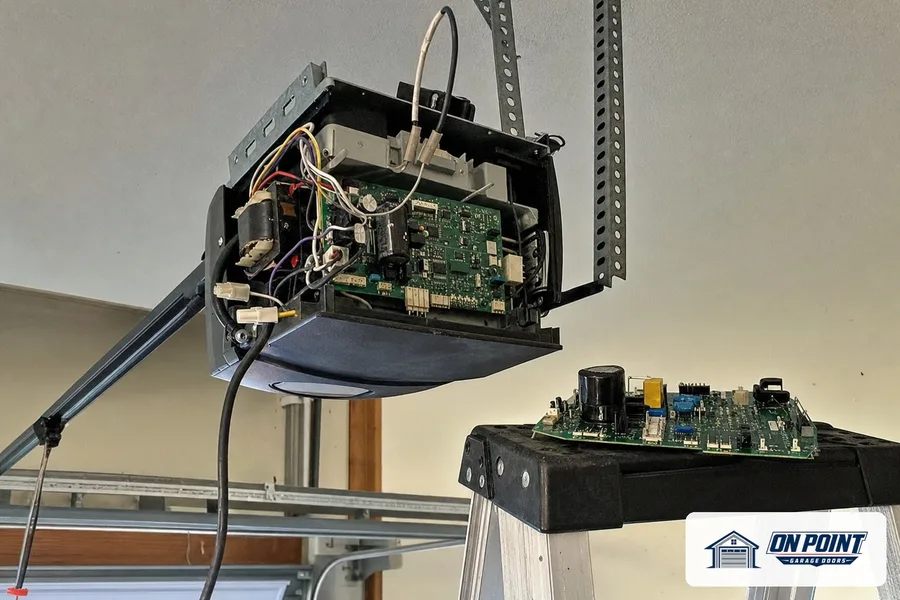
Inside the opener, gears, boards and remotes for older models are increasingly scarce. When the right part is available, we can repair it. When it is not, we tell you plainly.
If the opener needs an internal part that is no longer made, has no photo-eye safety sensors, or uses remotes with fixed codes that can be copied, replacing it is usually the better choice. A new opener gives you safety sensors, rolling-code remotes, quieter operation and phone control.
You get a free estimate on the repair, when one is possible, and on a new opener, so you can compare.
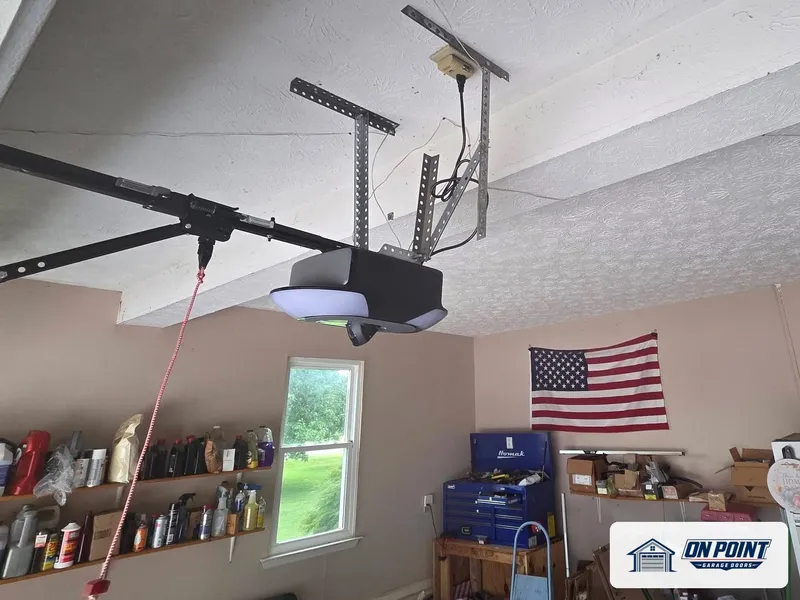
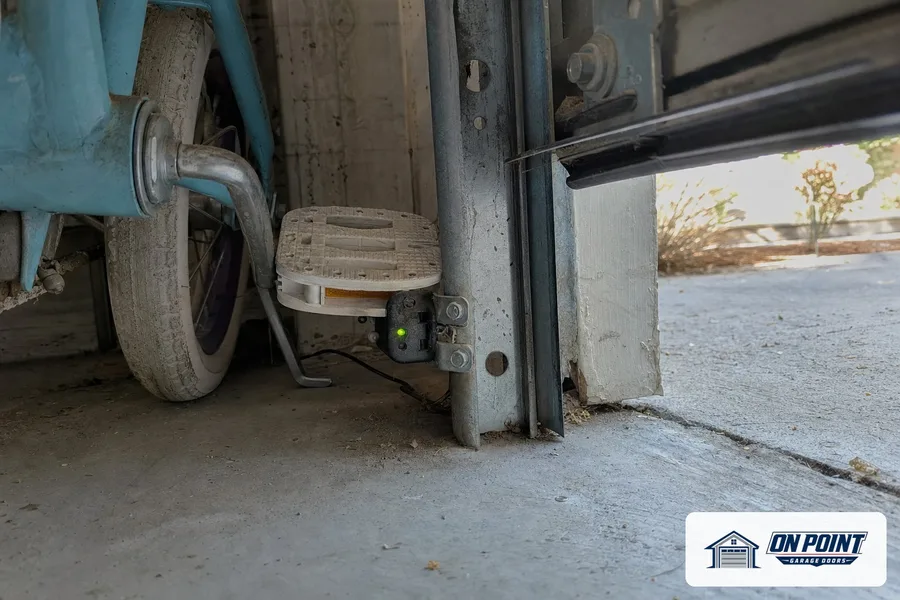
Some older openers were installed before safety sensors were required. If the door does not reverse when something is in the way, it can injure a child or a pet or damage a car. That alone is a strong reason to replace an opener without sensors.
Older Stanley remotes often use codes set with small switches inside the remote and the opener. Those codes can be copied, and a lost remote is a way into your garage. New openers change the code every time the button is used, and old remotes can be cleared out of memory.
For attached garages with rooms above, a quiet belt drive is the usual choice. For low ceilings or garages with storage overhead, a wall-mounted opener frees the ceiling. For detached garages, a chain drive is simple and strong. Each is matched to your door's weight and size.
Many old openers fail because the door has become heavy as its springs wore out. Before any new opener goes in, the springs are checked and the door is balanced, so the new opener lasts. The rollers, hinges and tracks are checked too.
The technician identifies your Stanley model, tests the opener, the remotes, the sensors and the door, and explains what is wrong. You get a free estimate on a repair when parts are available and on a new opener. If you choose a new one, the old unit, rail and wiring are removed and taken away.
Many older Stanley units we find are in detached garages at the back of the lot, where they have quietly worked for years with little attention. Those garages are often damp, so wiring, boards and the rail can corrode. Moisture damage inside an old opener is a common reason it cannot be saved.
A new opener for a detached garage is usually a strong chain or belt drive, and if you want phone control, the Wi-Fi signal at the back of the lot is checked first.
Older openers are often paired with older doors that still use extension springs along the tracks. Those springs need safety cables through them, and when we find them missing, they are added. If the springs are near the end of their life, the door is balanced again before a new opener goes in.
When a Stanley opener is replaced, the motor, the rail, the old wall button and the wiring come down together. Loose wires stapled along the ceiling are removed or tidied, and the new wiring is run neatly so nothing hangs where it can be snagged.
Along with Stanley, we often find older Genie, Craftsman, Sears, Linear and Allister openers still running. The same advice applies: fix what makes sense, and replace when parts or safety say it is time.
Sometimes. Problems with the door, sensors or wall control are easy to fix. Internal parts for older models can be hard to find.
For some models, yes. For others, matching remotes are scarce and a new receiver or opener is the better choice.
Yes. Openers without sensors cannot stop the door from closing on a person, pet or car.
Usually a belt drive for attached garages, a wall-mount for low ceilings, or a chain drive for detached garages.
Yes. You see the repair and replacement options before any work starts.
Across Brooklyn, Queens and Long Island, tell us what the door is doing and we set a visit that fits your day.
Free estimate, call (929) 429-2429.
Tell us what the door is doing and we will give you an honest arrival time. The estimate is free.
Easier to explain by phone? Call (929) 429-2429.
Tell us what the door is doing. The estimate is free either way.