Takes 30 seconds. We call you back to set a time.
A car wash is one of the hardest places a garage door can live. The door sits in a wet bay, gets hit with soap, wax and road salt washed off every car, and opens and closes with each vehicle that rolls through. In winter the same bay can swing from warm steam inside to freezing air at the entrance. Ordinary door parts rust, swell or freeze under that load, and a door that will not open stops the whole line. This page covers which doors and parts hold up in a wash bay, what wears out first and what we look at when we service doors at self-serve bays, tunnel washes and detail shops. Free estimate at (929) 429-2429.
By Sean Cohen, owner, On Point Garage Doors · Updated
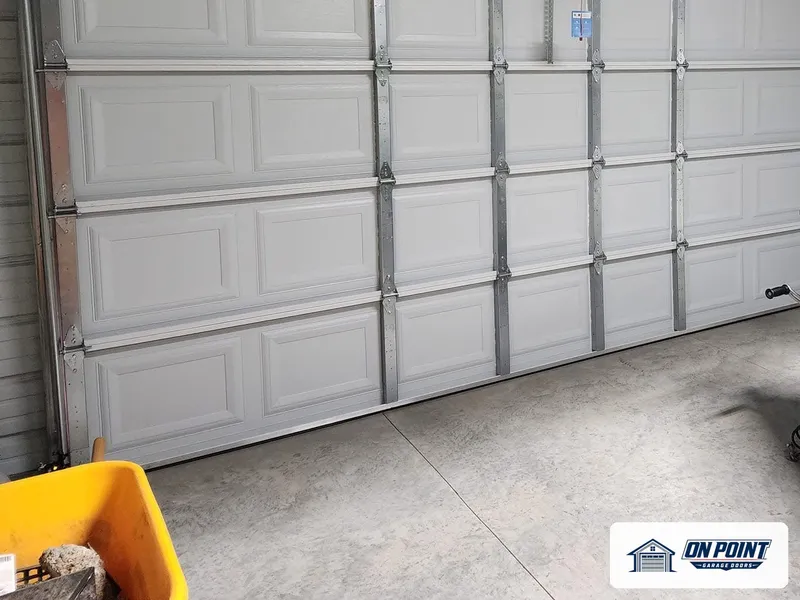
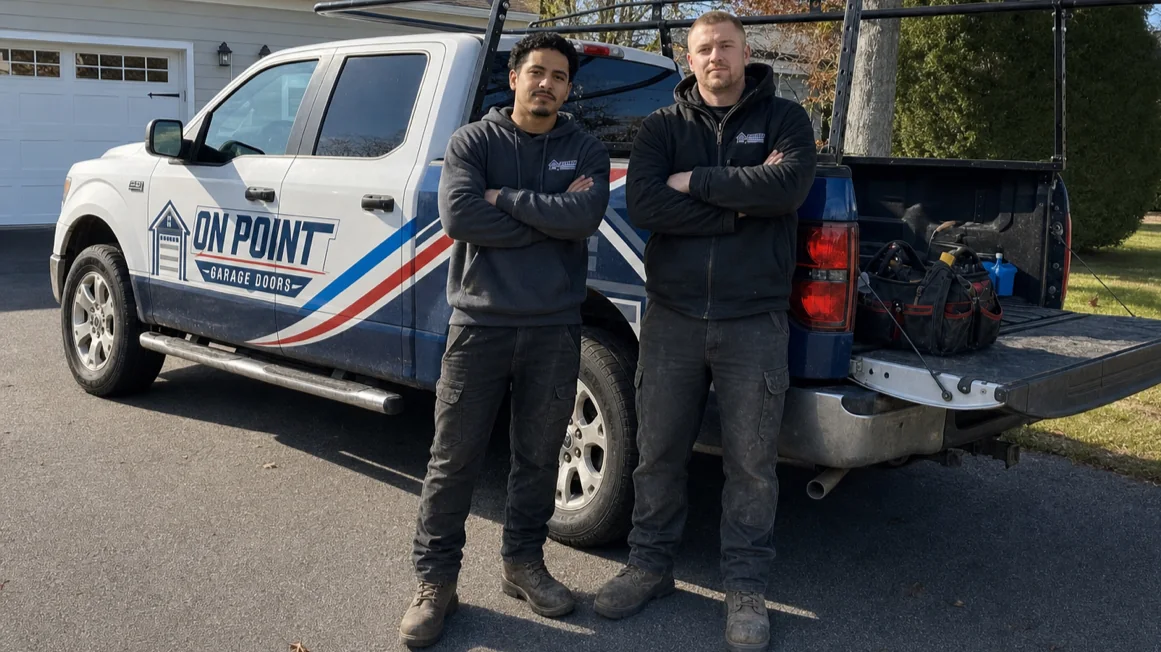
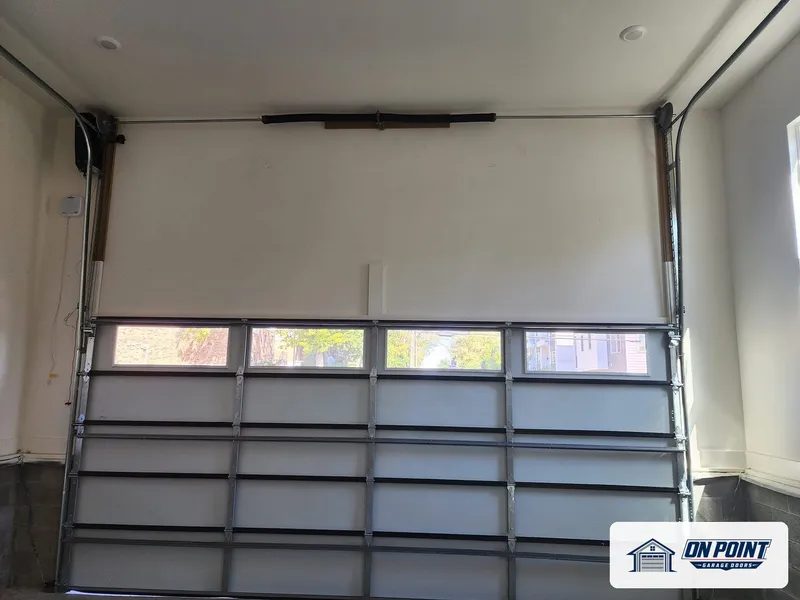
These photos are from our own jobs, with our logo on them.


Water alone is not the problem. It is water mixed with detergents, wheel cleaners and salt from winter roads, landing on the door day after day and drying in the joints. Steel that would last for decades on a house starts to bubble at the bottom section, the hinges and the track bolts. Rollers with plain steel bearings seize. Wood or wood-look composite doors swell. A door built for a dry garage simply does not belong in a wet bay.
Most wash bays do best with aluminum doors, or with steel doors that carry a heavy factory finish and stainless or galvanized hardware. Aluminum does not rust, it is light on the springs and the opener, and it can be ordered with full-view panels that let daylight into the bay. Polycarbonate panels are a common choice in the glazed sections because they take a knock better than glass. Insulated aluminum sections help where the bay is heated through the winter.
The small parts fail first. We use stainless or galvanized hinges, nylon rollers with sealed bearings, and stainless fasteners wherever the door gets wet. Springs can be ordered with a coated finish that resists rust far longer than bare oil-tempered wire. Cables are galvanized, and the bottom brackets, where the cable attaches and water collects, get extra attention on every visit.
A busy tunnel wash can run its entrance and exit doors with every car on a weekend. That is far more use than a home door sees in a season. Springs are sized for high cycles, so they do not snap halfway through the season, and the opener is a commercial operator with a duty rating that matches the traffic. A residential opener on a wash door is one of the most common causes of a dead door we find on these jobs.
Many washes tie the doors into the wash controller, so the door opens when a car is let in at the entry and closes behind it. When the door stops responding, the fault can be in the operator, the wiring, the loop detector in the floor or the signal from the wash system. We test the operator on its own first, then follow the signal back. Operators and control boxes are mounted where the water does not reach them, and the boxes are sealed against moisture.
Doors in a wash bay come down close to cars, attendants and customers on foot. Photo eyes and reversing edges are tested on every visit, and the photo eyes are placed and shielded so that mist and water drops do not make them trip when nothing is there. A wet sensor that keeps reversing the door is a common complaint, and the answer is usually better placement and a better housing, never switching the safety off.
Cold weather brings the worst calls. Water runs down the door, collects at the bottom and freezes the seal to the slab overnight. Ice builds in the tracks and on the rollers. A door that tries to open while frozen can tear its bottom seal or strain the operator. Heated bays help, and so do the right seals and a slab that drains away from the door. We look at where the water goes and suggest changes that keep the door free on cold mornings.
The bottom section and its seal take most of the punishment. Soap and salt collect along the bottom edge, and the seal hardens and cracks. On steel doors the bottom section is where rust shows first. We replace worn seals with materials that stay flexible in the cold and resist the chemicals used in the bay, and we can replace a rusted bottom section on its own when the rest of the door is sound.
Self-serve bays often have doors that stay open most of the day and close at night for security. Detail shops and hand-wash garages use their doors more like a service bay, closing them to keep heat in while a car is worked on. Each pattern wears the door differently. We ask how the doors are used before suggesting parts and a service schedule.
Because a stuck door can shut the wash down, most owners do better with planned visits than with waiting for a breakdown. A planned visit covers springs, cables, rollers, hinges, seals, the operator, the controls and the safety devices on every door. Worn parts are written up so they can be changed on a quiet weekday instead of a busy Saturday. Our page on commercial door maintenance explains how we set those visits up.
The technician runs each door through several cycles, looks closely at rust, wear and balance, and tests the operator and every safety device. You get a written estimate for anything that needs changing, with the parts suited to a wet bay. Small adjustments are done on the spot, and nothing larger is started without your approval.
Aluminum doors, or steel doors with a heavy factory finish, paired with stainless or galvanized hardware and sealed rollers. They stand up to water, soap and salt far better than a standard home door does.
Very often the photo eyes are reading water drops or mist as an obstruction. Better placement and a proper housing usually fix it. The safety system stays on, because people and cars are close to the door.
Yes. We test the operator, its wiring and the loop detector, then follow the signal back toward the wash system to find where the command is lost.
It comes down to the seal, the slab drainage and the bay heat. We look at where water collects at the door and suggest changes so the door opens freely on cold mornings.
Yes. We look at each door, how often it runs and what it is exposed to before recommending parts or a service plan.
Across Brooklyn, Queens and Long Island, tell us what the door is doing and we set a visit that fits your day.
Free estimate, call (929) 429-2429.
Tell us what the door is doing and we will give you an honest arrival time. The estimate is free.
Easier to explain by phone? Call (929) 429-2429.
Tell us what the door is doing. The estimate is free either way.