Takes 30 seconds. We call you back to set a time.
In row houses, high ranches, splits and many attached homes, the garage sits right under a bedroom, a nursery or the living room. Every morning departure and late arrival sends the sound of the door and opener into the house. The good news is that a garage door can be made dramatically quieter, and the biggest gains usually come from a few specific changes. Free estimate at (929) 429-2429.
By Sean Cohen, owner, On Point Garage Doors · Updated
These photos are from our own jobs, with our logo on them.


A belt drive replaces the chain with a reinforced belt, which runs almost silently along the rail. Many belt-drive openers also have DC motors that start and stop softly. For a garage under a bedroom, a belt drive is the most common upgrade we install.
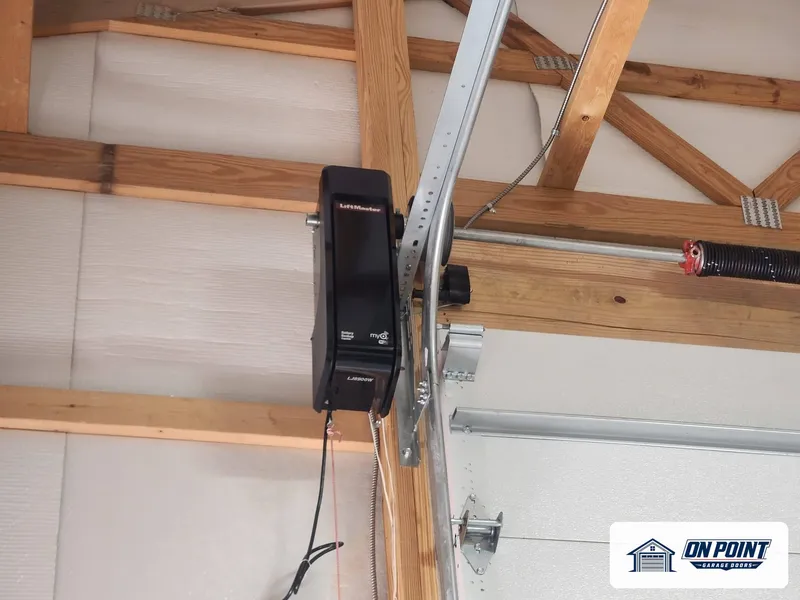
A wall-mounted opener sits beside the door and turns the spring bar directly. There is no rail and no motor on the ceiling, so very little sound or vibration reaches the room above. It is the quietest option for many garages, and it frees the ceiling too.
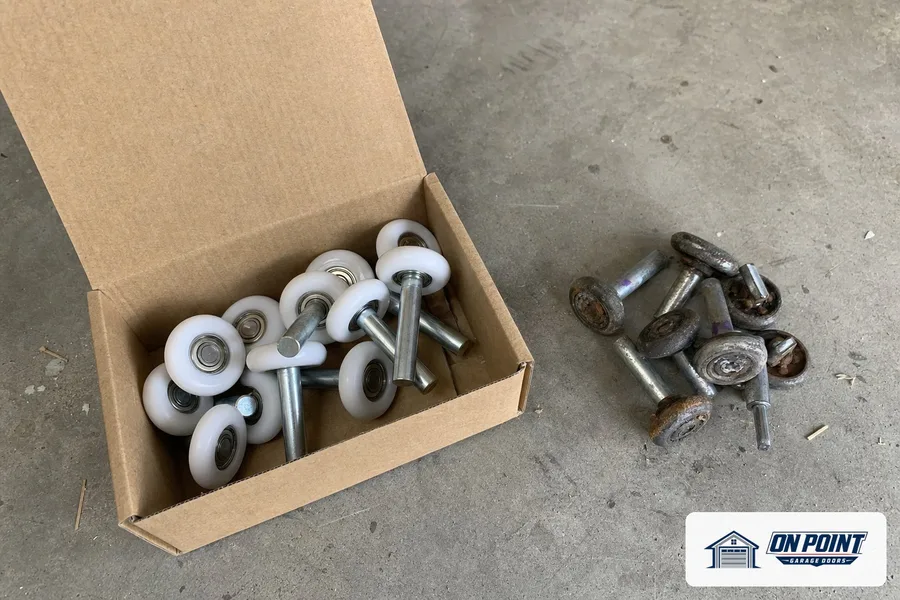
Old steel rollers with open bearings are often the loudest part of the whole system. Sealed nylon rollers with ball bearings are quiet and smooth. Owners are often surprised how much quieter the door is after new rollers alone.
A door with weak springs is heavier for the opener, which strains, shakes the rail and makes the door shudder. Balancing the door or replacing tired springs lets the opener work lightly and quietly.
An opener hung straight from the joists turns the ceiling into a speaker. Mounting it on a solid frame, with rubber isolators where appropriate, keeps vibration out of the room above.
A thin steel door drums and rattles; an insulated door is stiffer and quieter as it moves, and it blocks street noise and cold. For a garage under living space, an insulated door makes the room above warmer and quieter.
Shift workers and early commuters often open the garage while the rest of the house sleeps. Soft start and stop, a quiet drive and a smooth door let one person leave without waking everyone.
The technician listens to the door and opener, checks the rollers, hinges, springs, balance, tracks and opener mount, and explains which changes will make the biggest difference, with a free estimate. After the work, the door is balanced and the safety reverse is tested.
Noise is usually a sign of wear: grinding rollers, knocking hinges, a straining opener. Fixing the noise usually fixes the wear too, so the door also lasts longer.
Parents of babies often call because the garage door wakes the baby. A wall-mounted or belt-drive opener, sealed rollers, new hinges and a balanced door usually make the door quiet enough that it is barely heard upstairs.
When the garage sits under a tenant's or a relative's bedroom, the noise affects more than one household. A quiet door and opener is one of the simplest ways to keep everyone in the house happy.
A door that slams at the top or bangs down at the bottom usually has travel limits set wrong or springs out of balance. Setting the limits and balancing the door stops the bang and protects the door.
Phone control and a keypad let someone come in late without fumbling for a remote, and a soft-start opener closes the door gently behind them.
Hinge screws, track bolts and opener rail fasteners work loose over the years, and each loose piece adds its own rattle. During the visit every fastener is checked and made secure. On thin doors, panels that buzz against each other can be quieted with struts or by replacing worn hinges.
On attached houses, a loud door carries through the shared wall to the house next door as well. A quiet door keeps the peace on both sides of the wall.
New sealed rollers, a balanced door and a belt-drive or wall-mounted opener make the biggest difference.
Wall-mounted and belt-drive openers are the quietest, especially on a balanced door.
Usually yes. Old steel rollers are often the loudest part.
Yes. It is stiffer and quieter and blocks street noise.
Yes. You see which changes will help before any work starts.
Across Brooklyn, Queens and Long Island, tell us what the door is doing and we set a visit that fits your day.
Free estimate, call (929) 429-2429.
Tell us what the door is doing and we will give you an honest arrival time. The estimate is free.
Easier to explain by phone? Call (929) 429-2429.
Tell us what the door is doing. The estimate is free either way.