Takes 30 seconds. We call you back to set a time.
Before sectional doors took over, many garages were built with a single solid panel that tilts out and up on pivoting hardware and heavy side springs. Plenty of them are still in use behind older homes in Brooklyn, Queens and Long Island. They worked for decades, but they swing out over the driveway, leave gaps around the edges, are hard to automate safely, and their springs are some of the most dangerous on any garage. Free estimate at (929) 429-2429.
By Sean Cohen, owner, On Point Garage Doors · Updated
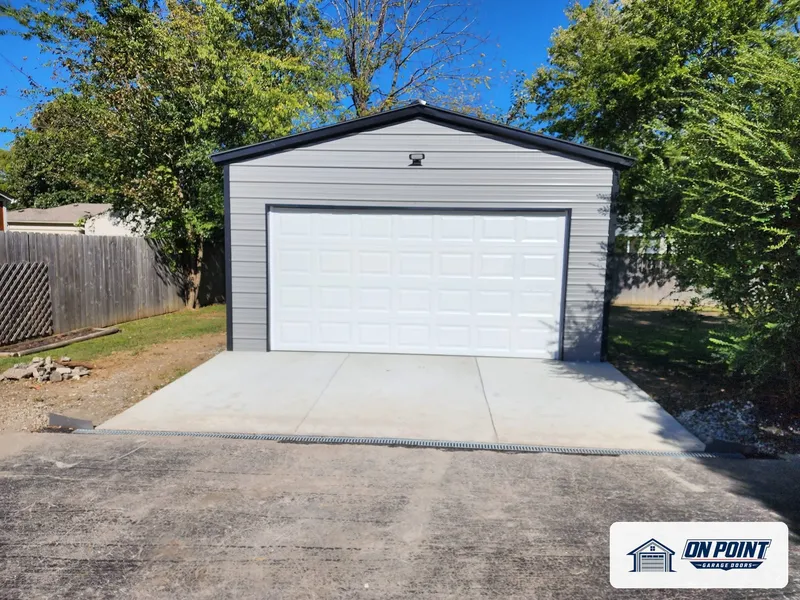
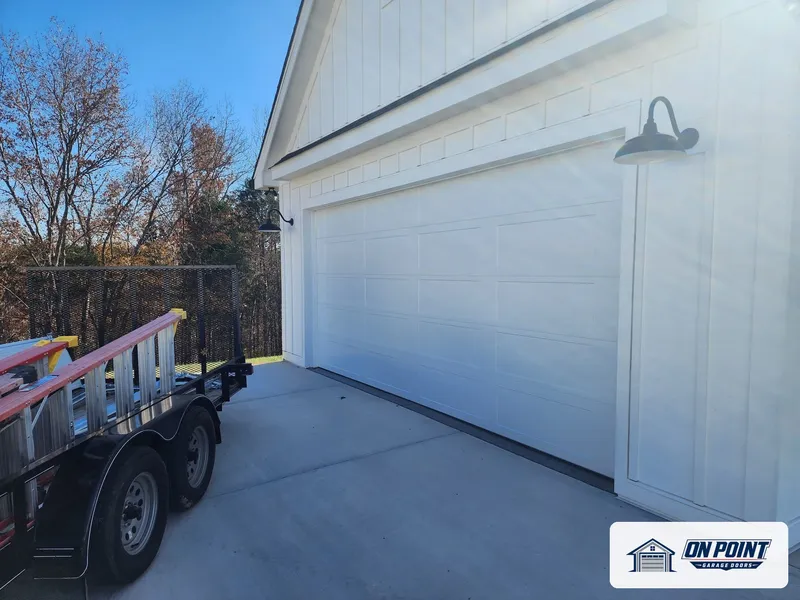
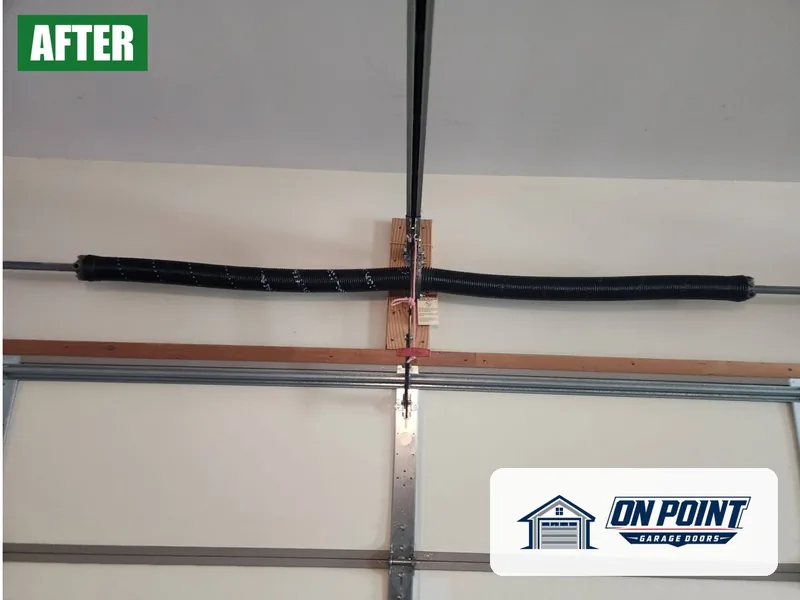
These photos are from our own jobs, with our logo on them.


The whole door is one panel, usually wood framing with a wood or hardboard face. Pivoting arms on each side guide it as it tilts out at the bottom and slides up into the garage. Long extension springs on each side, often anchored to the wall or the jamb, balance its weight. Some versions run on short tracks; others hang on the arms alone.
Tilt-up doors usually use large extension springs mounted beside the opening. When one breaks, it can fly across the garage, and older setups rarely have safety cables. Adjusting or replacing those springs is risky work. Many owners decide to replace the door the first time a spring breaks, rather than putting new springs on an old door.
A sectional door rises straight up and slides back under the ceiling. It needs no space in front of the garage, seals against the frame and floor, and works smoothly with any modern opener. Torsion springs above the door replace the side springs, and safety is far better.
One-piece doors were often hung in openings that are not a standard size, with old framing that has shifted. The opening is measured carefully. The jambs and header may need repair or new trim so the sectional door's tracks have solid wood to bolt to and the door seals properly.
Sectional doors need some room above the opening for the tracks and springs, and a little room on each side. Older detached garages sometimes have very little. Low-headroom track and the right spring setup let a sectional door fit in most of them.
Most one-piece doors we replace are on detached garages at the back of the lot. Those garages often need a little frame repair, a new bottom seal on an uneven slab, and sometimes power for an opener. All of that is planned before the new door is ordered.
Carriage-style doors are popular replacements because they keep the old swing-door look while opening overhead. Plain raised-panel steel doors suit utility garages. Insulated doors make sense if the garage is a workshop or connects to the house.
The old door, its arms and its springs are taken down safely and hauled away. The opening is repaired and squared, new tracks, torsion springs, rollers, hinges and seals go in with the new door, and the opener is installed or set to the new door. The door is balanced and the safety reverse is tested.
The technician measures the opening, the headroom and the side room, checks the framing and the slab, and shows you the sectional doors that fit, with a free estimate that includes any frame work.
Openers paired with one-piece doors often need a special arm and careful force settings, because the door swings out in an arc before it rises. Many of these openers are old, with no safety sensors. Replacing the door is the natural moment to replace the opener too, with sensors, rolling-code remotes and phone control.
Owners who like the plain look of an old one-piece door can choose a flat-panel sectional door that looks almost the same from the street, while opening straight up and sealing tightly.
A single solid panel that tilts out and up on pivoting hardware, balanced by heavy springs on each side.
Their side springs hold great force and often have no safety cables. A broken spring can fly across the garage.
Yes. The opening is measured and repaired if needed, and a sectional door with torsion springs goes in.
Usually, with low-headroom track if the ceiling is tight. We measure before ordering.
Yes. You see the options and any frame work before anything is ordered.
Across Brooklyn, Queens and Long Island, tell us what the door is doing and we set a visit that fits your day.
Free estimate, call (929) 429-2429.
Tell us what the door is doing and we will give you an honest arrival time. The estimate is free.
Easier to explain by phone? Call (929) 429-2429.
Tell us what the door is doing. The estimate is free either way.