Takes 30 seconds. We call you back to set a time.
A garage door pulley is a small grooved wheel that guides a lift cable. You find pulleys on doors that use extension springs, the long springs that stretch along the tracks above the door on each side. When the door closes, the springs stretch and store energy. The cables run from the bottom corners of the door, over the pulleys and back to the springs, so the springs can help lift the door when it opens. If a pulley wears out, cracks or seizes, the cable can slip off, the door can lift crooked, and the whole system becomes unsafe. Free estimate at (929) 429-2429.
By Sean Cohen, owner, On Point Garage Doors · Updated
These photos are from our own jobs, with our logo on them.


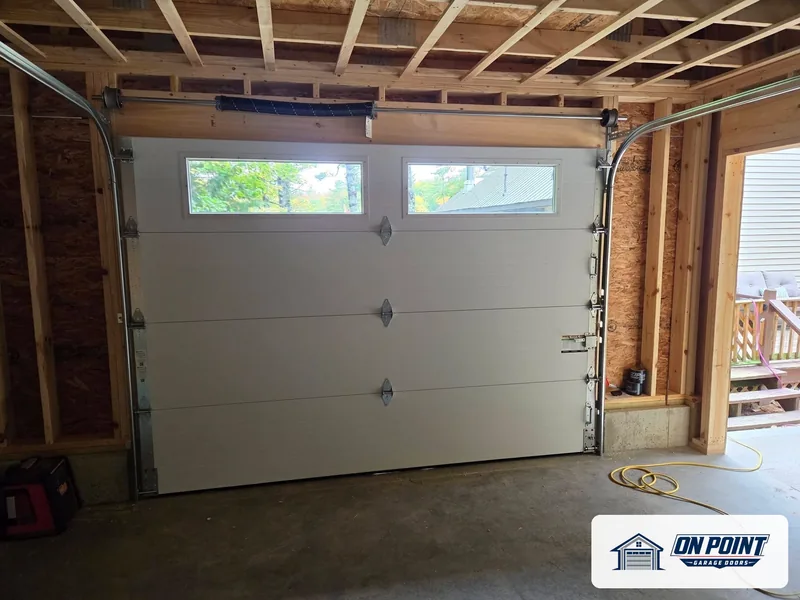
Each side of the door has its own cable, spring and pair of pulleys. The cable is tied off at the back, runs around the spring pulley, forward to the fixed pulley, and down to the bottom bracket. Both sides have to match. If one pulley drags or one cable stretches more, that side lifts later than the other and the door goes up crooked.
Every time the door moves, the pulleys spin under the full pull of the springs. Over years, the bearings inside wear and the wheel starts to wobble. Damp garages, salt air near the shore and cold winters speed up the wear. Old plastic pulleys get brittle and can crack, while steel pulleys can rust on their axles.
If a cable jumps out of the pulley groove, it can bind, fray or slip off the door's bottom bracket. The door may stop crooked, jam in the track or drop on one side. Leave a door like that where it is, keep people and cars away from it and do not run the opener. The springs are still under tension, and the door can move without warning.
Changing a pulley means taking the tension off the spring and the cable first. On an extension spring door, that tension is what makes the job dangerous. A spring that lets go can whip across the garage, and a pulley that breaks under load can send parts flying. This is a repair for a trained technician with the right tools.
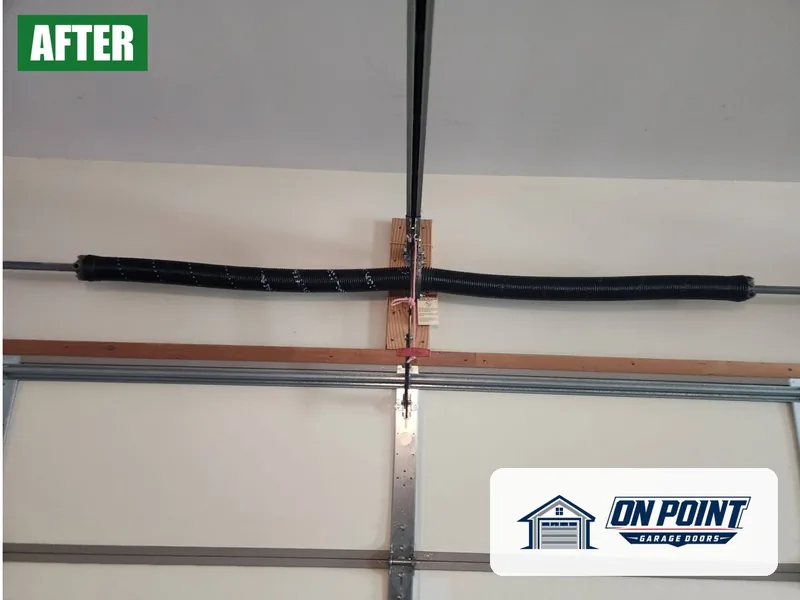
A safety cable is a steel line threaded through the middle of each extension spring and tied off at both ends. If the spring or its pulley breaks, the safety cable holds the pieces so they do not fly across the garage. Many older doors were set up without them. If yours has none, we add them when we work on the springs.
Pulleys on the same door have worked the same number of cycles, so when one is worn, the others are usually close behind. Replacing the set, along with any frayed cables, keeps both sides of the door lifting evenly and saves a second visit later.
Some owners decide to do away with the extension springs, pulleys and long cables altogether. A torsion spring system mounts on a bar above the door, has fewer moving parts out in the open, and runs more smoothly. It is a common upgrade when the old springs and pulleys are worn out at the same time. See our page on converting extension springs to torsion.
Doors with a torsion spring above the opening do not use spring pulleys. Their cables wind onto drums at each end of the bar instead. If your door has a spring on a bar above the door, look at our cable drum page instead.
The technician looks at both sides of the door: pulleys, springs, cables, bottom brackets and safety cables. You hear what is worn and what is fine, and you get a free estimate before any work starts.
It guides the lift cable between the extension spring and the bottom of the door, so the spring can help lift the door.
Squealing, wobbling, cracks in the wheel, a cable rubbing its side or a door that lifts crooked.
We do not advise it. The spring and cable are under tension, and a part that lets go can cause serious injury.
Usually yes. They wear together, and matching parts keep both sides lifting evenly.
Yes. You hear what is worn and the options before any work starts.
Across Brooklyn, Queens and Long Island, tell us what the door is doing and we set a visit that fits your day.
Free estimate, call (929) 429-2429.
Tell us what the door is doing and we will give you an honest arrival time. The estimate is free.
Easier to explain by phone? Call (929) 429-2429.
Tell us what the door is doing. The estimate is free either way.