Takes 30 seconds. We call you back to set a time.
Normally a garage door opener runs until the door is fully open or fully closed, then stops. When it keeps running after the door has reached the end, keeps pushing a closed door into the floor, or hums with nothing moving, something is wrong with how the opener knows where the door is. Leaving it this way heats the motor, strains the gears and can bend the door at the top. Unplugging the opener stops it until the cause can be found. Free estimate at (929) 429-2429.
By Sean Cohen, owner, On Point Garage Doors · Updated
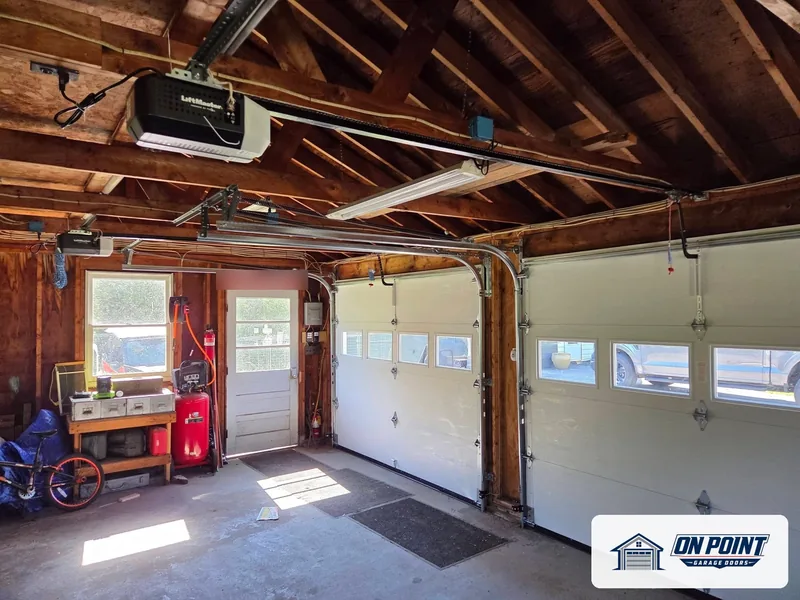
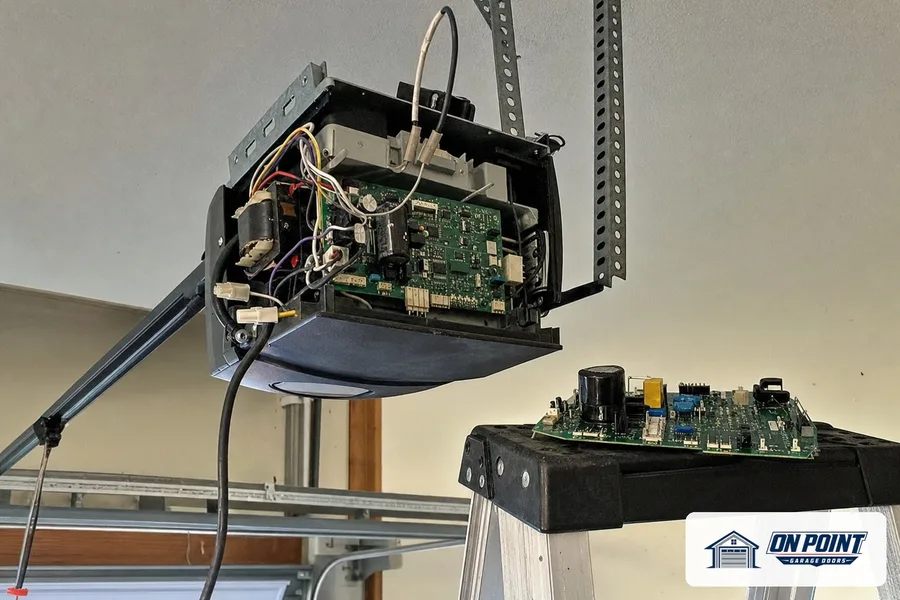
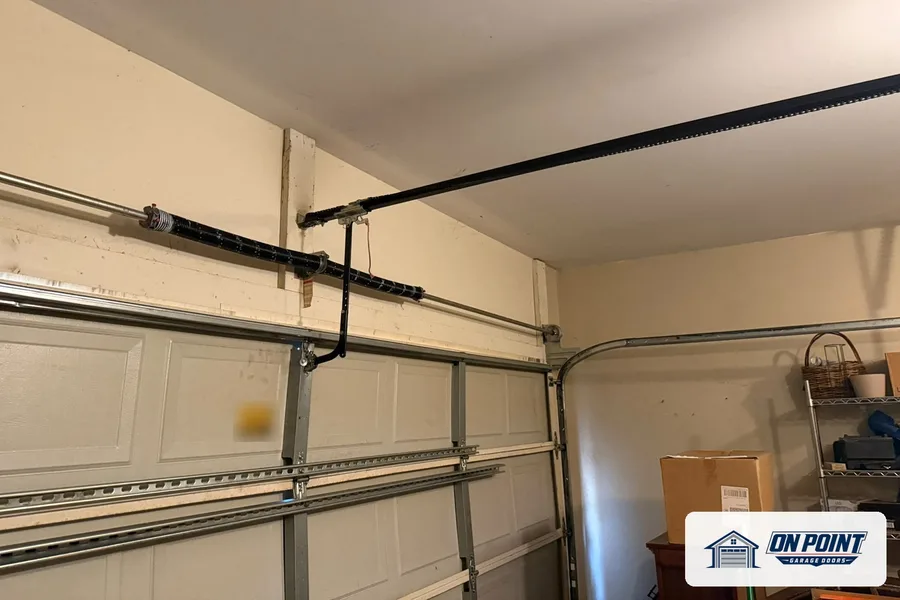
These photos are from our own jobs, with our logo on them.


Every opener has limits, the two points where it should stop: door open and door closed. Older openers use small switches or screws on the motor that are tripped as the drive turns. Newer openers count the turns of the motor electronically and learn the limits during setup. If the opener loses track of those points, it does not know when to stop.
After a new door, new springs or a change in the floor, the old limits may no longer match. An opener set to close too far keeps pushing after the door touches the floor. On many models it then reverses, which looks like a different problem. On others the motor keeps straining.
If the drive gear inside the opener is worn, or the chain or belt slips on its sprocket, the motor turns while the door moves less than the opener expects. The opener keeps running, trying to reach a point the door has already passed or will never reach. Our page on opener gear replacement covers worn gears.
If the trolley that connects to the door has been released or has cracked, the drive moves but the door does not. On some openers the motor runs to its limit and stops; on others it runs on, because the parts it uses to count turns are not where it expects. Our page on the opener trolley explains this part.
The circuit board uses relays to switch the motor on and off. A relay can stick closed after a power surge or simply from age. Then the motor runs whenever the opener has power, even with nothing pressed. This is one case where unplugging is the only way to stop it until the board is replaced.
On simple wall buttons, a button jammed in or a wire shorted by a staple acts like someone holding the button down. The opener may run, stop and start again. Unhooking the wall button, done by a technician, quickly shows whether that is the cause. Our page on a wall button that is not working covers wiring faults.
A door that sticks in its tracks can slow the motor so much that the opener's count no longer matches. Bent tracks, broken rollers or a door off balance all make the opener work harder and run longer. Fixing the door is often part of fixing the opener.
Some owners notice the opener running when no one touched it. That points to a remote button stuck down in a car, a wall button shorted in its wire, or a board that reads noise as a signal. It is a different problem from an opener that will not stop, but both come back to the controls and the board. Our page on a garage door that opens by itself covers the remote side of it.
A limit setting, a wall button or a trolley is a simple repair. A board or gear can often be replaced on a current model. On an opener that is many years old, with a stuck relay and worn gears, a new opener can make more sense. The technician will tell you which they would choose and why.
Unplug the opener and use the emergency release to move the door by hand, as long as the door is balanced and lifts easily. If the door is heavy, leave it closed and wait for a check.
The technician checks the limits, the drive, the trolley, the board, the wall button and the door itself, then explains the repair. You get a free estimate before any work starts.
Usually the limits are off, the drive is slipping, or a relay on the board is stuck.
Yes. The motor overheats and the gears and door take strain. Unplug it until it is checked.
Yes. A jammed button or a shorted wire acts like someone holding the button down.
Not always. Limits, wall buttons and trolleys are simple repairs. Old openers with several worn parts may be better replaced.
Yes. We check the opener and the door before any work starts.
Across Brooklyn, Queens and Long Island, tell us what the door is doing and we set a visit that fits your day.
Free estimate, call (929) 429-2429.
Tell us what the door is doing and we will give you an honest arrival time. The estimate is free.
Easier to explain by phone? Call (929) 429-2429.
Tell us what the door is doing. The estimate is free either way.