Takes 30 seconds. We call you back to set a time.
A garage door should rise in one smooth movement. If it jerks, shudders, stops and starts or shakes as it goes up, something is fighting it: worn rollers, a bent or loose track, a spring that is losing strength, or an opener that is straining. Left alone, a jerking door wears the rest of its parts faster and can come off its track. Free estimate at (929) 429-2429.
By Sean Cohen, owner, On Point Garage Doors · Updated
These photos are from our own jobs, with our logo on them.


Describe what you hear when you call. Leave the springs, cables and tracks alone; they are under load.
He runs the door, watches where it catches, then checks every roller, hinge and track joint, the spring balance and the opener drive. Worn rollers are replaced as a set so the door runs evenly. Bent track sections are straightened or replaced, and loose brackets are secured.
If the spring is weak, it is replaced before the opener is adjusted. A smooth door is a balanced door first and an opener setting second.
A jerking door puts extra strain on the opener, the hinges and the top section, where the opener arm pulls. Small problems become bigger ones: a cracked hinge becomes a bent section, a weak spring becomes a broken one.
Catching it while it is just rollers usually keeps the repair small.
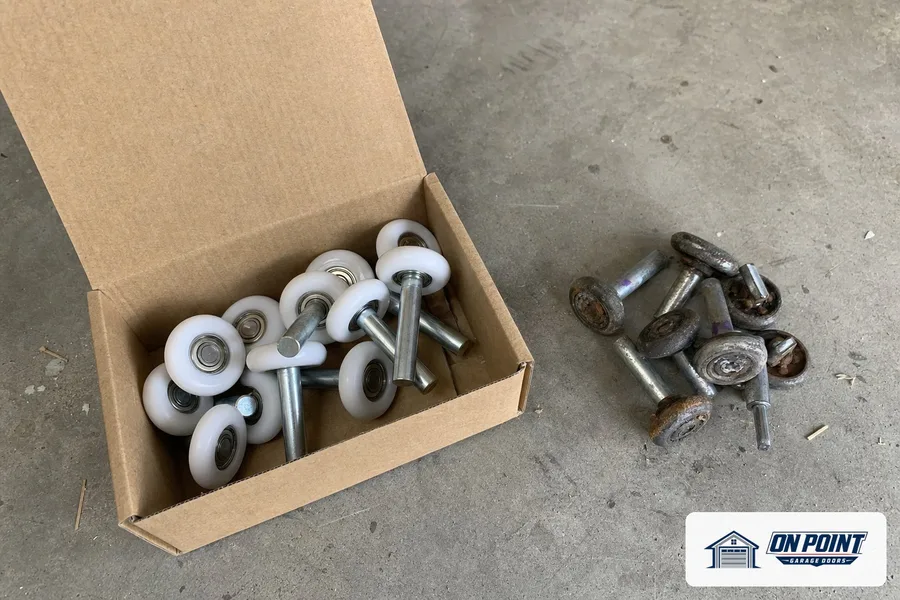
Most doors come with plain steel rollers or basic plastic ones. Over the years the wheels flatten, crack or lose their bearings, and the door bumps over each worn spot.
Sealed nylon rollers with ball bearings run smoothly and quietly for a long time. Replacing a full set is one of the simplest ways to make an old door feel new.
The vertical tracks must be plumb and parallel, and the horizontal tracks must meet them cleanly at the curve. A small knock from a car or a loose bracket throws that off.
The technician checks the full run of both tracks, not only the spot where it catches, and secures every bracket so the door stays aligned.
These make the door move in surges even when the door itself is fine. The door is checked first, then the opener, so the right part gets fixed.
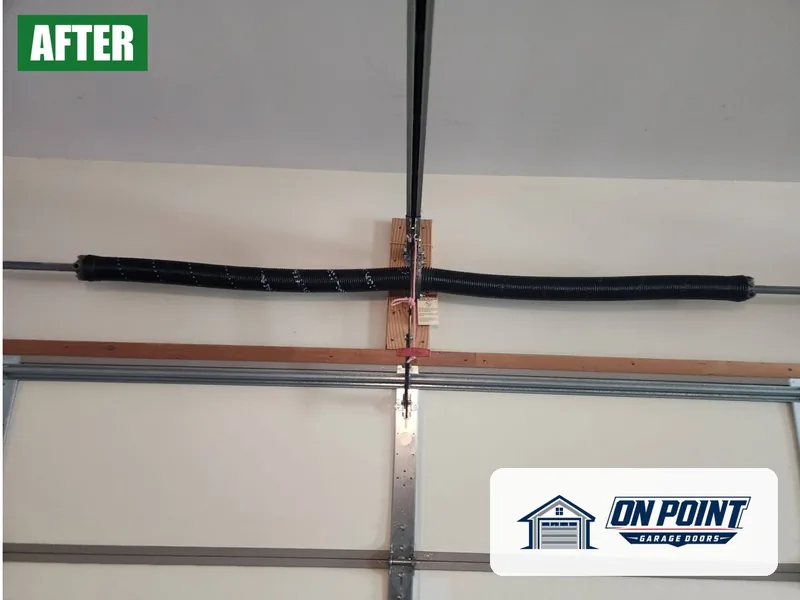
When a door rises in jerks and one side is ahead of the other, the cause is often a cable or spring on one side. On extension-spring doors each side has its own spring, so a weak one shows up as a crooked lift.
On torsion doors, a cable that has slipped on its drum does the same. Either way, the door should be left down until it is checked, because an uneven door can come off its tracks.
A healthy door lifts evenly, makes a steady low sound from the opener, and stays where it is if stopped halfway. It does not drift down or shoot up.
After the repair, the technician runs the door through its full travel, checks it stays put halfway, and tests the safety reverse, so you can see and hear the difference.
A car that bumps the door or the track can bend a section or twist the track just enough to make the door catch. The damage is not always visible from the outside.
Any door that started jerking after a bump is checked along its full track run and at every hinge before it is used again.
Usually worn rollers, a bent or loose track, a cracked hinge, or a spring that is losing strength. Each makes the door catch instead of rolling smoothly.
Yes. When the spring stops carrying its share of the weight, the opener pulls in surges, and the door rises in jerks.
It can be. A door that catches in a bent track can come off it, and a weak spring can break. Have it checked before it gets worse.
Usually yes. Rollers wear at the same rate, and replacing them all makes the door run evenly.
Yes. You hear what is causing it and what the fix involves before any work starts.
Across Brooklyn, Queens and Long Island, tell us what the door is doing and we set a visit that fits your day.
Free estimate, call (929) 429-2429.
Tell us what the door is doing and we will give you an honest arrival time. The estimate is free.
Easier to explain by phone? Call (929) 429-2429.
Tell us what the door is doing. The estimate is free either way.