Takes 30 seconds. We call you back to set a time.
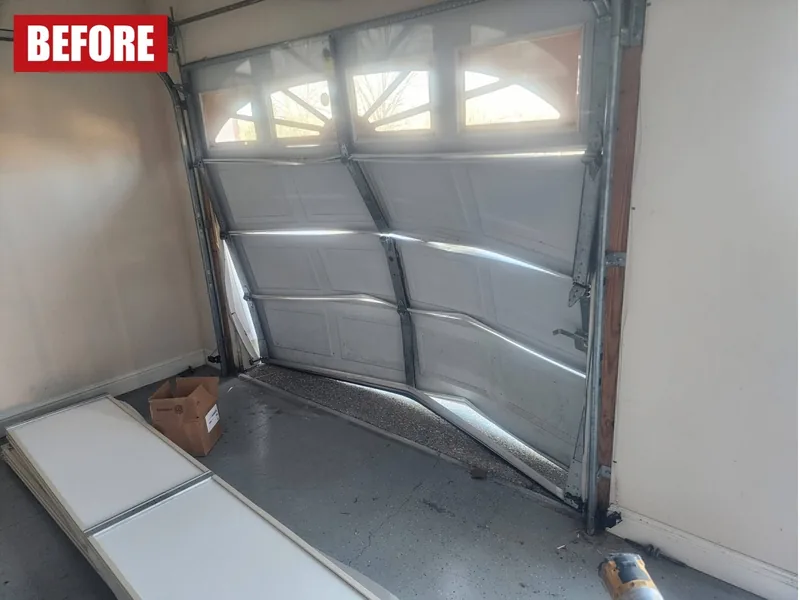
It happens to careful drivers every week: backing out before the door is fully up, a foot slipping off the brake, a teenager learning to park, a delivery truck turning in the driveway. A garage door that has been hit may look only dented, but the impact can bend the tracks, crack hinges, twist the sections and knock the door out of its rollers. Running it in that state can make the damage much worse. Free estimate at (929) 429-2429.
By Sean Cohen, owner, On Point Garage Doors · Updated
These photos are from our own jobs, with our logo on them.


A dent in the bottom section is the obvious part. Behind it, the impact may have bent the track on one side, cracked hinges higher up the door, popped rollers out of the track, twisted a strut or pulled the track brackets away from the wall. On some doors the cables or bottom brackets are affected too.
A door hit while it was open usually takes the damage at the bottom section and the lower track. A door hit while closing, or a car that backed out under a door coming down, can bend the bottom and middle sections and twist the whole door. Each is checked differently.
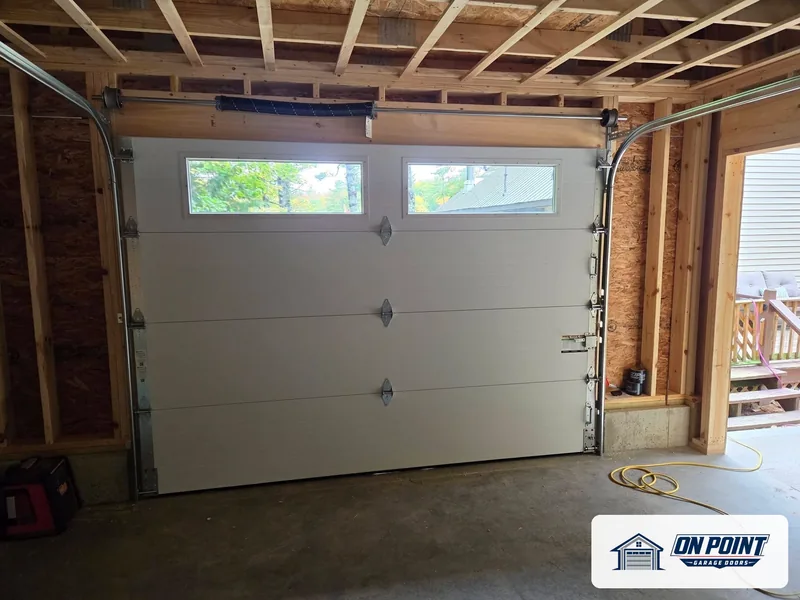
On many doors, a single damaged section can be replaced if a matching section is still made for that door model and color. That is often much less work than a new door. If the door is old or the match is no longer available, a new door is explained with a free estimate.
Bent track is straightened or replaced, and the tracks are set back in line and parallel. Cracked hinges and bent rollers are replaced. If a track bracket pulled out of the wall, it is anchored into solid framing again.
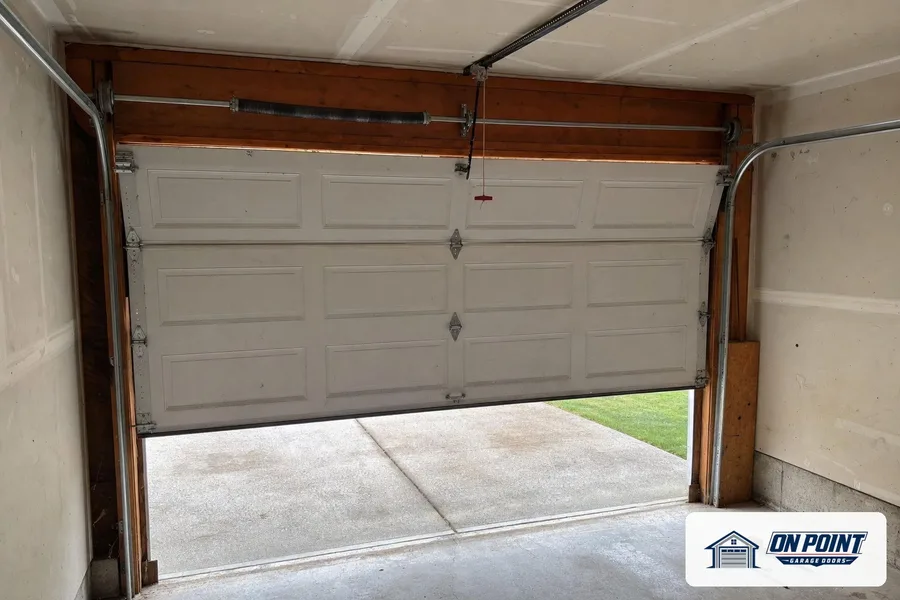
A hard hit can throw a cable off its drum or strain the springs. The springs and cables are checked and the door is balanced. The opener is tested too, because it may have tried to drive the damaged door and strained its gear or reversed with too much force.
You get a clear written description of the damage and the repair, with photos of what was hit. We repair the door; we do not handle insurance claims.
A car that clips the side of the opening can crack a jamb or push it out of line even if the door looks fine. The door then rubs or binds on that side. The jamb, the track and the door are checked together.
Loading doors and storefront gates get hit by trucks and forklifts. Bent bottom bars, guides, slats and sections are repaired or replaced, and the operator and safety devices are tested before the door goes back into service.
The technician secures the door, inspects the sections, hinges, rollers, tracks, cables, springs, frame and opener, and explains what can be repaired and what must be replaced, with a free estimate. After the repair, the door is balanced, run several times and the safety reverse is tested.
In row houses and attached homes with short garages, cars often stop inches from the door, and a small misjudgment means a bent bottom section. A parking aid on the wall or the floor, and an opener light that comes on with the door, cut those bumps sharply.
Sometimes nobody was driving: a car left in neutral or on a slope rolls into the closed door. The door takes the hit across its middle sections, often bending struts and hinges as well as the panels. The same rule applies: leave it closed and have it checked before it moves.
Stop using the opener, keep clear, do not force the door, take photos and call.
It is better not to. Hidden damage to tracks and hinges can get worse every time it runs.
Often, if a matching section is still made. Otherwise a new door is the option.
Yes. You see what is damaged and the options before any work starts.
Across Brooklyn, Queens and Long Island, tell us what the door is doing and we set a visit that fits your day.
Free estimate, call (929) 429-2429.
Tell us what the door is doing and we will give you an honest arrival time. The estimate is free.
Easier to explain by phone? Call (929) 429-2429.
Tell us what the door is doing. The estimate is free either way.