Takes 30 seconds. We call you back to set a time.
Detached garages at the back of the lot are common on older homes in Brooklyn, Queens and Long Island. They are often older than the house's other updates, built with wood framing that has taken decades of weather, and sometimes reached by a long narrow driveway. Choosing a door for a detached garage starts with the building itself. Free estimate at (929) 429-2429.
By Sean Cohen, owner, On Point Garage Doors · Updated
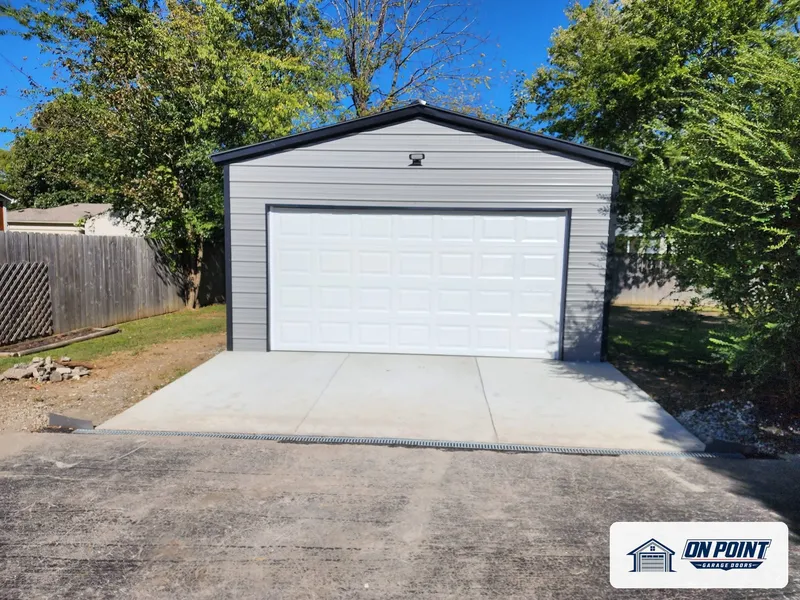
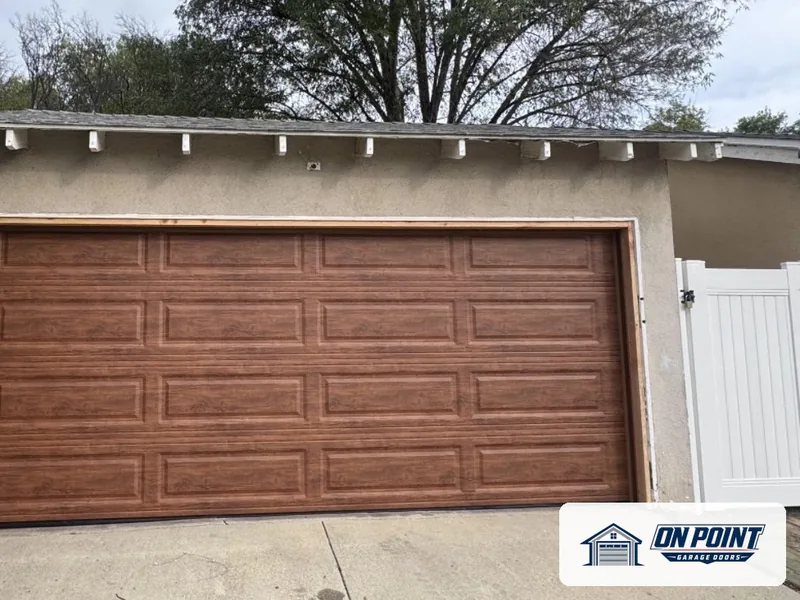
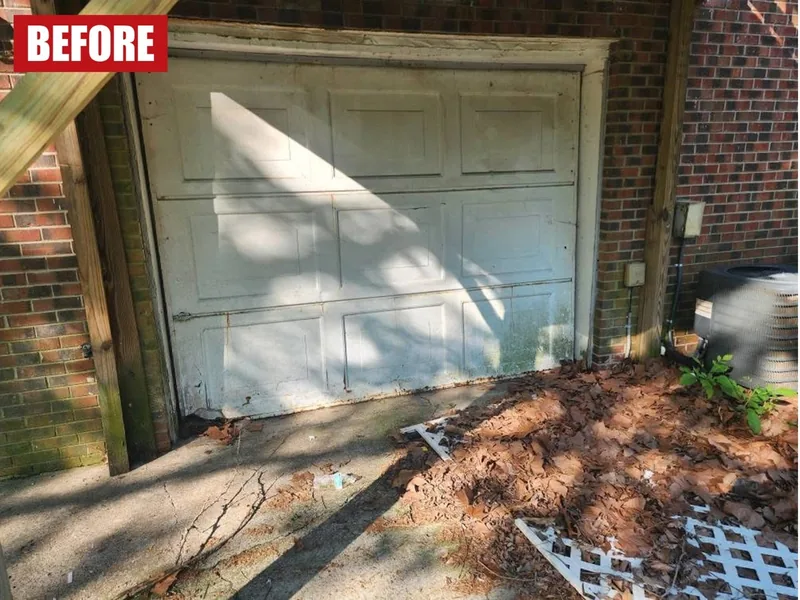
These photos are from our own jobs, with our logo on them.


An unheated detached garage rarely needs a heavily insulated door for warmth. A sturdy steel door with a good finish is often enough. Owners who use the garage as a workshop, a studio or a gym, or who want a quieter, stiffer door, often choose insulation anyway.
Carriage-style doors suit the many detached garages that once were carriage houses or sheds. Simple raised panel steel doors suit utility garages. Wood-look doors give the look of wood without the swelling and rot that damp detached garages bring to real wood.
Detached garages are often damp, with water running toward the door from the yard or the driveway. The bottom section, the cables, the bottom brackets and the lowest track rust first. A good bottom seal, galvanized parts and a slab that sheds water help a door last.
A detached garage needs power for an opener, and some do not have an outlet near the ceiling. That is planned before the install. A strong chain or belt drive suits most detached garages. If you want phone control, the Wi-Fi signal at the back of the lot is checked first, because it is often weak.
Old detached garages often have openers without safety sensors, or extension springs with no safety cables. Both are fixed: sensors are added or the opener replaced, and safety cables go through extension springs so a broken spring cannot fly across the garage.
Many detached garages are reached by long narrow driveways, and cars pass close to the jambs. A jamb clipped by a mirror or a bumper can push a track out of line. Jambs and tracks are checked together, and guards can be added where cars rub.
Heavy wood doors on detached garages swell in humid weather, stick in winter and rot at the bottom. Replacing them with a lighter steel or composite door takes strain off the springs and opener and ends the yearly painting.
The technician checks the frame, the header, the slab, the power and the Wi-Fi signal, measures the opening and shows you the doors and openers that suit your garage, with a free estimate. Frame repairs, if needed, are included in the estimate.
Putting a new door into a rotted frame means it will bind and leak within a season. Fixing the building first is what makes a new door on a detached garage last. We tell you plainly what the frame needs before anything is ordered.
A detached garage at the back of the lot is out of sight from the house, which makes security matter. A door with a strong bottom section, a proper lock, an opener with rolling codes and a shield over the emergency handle keeps it secure. A phone alert when the door opens is a simple extra layer.
Walking to a detached garage after dark is easier with a motion light outside and a bright opener light inside. Many new openers have strong built-in lights that switch on when the door moves. Those are worth having on a garage at the end of a dark yard.
Many detached garages still have a one-piece tilt-up door with big side springs. Those springs are dangerous when they break, and the door leaves gaps on every side. A sectional door is safer, seals better and works with a modern opener.
Many detached garages are now workshops, studios or storage. For those, a door with windows for daylight, insulation for comfort and a quiet opener makes the space far more pleasant to use.
Usually a sturdy steel or carriage-style door. Insulation is optional unless the garage is used as a workspace.
Often the frame has rotted, the header has sagged or the slab has settled.
Yes, if the Wi-Fi reaches. The signal is checked first.
Yes. Every opener should have working sensors. They are added or the opener is replaced.
Yes. You see what the building and the door need before any work starts.
Across Brooklyn, Queens and Long Island, tell us what the door is doing and we set a visit that fits your day.
Free estimate, call (929) 429-2429.
Tell us what the door is doing and we will give you an honest arrival time. The estimate is free.
Easier to explain by phone? Call (929) 429-2429.
Tell us what the door is doing. The estimate is free either way.