Takes 30 seconds. We call you back to set a time.
A canopy garage door is a single solid panel that swings up and over when it opens. Unlike most doors, it does not disappear fully into the garage. About a third of it ends up sticking out past the front wall, over the driveway, like a little roof. That overhang gives the door its name. Canopy doors are still found on older homes in our area, often on detached garages behind the house. This page explains how they work, how they differ from the other one-piece design, and when replacing one makes sense. Free estimate at (929) 429-2429.
By Sean Cohen, owner, On Point Garage Doors · Updated
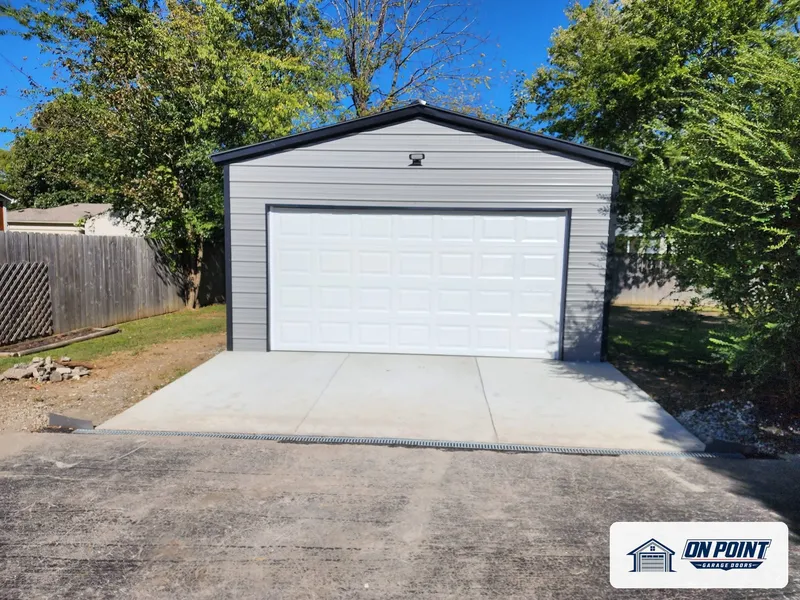
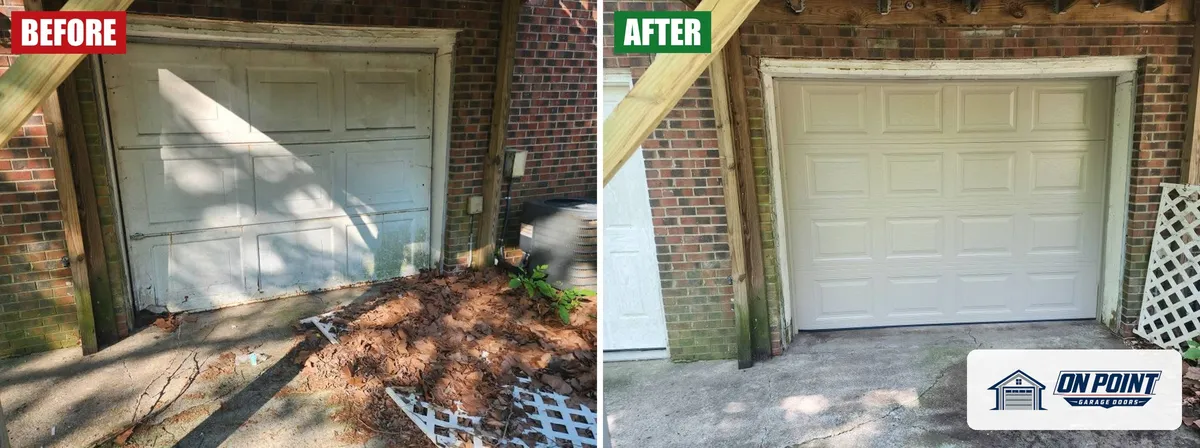
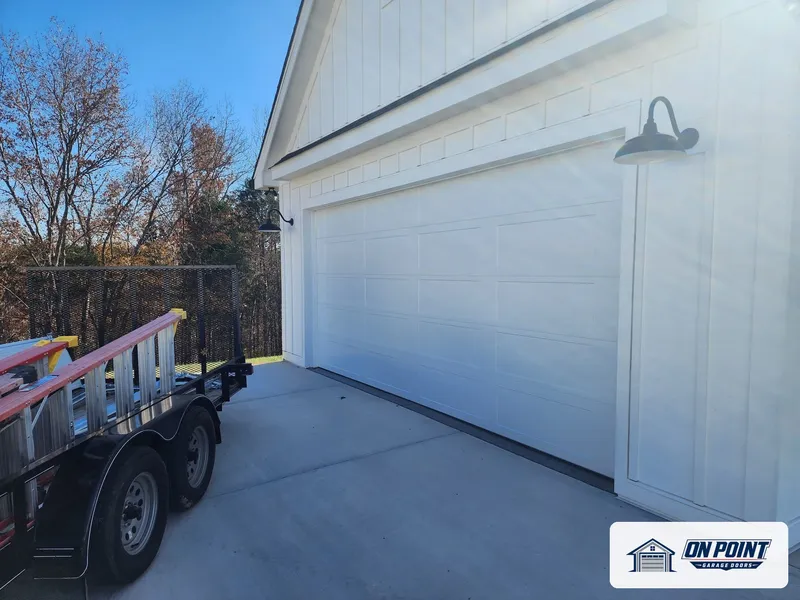
These photos are from our own jobs, with our logo on them.


The door hangs on pivot arms fixed to the sides of the frame. When you lift it, the bottom swings out and up while the top slides back into the garage. Springs on the pivot arms carry most of the weight. At the fully open point, the door sits level, partly inside and partly outside the opening.
Canopy doors need very little room inside the garage, since there are no long tracks running back along the ceiling. That made them popular on small garages and on garages with storage or lofts overhead. The single panel also gives a clean look with no section lines.
The pivot hardware is where most trouble starts. Springs wear and lose tension, so the door gets heavy and drops when you let go. Pivot arms bend, so one side of the door sits lower than the other. On wood canopy doors, the bottom edge rots and the frame flexes, and the door rubs the opening as it swings.
The springs on a canopy door are stretched hard when the door is closed. If a spring or its mounting gives way, it can snap with real force. Never try to adjust or remove one. If a spring is broken or hanging loose, leave the door alone and call for a check. Our page on garage door spring safety explains why.
Yes, with the right arm and bracket for a door that swings rather than rolls. The opener must be set carefully, because the door travels in an arc and the forces change through the swing. Many older canopy doors were never meant for an opener and get heavier to lift as they age, so the door has to be balanced first.
If the panel is rotted, cracked or badly bent, or the pivot hardware is worn out and parts are hard to find, a new door is often the better choice. Most canopy openings can take a sectional door, which rolls up inside and leaves the driveway clear. Our page on replacing a one-piece door explains what the change involves.
A sectional door needs head room above the opening for the spring and track, and side room for the vertical tracks. Garages built for canopy doors sometimes have neither. Low headroom tracks or a roll-up door can solve a tight opening. The frame may also need repair before the new door goes in.
Some owners like the flat face of the old door. Flush steel doors, carriage-style doors and wood-look doors can all keep a similar look while working far more safely. On a detached garage behind a classic house, a carriage-style sectional door is a common choice.
Many canopy doors we see hang on small detached garages at the end of a long driveway, built when cars were narrower. Those openings are often tight, the framing has settled, and the door has been patched more than once. We check whether the opening is still square and whether the frame can hold new hardware before suggesting anything.
The technician checks the door, the pivot hardware, the springs and the opening, then explains whether repair or a new door makes more sense. You get a free estimate before any work starts.
A one-piece door that tilts up on pivot arms and leaves part of itself sticking out past the house when open.
A retractable door slides fully into the garage on tracks. A canopy door stays partly outside.
Yes, with the right arm and bracket, once the door is balanced.
Usually, yes. The opening may need some framing work and the right tracks for the head room.
Yes. We look at the door and the opening before any work starts.
Across Brooklyn, Queens and Long Island, tell us what the door is doing and we set a visit that fits your day.
Free estimate, call (929) 429-2429.
Tell us what the door is doing and we will give you an honest arrival time. The estimate is free.
Easier to explain by phone? Call (929) 429-2429.
Tell us what the door is doing. The estimate is free either way.