Takes 30 seconds. We call you back to set a time.
Garage door springs do not last forever. They are made to twist or stretch a certain number of times before the steel fatigues and breaks. How long that takes depends far more on how often your door moves than on how many years have passed. A spring on a door used as the family's main entrance can wear out several times faster than one on a door that opens on weekends. Free estimate at (929) 429-2429.
By Sean Cohen, owner, On Point Garage Doors · Updated
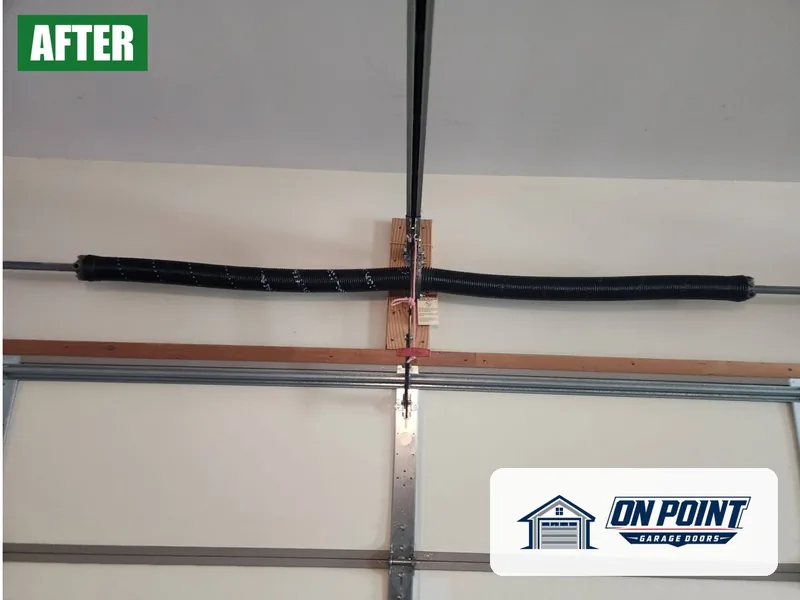
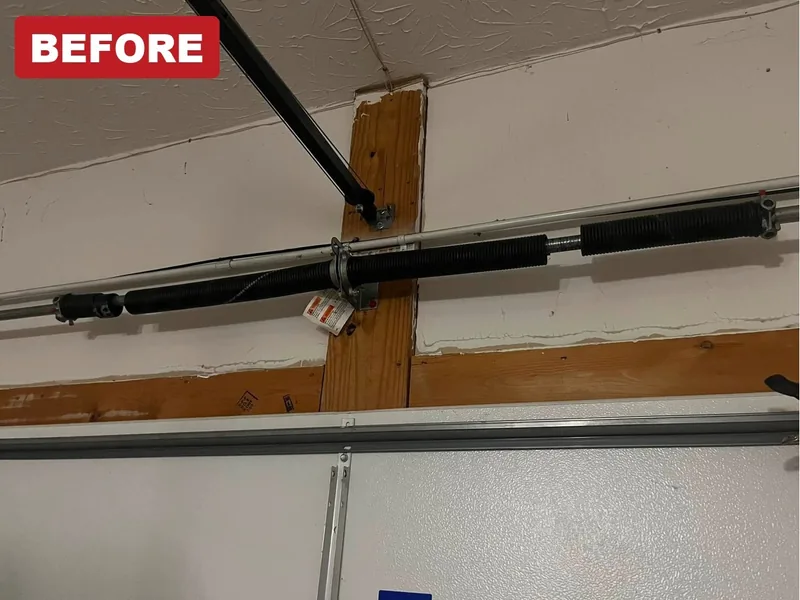
These photos are from our own jobs, with our logo on them.


A cycle is one open and one close. Standard springs are built for a certain number of cycles, and longer-life springs are built for several times more. Once a spring reaches the end of its life, the steel fails, usually with a loud bang.
That is why two houses with the same door can have very different spring lives: one opens the garage a few times a week, the other a dozen times a day.
Torsion springs sit on a bar above the door and twist to lift it. Extension springs run along the tracks on each side and stretch. Both are rated in cycles. Torsion springs give smoother, more balanced lifting and are the standard on most doors we service; extension springs are common on older and lighter doors.
Extension springs should always have safety cables through them, so a broken spring cannot whip across the garage.
Most doors with two springs had both installed together, so both have done the same number of cycles. When one breaks, the other is close behind. Replacing both at once keeps the door balanced and saves a second visit soon after.
If your door is used often, longer-life springs are usually worth it. They are made from heavier wire and longer coils, so each cycle stresses the steel less and the spring lasts much longer. The technician can tell you how often your door moves and whether the upgrade makes sense for your household.
Springs hold enough force to lift the whole door, and that force is released in a flash when they are handled wrong. Every year people are hurt adjusting springs. This is a job for a trained technician with the right tools.
When a door is replaced, new springs are sized to the new door's weight. Reusing old springs on a new door is one of the most common reasons we find a door that is heavy, uneven or hard on its opener. A heavier insulated door or a door with glass needs stronger springs than the thin door it replaced.
If you added insulation panels, windows or decorative hardware to an existing door, the springs may also need to be resized, because every pound added changes the balance.
Salt air and damp garages make springs rust, and rust eats into the steel and shortens its life. Coated or galvanized springs and a yearly look at the coils help on homes by the bay and the canals. Rust on the coils is a good reason to have the springs checked before they fail.
When a torsion spring snaps, the door usually stays closed and becomes too heavy to lift. The opener may hum, strain or lift the door a little and stop. Please do not keep trying the opener, and do not try to lift the door by hand. Keep clear of the springs, and call. If a car is trapped inside, tell us so the technician knows the situation.
The technician weighs the door, sizes the springs to it and your use, replaces both springs where there are two, checks the cables, drums, bearings and rollers, balances the door and tests the opener's force and the safety reverse. You get a free estimate before any work starts.
It depends on use. Springs are rated in open-and-close cycles, so a door used many times a day wears its springs out much sooner than one used a few times a week.
A heavy door, an uneven door, rust or stretched coils, and a straining opener are the common signs.
Yes, on doors with two springs. They wear together, and the second usually fails soon after the first.
For doors used often, yes. They last several times longer than standard springs.
Yes. You see the options before any work starts.
Across Brooklyn, Queens and Long Island, tell us what the door is doing and we set a visit that fits your day.
Free estimate, call (929) 429-2429.
Tell us what the door is doing and we will give you an honest arrival time. The estimate is free.
Easier to explain by phone? Call (929) 429-2429.
Tell us what the door is doing. The estimate is free either way.