Takes 30 seconds. We call you back to set a time.
Garage door openers are reliable machines, and many run for years without trouble. How long yours lasts depends on the kind of opener, how many times a day it runs, how heavy the door is, and above all whether the door's springs are doing their job. An opener that guides a balanced door can last far longer than one that has been lifting a heavy door every morning. Free estimate at (929) 429-2429.
By Sean Cohen, owner, On Point Garage Doors · Updated
These photos are from our own jobs, with our logo on them.


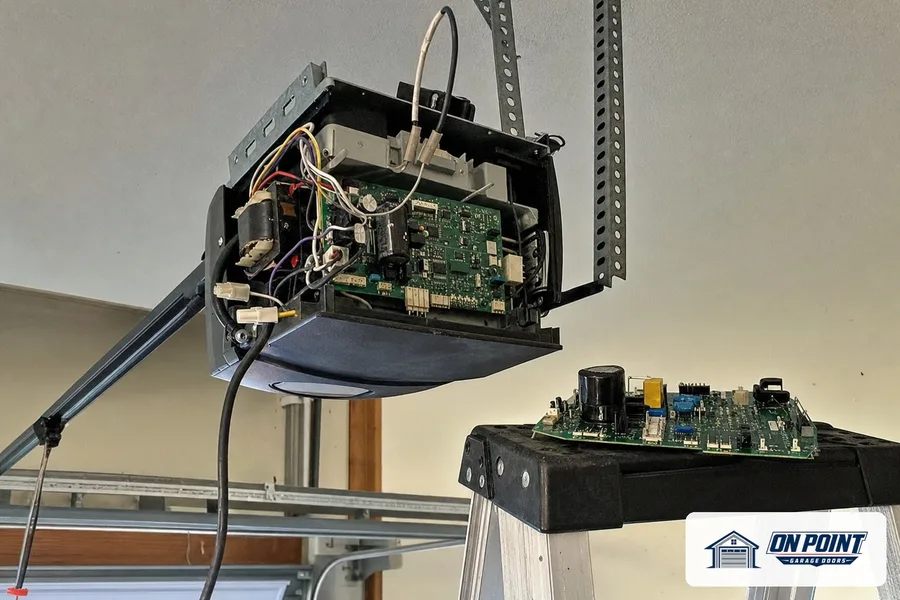
Gears, sprockets, belts and chains, capacitors, sensors, wall controls, remotes and many boards can be replaced. When the rest of the opener is sound and parts are available, a repair often gives it years more life.
If the opener has no safety sensors, uses fixed-code remotes, needs a board that is no longer made, or needs several parts at once, a new opener is usually better. A new opener also brings quiet operation, phone control, battery backup and soft start and stop.
Openers made before safety sensors were required cannot stop the door from closing on a person or pet. If yours has no small sensors near the floor beside the door, replacing it is worth doing regardless of age.
Old openers with fixed codes can be copied, and their remotes are a security risk if lost. Rolling-code openers change the code every time, which is far safer.
Before replacing an opener, the door's springs and balance are checked. Putting a new opener on a door with weak springs means the new one will wear out early too. Often the right repair is springs first, opener second.
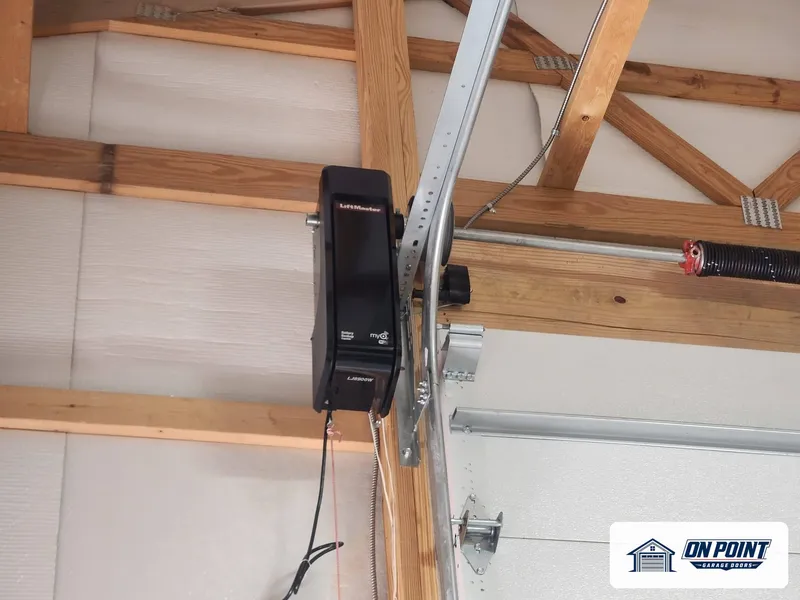
Chain drives are tough but wear their chain and sprocket. Belt drives are quieter and wear their belt over many years. Screw drives wear the carriage on the rod. Wall-mounted openers have fewer moving parts outside the unit and tend to wear slowly on a balanced door.
The technician tests the door's balance, checks the opener's drive, gear, board, sensors and remotes, and tells you plainly whether a repair or a new opener makes more sense, with a free estimate on both.
Belt drives suit attached garages and rooms above; wall-mounted openers suit low ceilings and garages with storage; chain drives suit detached garages. Battery backup and phone control are available on most new models.
Detached garages and garages with damp floors are hard on opener electronics, and very hot garages are hard on batteries and boards. A dry, solid mount and a protected outlet help. If your opener has failed after rainy weeks or a heat wave, the environment may be part of the reason.
Remotes lose range as their batteries and buttons wear, and outside keypads wear out from weather. Replacing them is simple and often makes an older opener feel new again.
Commercial operators on shop, warehouse and parking doors are built for many more cycles than home openers, but they still wear. Regular service of the brake, limits, drive and safety devices keeps them running and catches problems before the door stops during business.
An older opener in good working order can often get phone control and alerts with a smart add-on. If it is too old for that, a new opener with Wi-Fi built in is the way to get it.
Many openers that seemed to die of old age were actually finished off by a power surge during a storm. A surge protector on the opener outlet is simple protection for the board and the power supply.
A new opener comes with new remotes, and old ones are cleared so they no longer work.
Many run for years. A balanced door, moderate use and protection from surges make them last longest.
Usually the drive gear, the chain or belt, or the board after a power surge.
Yes. It cannot stop the door from closing on a person or pet.
Yes. They make the opener lift weight the springs should carry.
Yes. You see repair and replacement options before any work starts.
Across Brooklyn, Queens and Long Island, tell us what the door is doing and we set a visit that fits your day.
Free estimate, call (929) 429-2429.
Tell us what the door is doing and we will give you an honest arrival time. The estimate is free.
Easier to explain by phone? Call (929) 429-2429.
Tell us what the door is doing. The estimate is free either way.