Takes 30 seconds. We call you back to set a time.
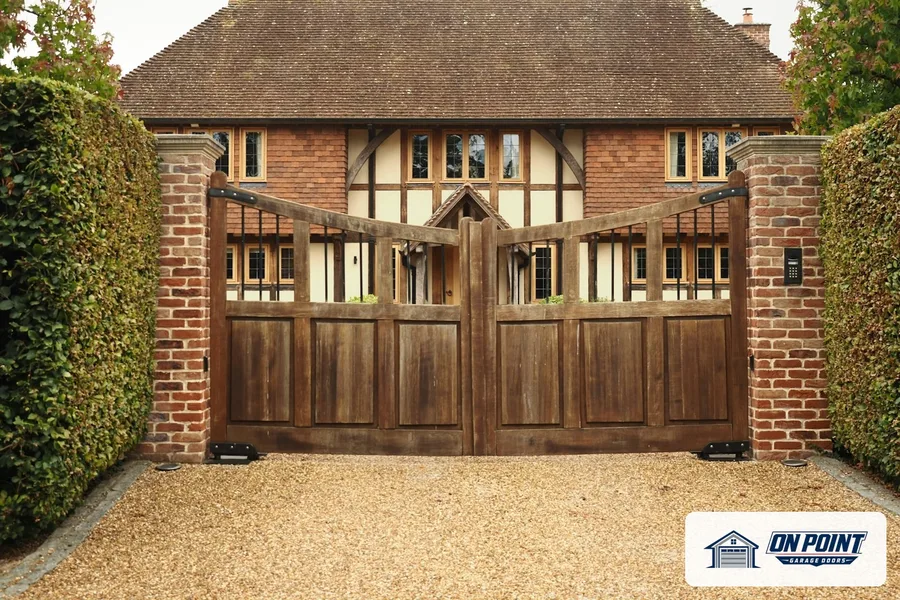
A swing gate hangs from one side and has to hold its own weight out in the air every day, in wind, rain and frost. Over time almost every swing gate starts to drop at the far end. It drags on the driveway, stops lining up with its latch or with the other leaf, and an automatic gate starts to stop halfway. Most of these problems start with the hinges, the post or the frame, not with the motor. This page covers what goes wrong on manual and automatic swing gates and how we track down the cause. Free estimate at (929) 429-2429.
By Sean Cohen, owner, On Point Garage Doors · Updated
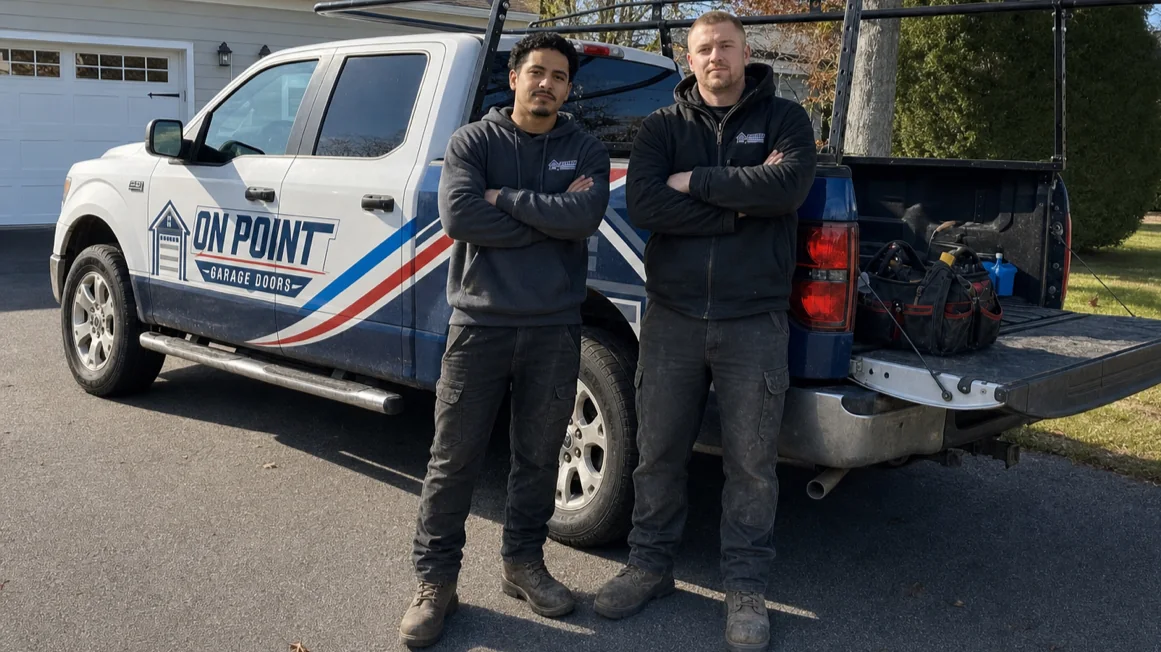
These photos are from our own jobs, with our logo on them.


All the weight of the leaf hangs from two or three hinges on one post. That puts the top hinge in pull and the bottom hinge in push, and it tries to tip the post toward the opening. If the hinges wear, the post leans or the frame racks out of square, the latch end drops. Wide leaves and heavy wood or steel gates sag sooner than short, light ones.
A gate that keeps sagging after the hinges are changed usually has a post that is moving. Wood posts rot at the ground. Steel posts set in shallow concrete lean as frost pushes the ground up and down each winter. Brick and stone pillars can crack around the hinge anchors. We check the post and its footing before touching the gate, because a new hinge on a leaning post buys very little time.
Hinges wear at the pin, rust solid or pull out of the post. Some gates have simple strap hinges that were never meant for the weight. On the gate itself, welds crack at the corners, wood joints open up and the diagonal brace that keeps the frame square comes loose. We replace worn hinges with ones sized for the leaf, add or repair bracing and straighten the frame where it can be done.
Dragging can be the gate dropping, but it can also be the ground rising. Pavers heave, driveways get a new layer of asphalt and frost lifts the slab under the swing path. A dragging gate scrapes its bottom, strains the hinges and makes a motor stop and reverse. We find out whether the gate came down or the ground came up, because the fix is different.
When the latch end drops or the post moves, the latch, the drop rod or the electric lock stops lining up. Double gates stop meeting in the middle. People start lifting the gate to close it, which wears everything faster. Once the gate is hanging true again, we reset the latch, the center stop and any lock so they meet cleanly.
Swing gates are opened by arm-style operators that push and pull the leaf, by jointed arms on a post, or by motors buried under the hinge. A sagging or dragging gate is the most common reason these operators stop halfway, reverse or wear out early. The operator senses the extra effort and backs off as a safety step. That is why we look at how the gate swings by hand before testing the motor.
Swing gates catch the wind like a sail. A gust can push an automatic gate hard enough to trip its obstruction sensing, and it can slam a manual gate into its stop. Double gates feel it twice. Good gate stops, a solid center stop and an operator set for the gate size help. On very windy sites we may suggest a lighter style of leaf.
A swinging leaf can pin a person against a wall or a car. Automatic swing gates need photo eyes on both sides of the swing path and should stop and reverse when they meet something. We test these on every visit and never turn safety settings down to get a sagging gate to finish its swing. The gate gets fixed instead.
Most swing gates can be rehung, braced and given new hinges. A new leaf makes sense when the frame is rotted or rusted through, or when a heavy gate keeps beating its post and operator. For driveways where a swing gate never had enough room, a sliding gate can be the better answer, and we can talk through that too.
The technician checks the posts, footings, hinges, frame, latch and the ground under the swing, then the operator, the controls and the safety devices if the gate is automatic. You get a written estimate before any parts are ordered, and nothing is started without your approval.
Usually the post is leaning or the hinges are worn. A new hinge on a moving post will not last, so we check the post and footing first.
Often the gate is dragging or binding and the operator is backing off as a safety step. We check the gate by hand before blaming the motor.
Yes. We find out whether the gate dropped or the ground rose, then rehang, adjust or rework it to clear the drive.
We can tell you what we find around the hinge anchors. Badly cracked masonry may need a mason before the gate is rehung.
Yes. We look at the gate, posts and operator before suggesting anything.
Across Brooklyn, Queens and Long Island, tell us what the door is doing and we set a visit that fits your day.
Free estimate, call (929) 429-2429.
Tell us what the door is doing and we will give you an honest arrival time. The estimate is free.
Easier to explain by phone? Call (929) 429-2429.
Tell us what the door is doing. The estimate is free either way.