Takes 30 seconds. We call you back to set a time.
LiftMaster makes more than garage door openers. Its gate operators run driveway gates at homes, lot gates at businesses and entry gates at buildings and shared driveways. There are arm-style operators for swing gates, pad-mounted operators for sliding gates and the heavy Elite Series line for commercial gates. When one of them quits, the cause is often outside the operator: the gate, the battery, the safety devices or the controls. This page covers the faults we see most on these operators and what we check before replacing parts. Free estimate at (929) 429-2429.
By Sean Cohen, owner, On Point Garage Doors · Updated
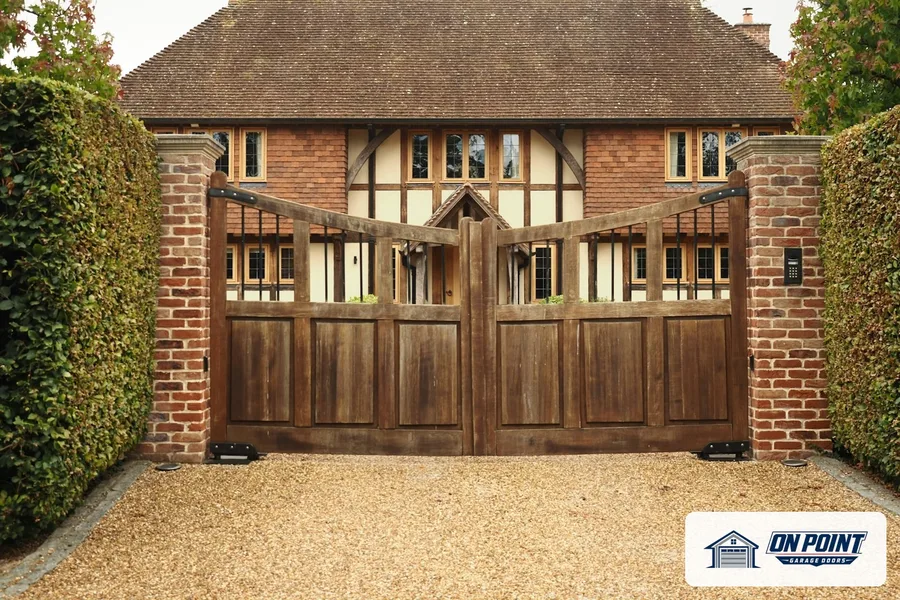
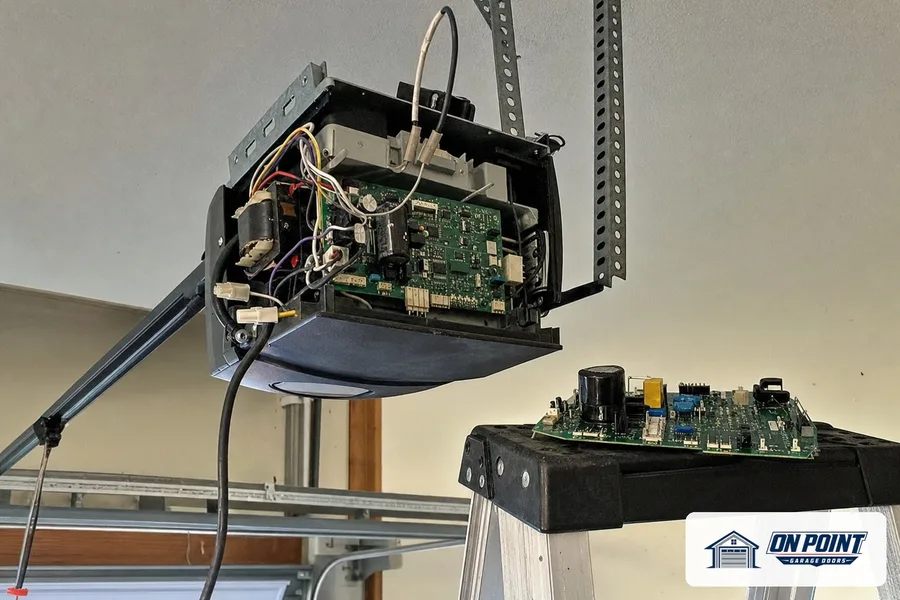
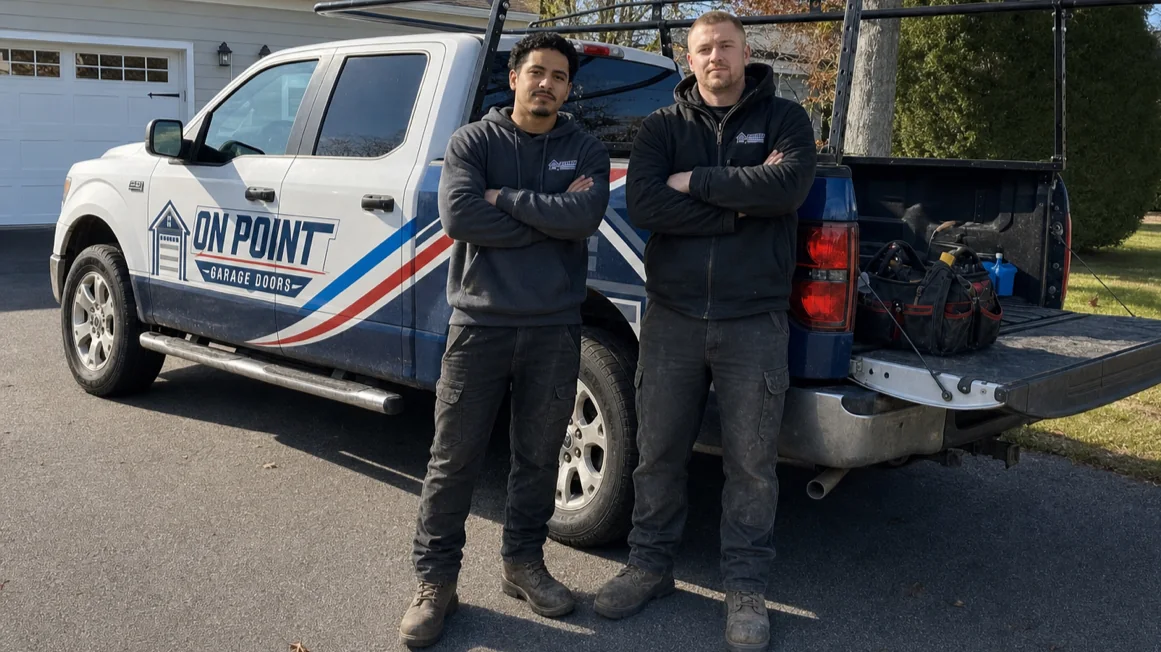
These photos are from our own jobs, with our logo on them.


On homes we mostly see LiftMaster arm operators that push a swing gate open and closed, and smaller pad-mounted slide operators on driveway gates. On businesses and buildings we see the heavier commercial swing and slide operators, including the Elite Series. Many newer ones run on direct current with a battery inside, and many can connect to the myQ app. Older units may still use remotes that newer receivers do not recognize.
LiftMaster gate operators are built to stop and reverse when they hit something. If they meet an obstruction twice in a row without a full cycle in between, they shut down and sound an alarm until they are reset. Owners often think the operator has died, but it is doing its job. The real question is what it hit or what made it think so: a dragging gate, wind, a bad photo eye or an edge with a broken wire. We find that cause before resetting the operator.
Battery-backed operators keep running for a while in a power outage, and solar models run on their battery all the time. When the battery ages, the gate slows, stops partway or will not move at all, often on cold mornings first. A blown fuse, a tripped breaker or a damaged power feed gives the same symptom. We test the battery, the charger or solar panel and the incoming power before looking deeper.
The arm on a swing operator takes every gust of wind and every bump from a car. Brackets bend or pull out of the gate and the post, the arm wears where it slides, and the motor or gearbox inside wears out after years of use. A gate that sags puts extra strain on the arm. We check how the gate swings by hand, then the brackets and the arm, then the motor.
On a slide operator the motor drives a gear against a toothed rack along the gate. When the rack bends, comes loose or wears, the gate jumps or grinds. When the gate rolls hard because of worn wheels or a dirty track, the operator strains and reverses. We look at the rack, the gear and how freely the gate rolls before replacing anything on the operator.
Limits tell the operator where open and closed are. When they drift, the gate stops short, slams at the end or will not close all the way. Some LiftMaster operators learn their limits with a setting routine and some use a sensor that can fail. We reset the limits and check whether something keeps knocking them out, such as a slipping arm or a loose rack.
If the gate works from the operator itself but not from remotes, the trouble is the signal. Batteries die, receivers fail and older remotes do not talk to newer boards. Keypads and telephone entry systems get water in them or lose their codes. myQ needs the gate to stay connected to the internet through its gateway. We test each control on its own to find which link is broken.
Every automatic gate should have photo eyes across its path and edges where it could catch someone. On LiftMaster operators a faulty eye or edge can keep the gate from closing, make it reverse or trigger the alarm. Eyes go out of line, get covered by plants or snow, or lose their wiring. We test each one and never bypass a safety device to get a gate moving.
The control board sits in a box outdoors. Water that gets in, ants that build nests on the board and nearby lightning can all damage it. Symptoms are a gate that acts on its own, does nothing, or shows a fault the operator cannot clear. We check for moisture and pests, test the board and replace it with a matching one when it has failed.
A LiftMaster gate operator that is not too old and has parts available is usually worth repairing. A new operator makes sense when the unit is very old, has failed in several places or is too small for the gate it moves. We tell you which we would choose and why, and the estimate shows both options when both make sense.
The technician checks the gate by hand, the power and battery, the operator, the board, the limits, the safety devices and every control. You get a written estimate before any parts are ordered, and nothing is started without your approval.
It has most likely sensed two obstructions in a row and gone into its alarm mode. We find what caused it, then reset the operator.
An aging battery is the usual cause on battery and solar operators. We test the battery and the charging before anything else.
Many LiftMaster gate operators can work with myQ through a gateway. We check whether yours can and set it up.
Yes. We service LiftMaster commercial swing and slide operators as well as the home models.
Yes. We check the gate and the operator before you decide anything.
Across Brooklyn, Queens and Long Island, tell us what the door is doing and we set a visit that fits your day.
Free estimate, call (929) 429-2429.
Tell us what the door is doing and we will give you an honest arrival time. The estimate is free.
Easier to explain by phone? Call (929) 429-2429.
Tell us what the door is doing. The estimate is free either way.