Takes 30 seconds. We call you back to set a time.
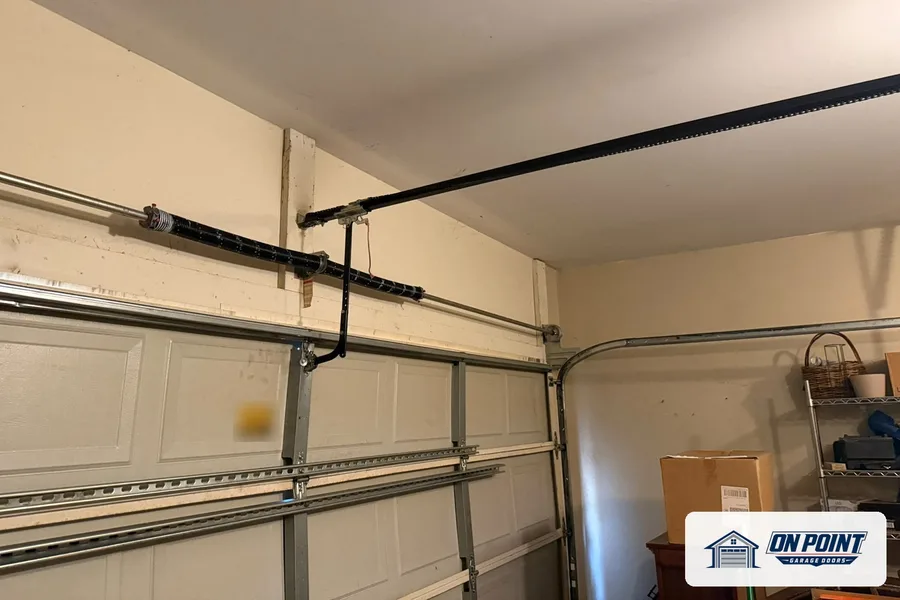
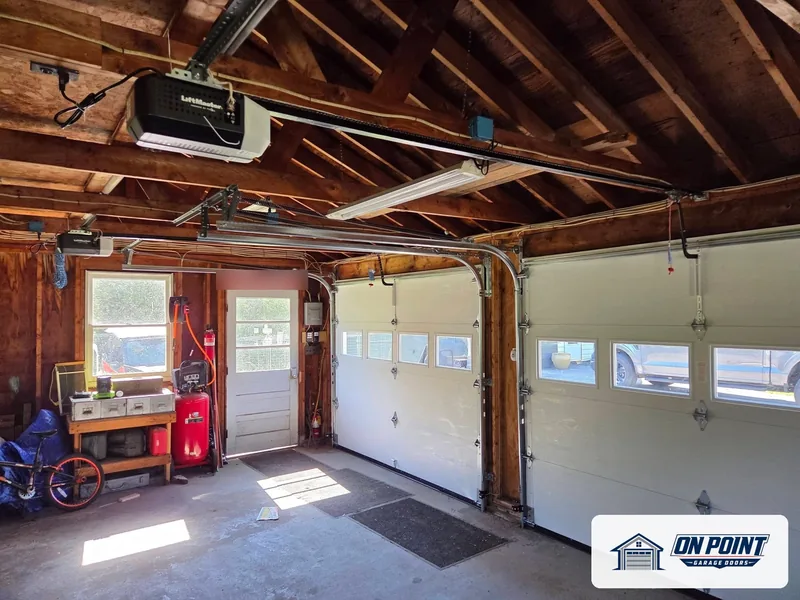
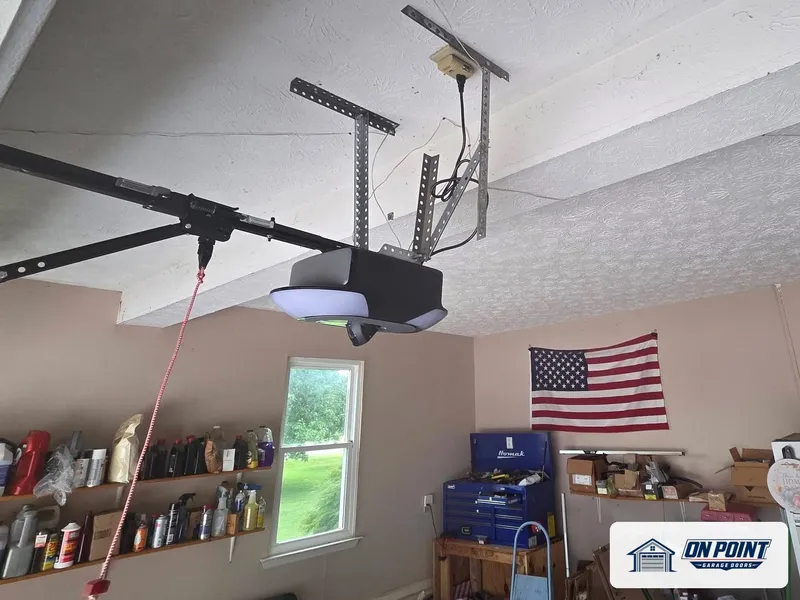
On a ceiling-mounted garage door opener, a long rail runs from the motor to the top of the door. A small carriage called the trolley rides along that rail. The chain, belt or screw moves the trolley, and an arm connects the trolley to the top of the door. When the opener runs, the trolley pulls the door open or pushes it closed. The red emergency release handle hangs from the trolley too. When the trolley breaks or comes loose, the motor can run while the door stays exactly where it is. Free estimate at (929) 429-2429.
By Sean Cohen, owner, On Point Garage Doors · Updated
These photos are from our own jobs, with our logo on them.


The trolley has two parts. The outer carriage is fixed to the chain or belt and is always moving with it. The inner part is attached to the door arm. A latch locks the two together. Pulling the emergency release lifts that latch, so the door can move by hand while the chain keeps its place.
The simplest cause is a trolley that was released and never latched again. After a power outage or a stuck door, people use the emergency release and forget it. Most openers reconnect when the motor runs and the trolley catches up to the latch, but a worn latch or a bent spring inside the trolley can stop it from locking.
Many trolleys are partly plastic. Years of cold winters and hot summers in a garage make plastic brittle, and a door that sticks or is heavy puts extra strain on it. Eventually a piece cracks and the trolley slips under load. A cracked trolley is replaced rather than repaired.
If the chain or belt has come off its sprocket or broken, the trolley stops moving even though the motor hums. Loose chains slap against the rail and can jump teeth. Our pages on opener chain problems and an opener that runs but the door does not move go through those causes.
An opener is meant to guide a balanced door, not lift dead weight. When springs are weak or broken, the trolley and arm take the full weight of the door. That strain cracks trolleys, bends door arms and strips gears. If a trolley keeps breaking, the springs are the first place we look.
Between the trolley and the door, the arm and the bracket on the top section take a lot of force. A bent arm or a bracket pulled loose from the door can look like trolley trouble. On older doors, the top section can crack where the bracket is fastened, and a reinforcing strut is often added.
The rail itself can sag if its hanger from the ceiling is loose, or bend if something heavy hit it. A trolley riding on a bent rail binds and wears quickly. The rail must be straight and firmly hung for the trolley to slide smoothly.
The trolley is built a little differently on each kind of opener. On chain and belt openers it is clamped to the drive and slides along the rail. On screw drive openers it rides on a long threaded rod and wears along with the rod. Trolleys are made for one brand and one style of rail, so a replacement has to match the opener exactly, not just look similar. The technician brings the right part for your model or tells you when it is no longer made.
Trolleys and rails are available for most current openers, so a broken trolley is often a simple repair. On a very old opener, parts may no longer be made, and the trolley may be only one of several worn parts. In that case a new opener can make more sense, and the technician will tell you plainly which way they would go.
If the trolley is broken but the door is balanced, the door can usually be opened and closed by hand. If the door feels very heavy, leave it closed and do not prop it, since a heavy door often means a spring problem that should be checked first.
The technician checks the trolley, the rail, the chain or belt, the arm and the springs, and explains what needs work. You get a free estimate before any work starts.
The carriage that rides along the opener rail and connects to the door through an arm.
Often the trolley is released, cracked or slipping, or the chain or belt is off the sprocket.
On most openers it latches again when the motor runs. If it does not, the latch may be worn and should be checked.
Usually the door is too heavy because of weak springs, so the trolley takes the weight.
Yes. We check the opener and the door before any work starts.
Across Brooklyn, Queens and Long Island, tell us what the door is doing and we set a visit that fits your day.
Free estimate, call (929) 429-2429.
Tell us what the door is doing and we will give you an honest arrival time. The estimate is free.
Easier to explain by phone? Call (929) 429-2429.
Tell us what the door is doing. The estimate is free either way.