Serving Brooklyn, Queens and Long Island(929) 429-2429Open six days a weekFree estimateGuaranteed work
On Point Garage Doors
Open 24 hours Sun-Thu, Fri until 5 pm Free estimate Springs, openers, cables We come to you
Emergency?Call nowBook free estimate
New York, NY - open six days a week

Garage door opener parts: what wears out and why

Free estimateSame-day serviceCommon parts on board
  • Free estimate
  • Same-day service
  • Common parts on board
Emergency garage door repair★★★★★ 5.0 on Google · 42 reviews

Book your free estimate

Takes 30 seconds. We call you back to set a time.

Or just call (929) 429-2429 and talk it through.

Home › Garage Door Opener Parts

A garage door opener looks like one box on the ceiling, but it is a set of parts that each do one job. A motor turns a gear, the gear drives a chain, belt or screw, a trolley pulls the door, a circuit board decides when to start and stop, and sensors and remotes tell the board what is happening. When an opener fails, it is usually one of those parts and not the whole thing. This page walks through each part, how it fails and how we decide between a single part and a new opener. Free estimate at (929) 429-2429.

By Sean Cohen, owner, On Point Garage Doors · Updated

Real jobs. Real photos.

These photos are from our own jobs, with our logo on them.

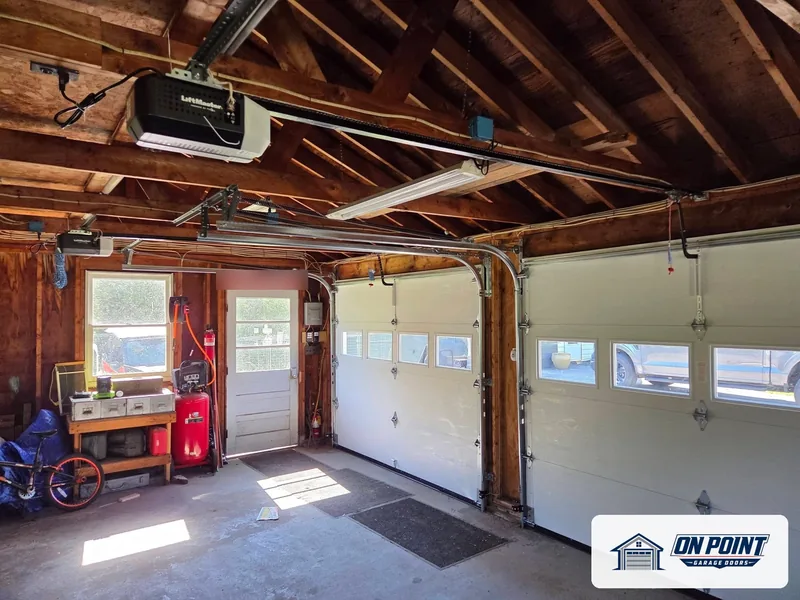
Garage door opener on the ceiling above two new doors, an On Point Garage Doors job
Opener motor and rail
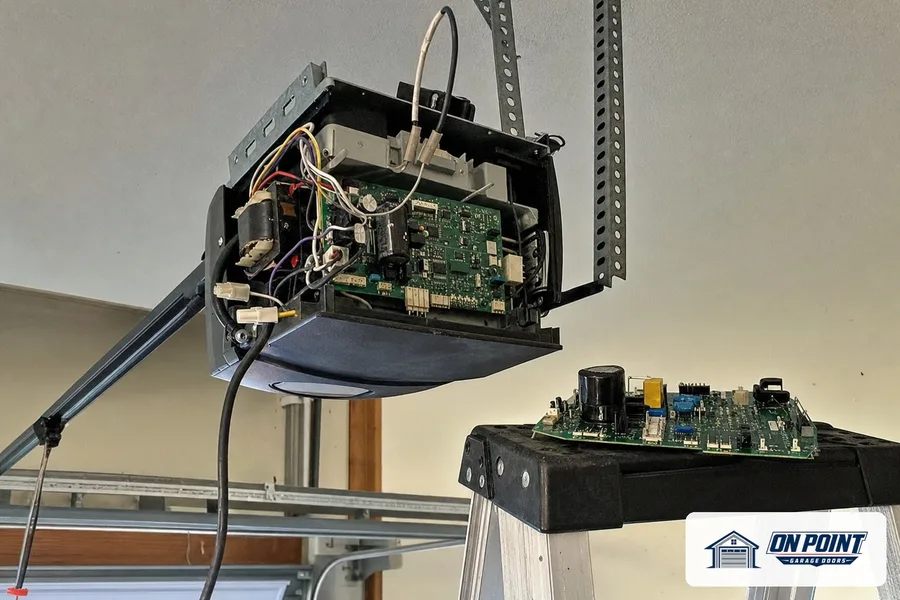
Opener circuit board, from one of our jobs
Opener circuit board
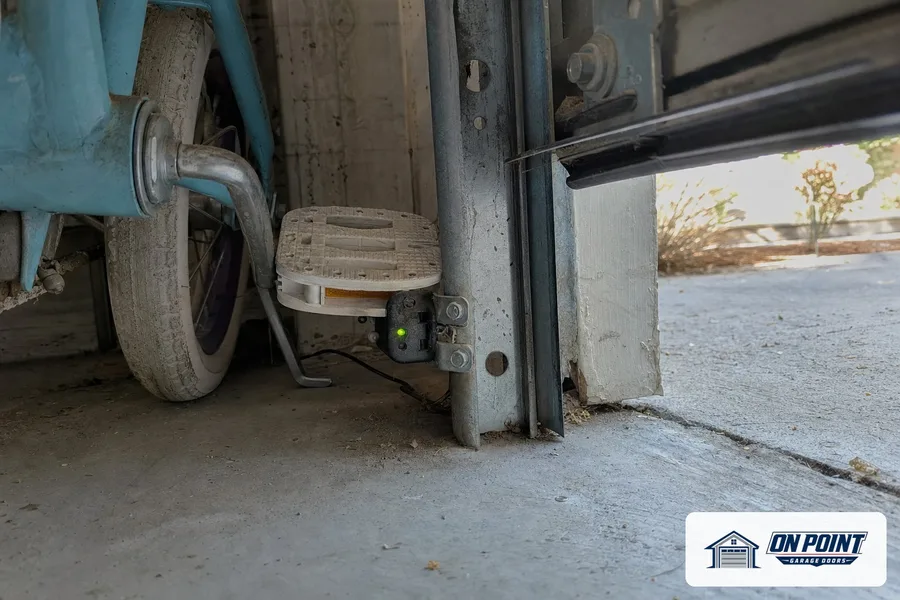
Safety sensor on the track, from one of our jobs
Safety sensor on the track

The drive gear

Many chain and belt openers turn the drive through a plastic gear inside the motor housing. It is made to be the weak point, so it strips before the motor burns out. A stripped gear sounds like a motor running with nothing happening, or a grinding noise as the teeth slip. Our page on opener gear replacement goes into this repair.

The circuit board

The board reads the remote, the wall button and the sensors, and switches the motor on and off. Power surges, lightning storms and plain age are the common causes of a failed board. Signs include an opener that does nothing at all, lights that blink in odd patterns, or a motor that runs by itself. Boards can often be replaced on a current model.

The motor

Motors outlast most other parts. When one does fail, it is often on an opener that is old enough that the rest of it is tired too. A humming opener that will not move can be a motor, but it is just as often a stuck capacitor, a stripped gear or a door that is too heavy to lift. Our motor replacement page covers how we tell them apart.

Chain, belt or screw

The drive runs along the rail from the motor to the door. A chain can stretch and slap the rail, a belt can wear at the teeth or slip on the sprocket, and a screw drive can wear its threads or the carriage that rides on it. Each can be adjusted or replaced without changing the whole opener.

The trolley and the arm

The trolley rides the rail and connects to the door through a curved or straight arm. It holds the emergency release. A cracked trolley lets the drive move while the door sits still, and a worn arm bracket can pull loose from the top of the door. Our page on the opener trolley explains this part in detail.

Safety sensors

The two photo eyes near the floor stop the door from closing on a person, a pet or a car. They are the most common reason a door will not close. A knocked sensor, a cut wire or sunlight hitting the receiving eye are all frequent causes. Sensors are simple to replace, and every opener made for homes in recent decades needs them to work.

Remotes, keypads and the receiver

Remotes fail from dead batteries, worn buttons or a drop on the driveway. Keypads by the door wear out from weather. Sometimes the problem is the receiver inside the opener, which stops hearing every remote at once. We match new remotes and keypads to the opener and set them up so every driver in the house is covered.

The wall button

The wall control is the button inside the garage. Simple ones are just a switch; newer ones carry a light switch, a lock button and a motion sensor. A shorted wire or a failed button can make the door do nothing, or make it run by itself. Our page on a wall button that is not working covers the wiring side.

Limits and travel settings

Every opener needs to know where the door is fully open and fully closed. Older models use switches along the drive, newer ones count motor turns electronically. When the limits drift, the door may reverse at the floor, stop short of the top or keep running. Setting the limits is part of almost every opener repair.

Parts that wear on the door, not the opener

Many opener calls are really door problems. A broken spring, a frayed cable or rollers that bind make the door too heavy, and the opener strains or quits. Before replacing any opener part, we check that the door itself is balanced and moving freely. Otherwise the new part fails for the same reason the old one did.

One part or a new opener

Brands we work on

We carry and fit parts for LiftMaster, Chamberlain, Genie, Craftsman and the other brands common in our area. If a part is no longer made for your model, we tell you so and explain your options.

Questions we get asked

What part fails most often in a garage door opener?

The safety sensors and the drive gear are the most common, followed by the circuit board.

Can you replace just one part of my opener?

Yes, on most current models. We replace gears, boards, trolleys, sensors, remotes and wall buttons.

Why does my opener hum but the door does not move?

Often a stripped gear or a door that is too heavy. A failed motor is less common.

Is it worth fixing an old opener?

If it has no safety sensors or several worn parts, a new opener usually makes more sense.

Is the estimate free?

Yes. We find the failed part and explain the repair before any work starts.

Booking takes a minute

Across Brooklyn, Queens and Long Island, tell us what the door is doing and we set a visit that fits your day.

Free estimate, call (929) 429-2429.

Opener acting up? We will find the part that failed

Tell us what the door is doing and we will give you an honest arrival time. The estimate is free.

Easier to explain by phone? Call (929) 429-2429.

Two minutes to a free estimate

Tell us what the door is doing. The estimate is free either way.

Or just call (929) 429-2429 and talk it through.

The other six things that go wrong