Takes 30 seconds. We call you back to set a time.
An opener is only as reliable as the power behind it. Most openers plug into an outlet on the ceiling right next to the motor, and many opener problems start there. Some garages have no ceiling outlet at all, so the opener ends up on a long extension cord. Others share a circuit with a freezer, a light or a power tool, and lose power whenever something else trips. This page explains what an opener needs, what to avoid, and how we work with an electrician when the garage needs new wiring. Free estimate at (929) 429-2429.
By Sean Cohen, owner, On Point Garage Doors · Updated
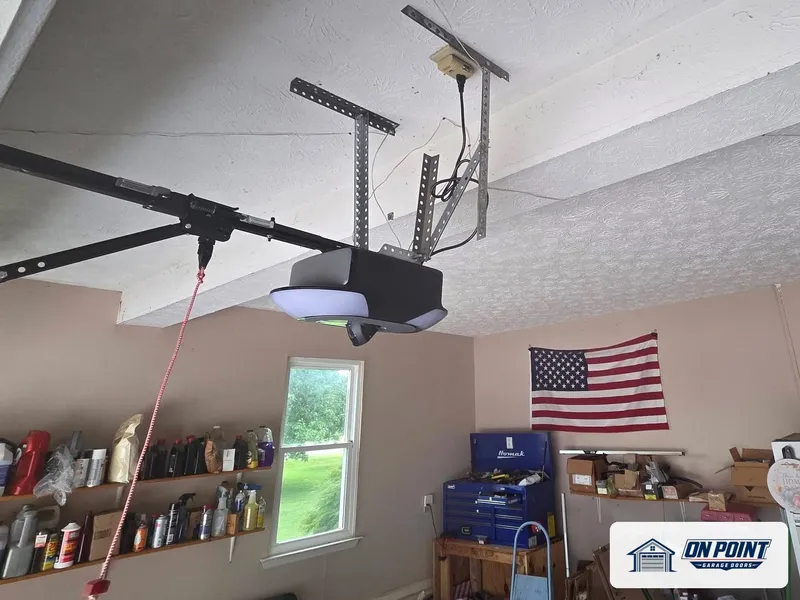
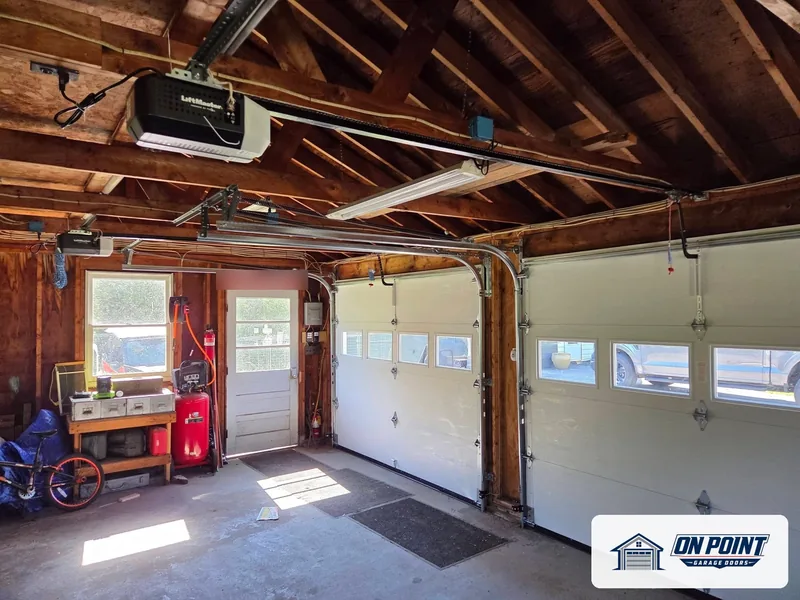
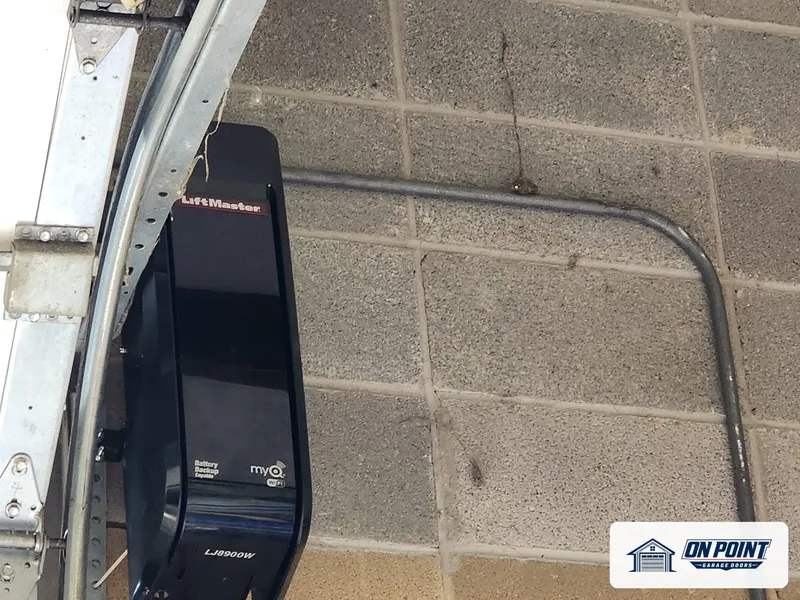
These photos are from our own jobs, with our logo on them.


The usual spot is on the ceiling within reach of the opener's short power cord, close to where the motor hangs. That keeps the cord out of the way of the door, the rail and anything stored overhead. When we install a new opener, we check where the outlet is before we decide exactly where the motor will hang.
Older garages, detached garages and garages under converted rooms often have a single light and nothing else. In that case an electrician needs to add an outlet before the opener goes in. We do not do electrical work, but we can tell you exactly where the outlet should be so the electrician puts it in the right place the first time.
Many garages put the opener on the same circuit as the lights, a freezer, a second refrigerator or the tool bench. If a saw or a heater trips the breaker, the opener goes dead with it. When an opener stops working for no clear reason, a tripped breaker or a tripped protected outlet somewhere else in the garage is one of the first things to rule out.
The board inside an opener is sensitive to surges from storms and the power grid. A damaged board can leave the opener dead even with good power at the outlet. A surge protector rated for the opener can help, and some newer openers have better protection built in. Our page on an opener that stopped working covers board failures.
Some openers include a battery that runs the door for a while when the power is out. This is useful in storm season, for homes where the garage is the main way in, and for anyone who cannot easily lift a door by hand. The opener still needs a good outlet to keep that battery charged. Our page on opener battery backup explains how it works.
The wall button and the safety sensors run on low voltage wires from the opener itself, not on their own outlets. The opener's light is powered through the opener too. If the light works but the door does not move, the outlet is fine and the problem is somewhere else, such as the sensors, the board or the door.
Smart openers also need a Wi-Fi signal that reaches the garage. A garage at the back of the house or under a brick floor may have a weak signal. That is not a power problem, but it shows up the same way: the app says offline. Our page on smart openers covers getting the signal to the garage.
Before hanging a new opener, we check the outlet location, make sure the cord reaches without strain, and confirm the circuit is not shared with a heavy tool or a heater if we can tell. If the garage needs an outlet, we tell you before install day so the electrician can come first.
If your opener has gone dead, the technician checks for power, then the board, the wall button, the sensors and the door. You get a free estimate before any work starts.
It needs an outlet on the ceiling near the motor. Sharing a circuit with heavy tools or a freezer can cause it to lose power.
Opener makers advise against it. Loose plugs and damaged cords cause outages and other problems.
An electrician. We tell you where it should go so the opener can hang in the right spot.
A tripped breaker, a tripped outlet or a surge that damaged the board are the common causes.
Yes. We check the opener and its power before any work starts.
Across Brooklyn, Queens and Long Island, tell us what the door is doing and we set a visit that fits your day.
Free estimate, call (929) 429-2429.
Tell us what the door is doing and we will give you an honest arrival time. The estimate is free.
Easier to explain by phone? Call (929) 429-2429.
Tell us what the door is doing. The estimate is free either way.