Takes 30 seconds. We call you back to set a time.
Many chain drive and screw drive openers have a small part inside called a start capacitor. It gives the motor a push to get it spinning from a dead stop. When it weakens, the opener hums, clicks or tries to start and gives up, even though the motor itself is fine. It is one of the more common opener parts we change, and also one of the most often blamed when the real trouble is somewhere else. This page explains what the capacitor does, the signs it is failing and what we check before replacing it. Free estimate at (929) 429-2429.
By Sean Cohen, owner, On Point Garage Doors · Updated
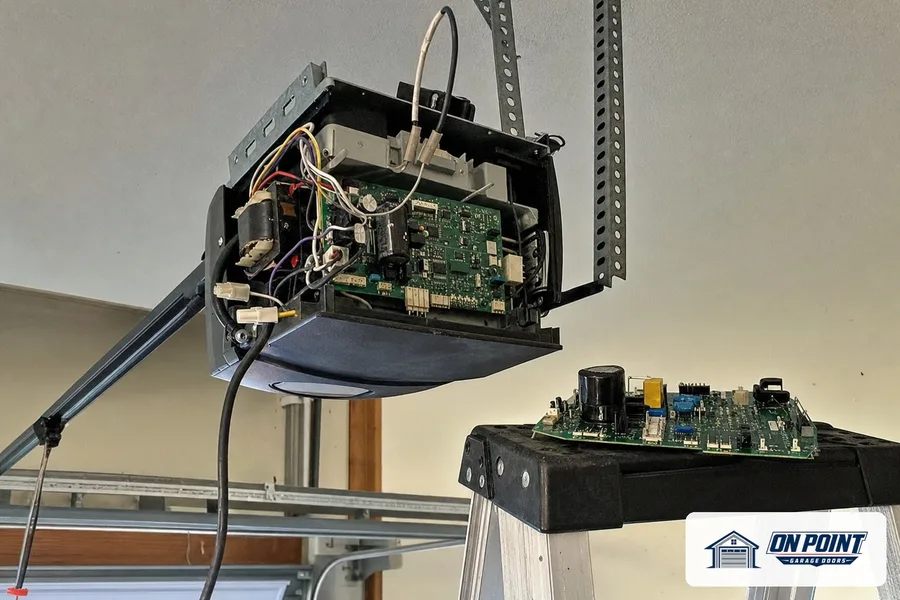
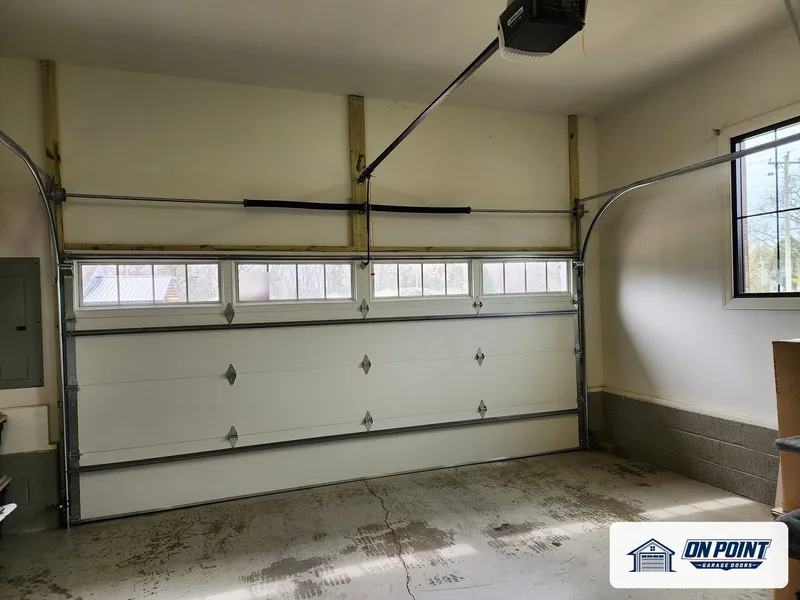
These photos are from our own jobs, with our logo on them.


Older style openers use an AC motor. That kind of motor needs help to start turning in the right direction. The capacitor stores up energy and lets it go as the door is called, giving the motor that first kick. Once it is spinning, the capacitor drops out and the motor runs on its own. It is a small can, often black or silver, wired near the motor inside the cover.
Most chain drive and screw drive openers built around an AC motor have a start capacitor. Many newer belt drive and wall mount openers run on DC motors, which do not need one; their trouble shows up in the board or the motor instead. If you are not sure which kind you have, the brand and model on the label tell us what is inside before we open it.
Heat and age are the main causes. A garage ceiling gets very hot in summer, and an opener mounted near the roof bakes year after year. Each start also stresses the part. Power surges from storms and lightning can finish off a weak one. On a door that is too heavy, the motor struggles at every start, and the capacitor wears out sooner.
When the cover comes off, a bad capacitor can look puffed up, cracked or stained with oil around the top. Some fail with no outward sign at all, which is why the part is tested, not just looked at. Either way, the capacitor can still hold stored energy even with the opener unplugged, so it is handled by a technician with the right tools.
A hum with no lift is not always the capacitor. A broken spring makes the door far too heavy, and the opener hums against it. A stripped drive gear lets the motor spin while the door stays put. A locked door, a slide bolt left closed or a trolley that came off the chain all look similar from the floor. That is why the door is checked first.
Before any opener part is changed, the technician disconnects the opener and checks the door on its own. If the door is heavy or will not stay put halfway up, the springs are the problem, and a new capacitor would only fail again. If the door moves freely and is balanced, the opener gets tested part by part.
A motor that hums without turning is drawing power with nowhere to put it. Holding the button down or trying over and over can overheat the motor or burn out the board. If the opener hums and the door does not move, stop, unplug it if you can reach the plug safely, and leave the door where it is. Our page on an opener that hums covers this in more detail.
On a sound opener with a good motor and gear, a new capacitor brings it back to life. On an old opener with a tired motor, worn gears and no modern safety features, the capacitor may be the first of several parts to go. We tell you which kind of opener you have and whether the repair makes sense on it.
A balanced door is the best protection for every opener part, because the motor does far less work at each start. A surge protector at the outlet helps in areas where storms knock the power out. Have the springs and balance checked when the door starts to feel heavy, not after the opener gives up.
The technician checks the door's balance, the springs and the tracks, then tests the opener: the capacitor, the motor, the gear, the board and the safety sensors. You get a written estimate before any work starts, and the opener is tested with the door afterward, including the safety reverse.
It gives an AC motor the push it needs to start turning, then drops out once the motor is running.
The opener hums but will not start, starts only sometimes, or starts after the door is given a small push.
No. Many chain and screw drive openers do. Many newer belt drive and wall mount openers use DC motors without one.
Yes. A broken spring, a stripped gear or a locked door can all cause a hum, so the door is checked first.
Yes. We test the door and the opener before any work starts.
Across Brooklyn, Queens and Long Island, tell us what the door is doing and we set a visit that fits your day.
Free estimate, call (929) 429-2429.
Tell us what the door is doing and we will give you an honest arrival time. The estimate is free.
Easier to explain by phone? Call (929) 429-2429.
Tell us what the door is doing. The estimate is free either way.