Takes 30 seconds. We call you back to set a time.
Many people tell us the same story: they heard a bang from the garage so loud they thought something had exploded or a car had crashed into the house. Then the garage door would not open. That sound is almost always a torsion spring snapping. A spring stores a lot of energy, and when the steel finally breaks, that energy is released all at once with a crack that can be heard through the whole house. Free estimate at (929) 429-2429.
By Sean Cohen, owner, On Point Garage Doors · Updated
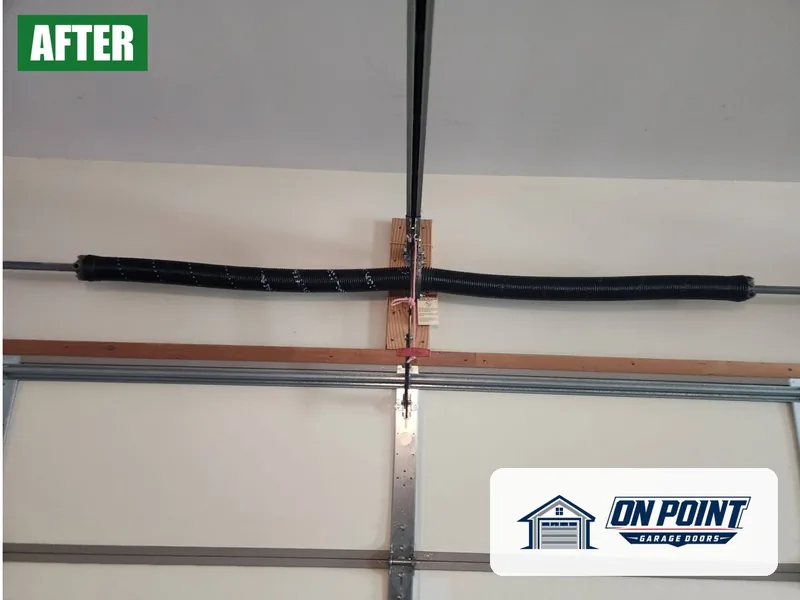
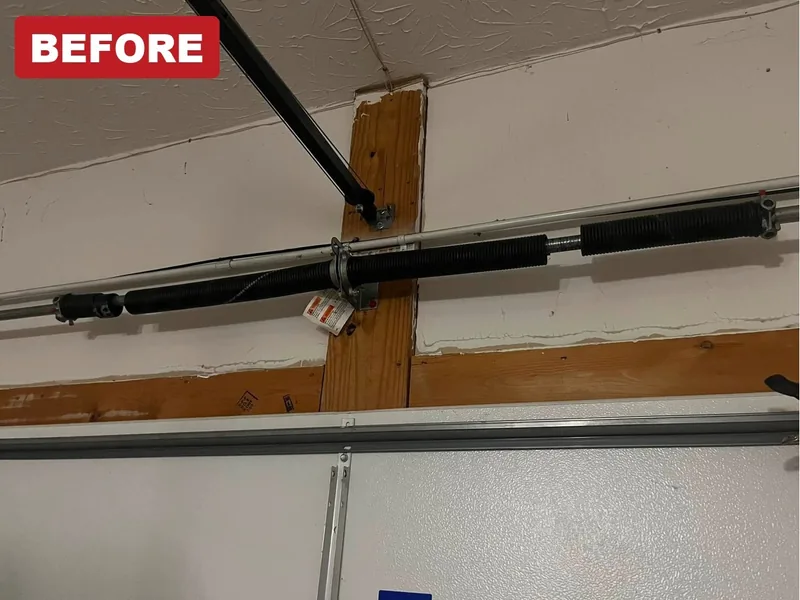
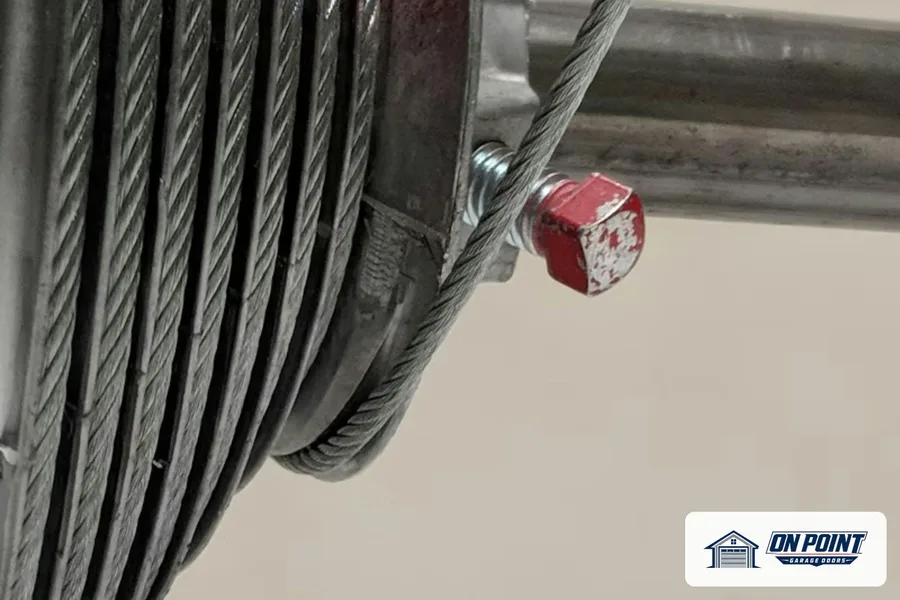
These photos are from our own jobs, with our logo on them.


Do not keep pressing the opener: lifting a door with a broken spring strips the opener's gear and can bend the top section. Do not try to lift the door by hand; it can weigh as much as a small motorcycle without the spring helping. Do not touch the springs, cables or the brackets at the bottom corners. Keep children and pets out of the area.
If the spring broke while the door was open, the door may be held up only by the opener or may be resting crooked in the tracks. Do not disconnect the opener and do not walk under the door. Call and tell us; the technician secures the door first.
This is one of the most common reasons people call in a hurry. Tell us when you call. The technician can usually replace the springs on the spot so the car can get out, rather than forcing a heavy door open.
Springs are rated for a certain number of open-and-close cycles. Every trip twists the steel, and eventually it fatigues and snaps. Doors used many times a day wear springs out much sooner. Rust from damp garages and salt air weakens the steel, and cold makes tired springs more likely to break.
Less often, a bang comes from a cable snapping, a door dropping off its track, or a roller popping out at the curve. Those leave the door crooked or jammed rather than simply heavy. Any of them is a reason to stop using the door and call.
On doors with two springs, both were installed together and have worn the same amount. When one breaks, the other is close behind. Replacing both keeps the door balanced and avoids a second bang a few weeks later.
The technician secures the door, safely releases any remaining tension, installs new springs sized to the door's weight, checks the cables, drums, bearings and bottom brackets, balances the door, and tests the opener's force and the safety reverse. You get a free estimate before any work starts.
If your door is used a lot, longer-life springs are worth considering. They are built for many more cycles, so the next bang is much further away.
If the opener was pressed several times against the heavy door before the spring problem was noticed, its gear may be worn. The opener is tested after the springs are replaced, and any damage is explained.
A yearly tune-up checks the springs for wear, rust and gaps, and tests the door's balance. Springs that are near the end can be replaced on your schedule, before they break on a cold morning when you need to leave.
On older doors with springs along the tracks, a breaking extension spring can whip and clang against the track or the ceiling, sometimes followed by a rattle as pieces land. If those springs have no safety cable through them, the broken parts can fly. That is why safety cables are added on every visit where they are missing.
Springs do not only break while the door is moving. A worn spring can snap while the door sits closed overnight, as the steel holds its tension. If you hear the bang at night, leave the door alone until morning and call; nothing about it gets worse while the door stays closed.
Once the new springs are in, the door should feel light and stay put halfway.
Most often a garage door torsion spring breaking. Look for a gap in the coil above the door.
No. The door is very heavy without its spring. Keep it closed and call.
No. It can strip the opener's gear and bend the door.
Yes, on doors with two springs. The other is close to breaking too.
Yes. You see the repair and the estimate before any work starts.
Across Brooklyn, Queens and Long Island, tell us what the door is doing and we set a visit that fits your day.
Free estimate, call (929) 429-2429.
Tell us what the door is doing and we will give you an honest arrival time. The estimate is free.
Easier to explain by phone? Call (929) 429-2429.
Tell us what the door is doing. The estimate is free either way.