Here a house usually comes with its own garage, and the door is usually a sectional on torsion springs. Repairs and new doors, with a free estimate before any work.
Tell us what the door is doing. The estimate is free either way.
Mid-Island, around New Dorp, Oakwood and Great Kills, the streets are full of older ranch and split-level houses, and many of their doors still run on the springs they were built with, which are now at the end of their life. Toward Tottenville and Annadale the houses are newer and the doors bigger, often heavy insulated doubles on their first set of springs. On the North Shore, in St. George and West Brighton, older attached garages with little headroom above the door often need a wall-mounted jackshaft opener instead of one on a rail.
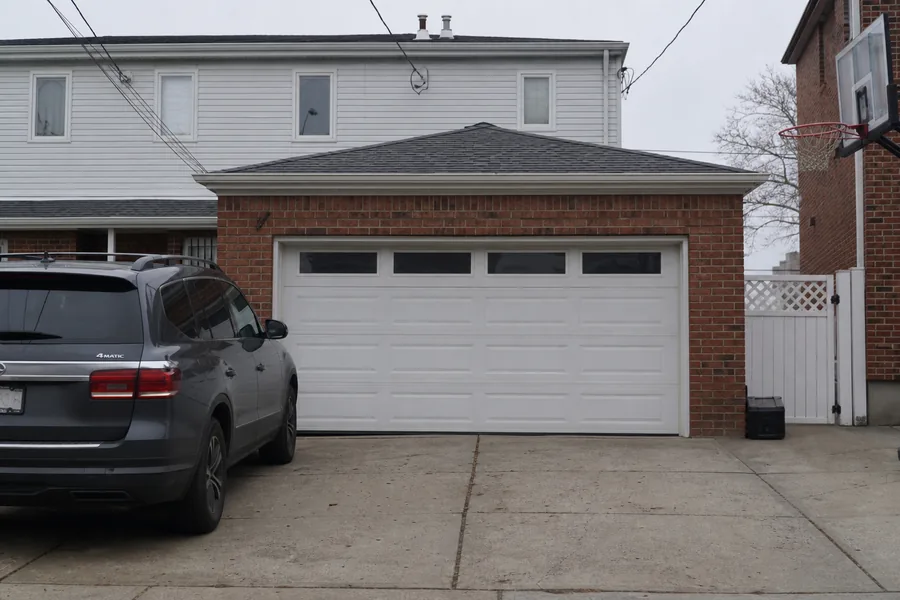
Elsewhere on the island it's the same picture in different proportions: single and double garages, some attached and some at the end of a driveway, many with doors that have been patched more than once. Telling us which kind you have, and whether the door is the original, says a lot about what's likely to have failed.
ZIP codes we serve: 10301, 10302, 10303, 10304, 10305, 10306, 10307, 10308, 10309, 10310, 10311, 10312, 10314.

The work comes down to six jobs, each explained on its own page:


Cables tend to go after springs. They hang down both sides of the door from drums on the spring shaft and take the door's weight as it moves, and the damp air rusts them where they wrap the drum. A cable that frays on one side throws the door out of level, so both are replaced together and the door is balanced before it runs again.
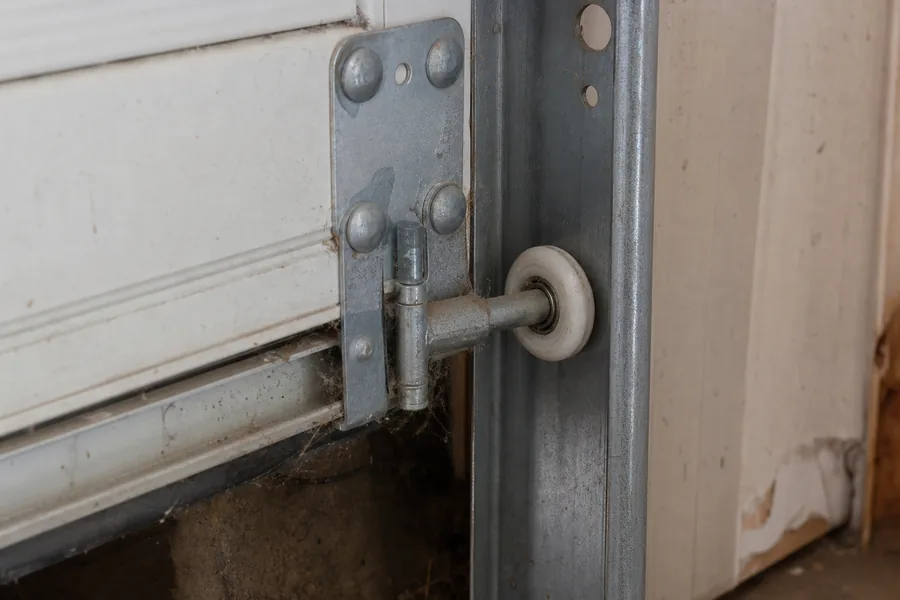
Off-track doors come from a roller leaving its track, after a knock from a car, a cable letting go or a roller worn down until it slips. A door in that state can drop, so it stays where it stopped, with the car and the family clear, until it has been supported and the cause found. Even a door that looks only slightly crooked can be hanging on one cable.
Openers on the older houses are often chain drives that have been running for a long time, and they tend to grind before they stop, which is the drive gear inside the head wearing away. A new gear can buy time if the motor and board are sound; if they're not, a belt-drive LiftMaster is the quiet replacement, and on a low-headroom garage a wall-mounted jackshaft model frees up the space above the door.
On many of the older ranches and split-levels, the springs on the door are the ones the builder put in. They've done their work, and when one goes the other is rarely far behind. A door like that deserves a full check when the first spring breaks, because the cables, rollers and opener have all aged alongside it. If the opener has been working against a weak spring for a while, its gear may be worn too, and it's better to know that before the new springs go on.
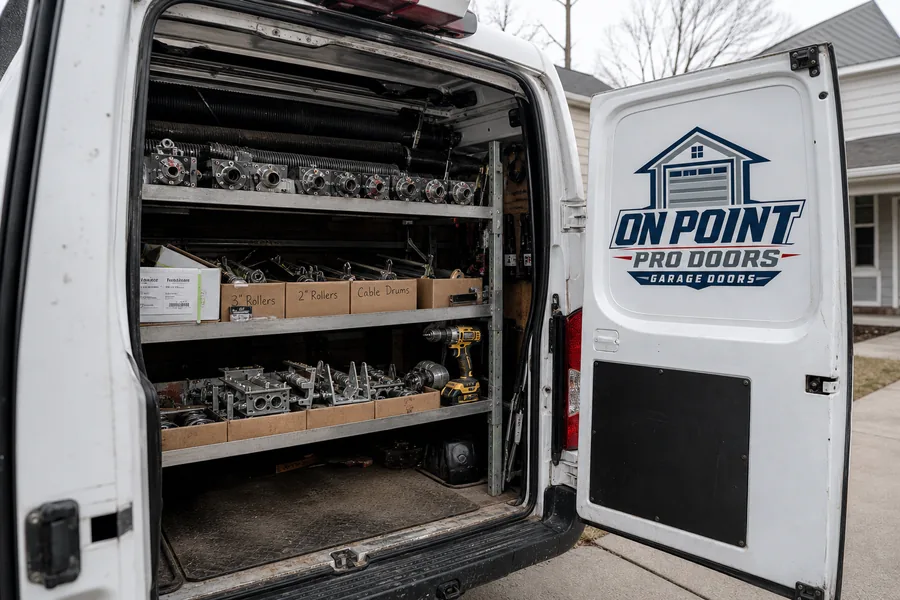
Openers by LiftMaster, Chamberlain and Genie, doors by Clopay, Wayne Dalton, Amarr and CHI, and Wayne Dalton's TorqueMaster system, which keeps its springs inside a tube above the door, are all routine work. If yours is something else, describe it on the call and you'll hear whether a part has to be ordered.
Associations and managers book the same way a homeowner does. When several doors in a complex went in at the same time, they tend to wear out together, so it's worth having the others looked at during the same visit.
For a row of garages, say who can open them, whether owners need notice and which doors are giving trouble, so the visit can be planned in one go.
Four questions about the door itself that come up again and again:
For a house door, a yearly check is a sensible rhythm; a door that runs many times a day benefits from more. A tune-up catches worn rollers, tired springs, loose hinges and a track that has drifted out of line before any of them fails. Between visits, the things to notice are new noises, a door that moves unevenly or one that suddenly feels heavy.
Yes. Older attached garages often have very little room between the top of the door and the ceiling. A wall-mounted jackshaft opener, or a low-headroom track, lets the door open fully without a rail running across the ceiling. The technician measures the space first, since the right answer depends on the door's height and the ceiling.
Yes. Those doors hide their springs in a tube above the opening and take Wayne Dalton's own replacement springs, not ordinary torsion springs; say it's a TorqueMaster when you call so the right ones come along.
Noise usually comes from worn steel rollers grinding in the track, worn hinges, or an old chain-drive opener slapping its chain against the rail. The technician can tell which it is, replace what's worn, and suggest nylon rollers or a belt drive if you want the door quieter.
Cleanup. Old springs, cables, opener heads and the packing from new parts go out with the technician, not into your trash. The garage is left the way it was found, apart from a door that works.
Winter. Snow that melts by day and refreezes at night bonds the rubber seal to the concrete, and an opener pulling against it can strip its gear. If the door is frozen down, leave it and call rather than pressing the button again.
Summer. Humid heat wears rubber seals out faster and swells wooden doors until they rub. A seal that has gone hard or started to crumble is a quick replacement, and catching it before fall keeps the water out.
Fall. The last mild weeks are the time to have springs, cables and rollers checked, since the first hard cold is when tired springs tend to break. It's also the moment to replace a worn bottom seal, before the first freeze bonds it to the slab.
Every part of the island is covered, from the ferry end of the North Shore to the far end of the South Shore.
Tell us the neighborhood and how the garage is reached, and you'll hear when a technician can be there. The street matters less than the door: its size, its spring system and its opener decide what comes on the truck. A double door on a split-level and a single door under a North Shore house need different springs, different tracks and sometimes a different opener.
The broken spring is the call we take most here, and it announces itself the same way every time: a bang from the garage, then a door that lifts a few inches and stops while the opener strains. On the two-car colonials toward the South Shore the doors are heavy insulated sectionals on torsion springs, and the spring is sized to the door's weight, not to a catalog. The common sizes are on the truck, both springs are replaced on a double door so the second doesn't let go soon after, and the door is balanced before we leave. Free estimate first.
We cover the whole island, including:
No. With the spring gone, the full weight of the door is on the opener or on whoever lifts it, and that's how people get hurt and openers get wrecked. Leave it closed, keep everyone clear and call (929) 429-2429.
That points to the remote or the opener's receiver rather than the motor. The technician checks whether the remote has lost its pairing, the receiver has failed or the logic board needs attention, and reprograms or replaces what's at fault. If the wall button stops working too, the fault is in the opener itself.
Yes. Clopay, Amarr, Wayne Dalton and CHI doors are measured to the opening and installed with new springs and track, and the old door is taken away. You can see the styles and colors before choosing, and the estimate is free.
Yes. We work on roll-up steel doors, commercial sectionals, dock doors and high-cycle openers, the kind found at auto shops, warehouses and fleet yards, and estimates are given in writing.
Usually a broken spring: the opener feels the weight and gives up. It can also be a cable that has come off its drum. Either way, stop pressing the button so the opener isn't damaged, and call.
If the motor and logic board are sound, a worn gear or a failed sensor is a repair. If the motor is worn out or its parts are no longer made, a new opener is the better choice, and on a low-headroom garage a wall-mounted model may suit the space better.
A cable that snapped as the door went up. One side let go, the door hung crooked in the frame and the car was stuck behind it. The door was supported and brought down level, both cables were replaced, and the car came out once the door ran true.
Doors for a new house. A builder needed doors for a new tri-level. The openings were measured, insulated steel doors ordered, the tracks and panels hung, the springs set to each door's weight and the LiftMaster jackshaft openers connected to myQ.
A seal frozen to the slab. After a night of melt and refreeze, the opener strained against a door stuck at the bottom until its gear stripped. A new gear went in, the seal was worked free of the concrete, and the door was run through a full cycle before the technician left.
Springs and balance. The spring tension is checked against the door's weight, and the door is stopped halfway to see whether it holds. A door that drifts down or flies up is out of balance and wearing out its opener.
Cables, rollers and hinges. Cables are checked for fraying at the drums, rollers for flat spots and worn bearings, and hinges for cracks. Worn parts are pointed out before anything is replaced.
Opener and safety. The opener's travel and force settings are matched to the door, the sensors are lined up, and the door is made to reverse twice: once on a block placed in its path and once when the beam is broken.
Often. If the door's maker still makes that section in your style and color, a dented or cracked panel can be swapped without a new door. If it isn't available, the technician says so and goes over the options.
Many newer LiftMaster and Chamberlain openers connect to the myQ app, and older ones can often be connected with an add-on. The technician can set it up during the visit.
An insulated door with good bottom and side seals makes a real difference, especially on an attached garage beside or under living space. The insulated options are gone through when the opening is measured for a new door.
Just make room around the door if you can: the car moved out of the way, boxes cleared from near the tracks and pets kept inside. Leave the door itself alone until the technician has seen it.
Yes. If the springs, cables or opener can be fixed, that's the recommendation. If the door itself is cracked, rotted or no longer safe, you'll hear that plainly, along with what a new door would involve.
Often there's no warning, but a door that feels heavier than it used to, rises unevenly or makes the opener strain is a sign. A gap between the coils of a torsion spring means it has already broken.
A phone call gets things moving. Say what the door is doing and which part of the island the garage is in, and the technician comes knowing what to bring.
The estimate is free on any door, anywhere on the island.
Describe the problem and you'll be told when a technician can realistically get there; the visit and the estimate are free.
Want to talk it over first? Call (929) 429-2429.
Tell us what the door is doing. The estimate is free either way.