People call asking whether to buy the LiftMaster or the Chamberlain. The honest answer is that they're built by the same manufacturer, and the differences are about where you buy it and what's bundled, not about which motor is better. Here's what actually matters when you pick one.
Tell us what the door is doing. The estimate is free either way.
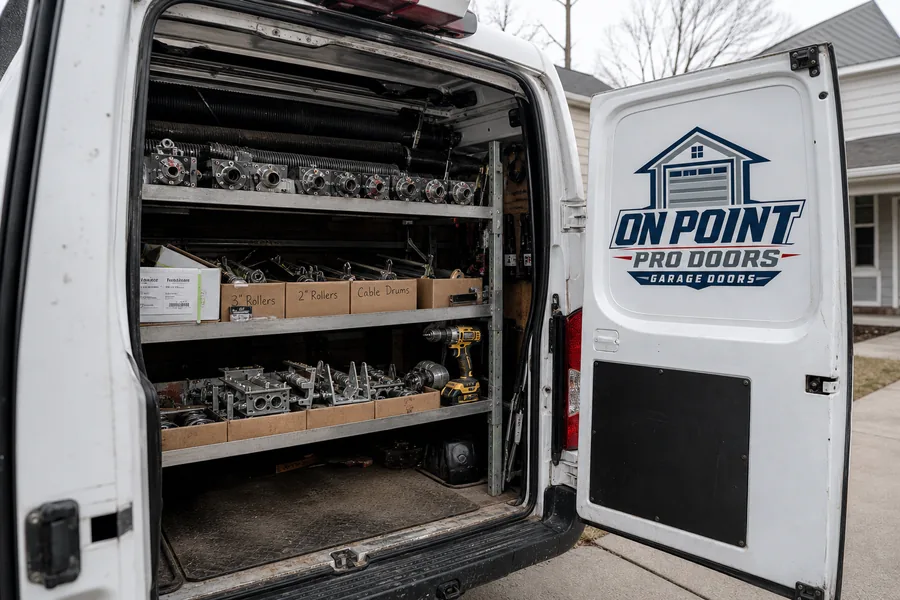
The Chamberlain Group makes both. LiftMaster is the line sold through installing dealers and garage door companies; Chamberlain is the line sold through hardware stores and online. The motors, the belts, the logic boards and the myQ app come out of the same factories. When a LiftMaster and a Chamberlain of the same generation sit side by side with the covers off, the parts inside are mostly interchangeable, and a technician carries one set of gears and boards that fits both.
That's why the question isn't really which brand. It's which model, which drive, what's bundled with it, and who installs it. Those four things decide how quiet the door is, how long the unit lasts, and whether the safety features are set up right.

None of that makes one brand better. It makes the dealer route more predictable, which is why installers use LiftMaster: not for the badge, for the parts on the truck and the warranty they can stand behind.


Both lines come as chain drive, belt drive, and, on LiftMaster, wall-mount direct drive. A chain drive is strong, simple and noisy; fine for a detached garage. A belt drive runs almost silently and is the usual choice for a garage under a bedroom, which describes most attached garages in the boroughs. The wall-mount unit hangs beside the door and drives the torsion shaft directly, which is the answer when there's a lift, storage racks, or a very low ceiling where the rail would go.
Horsepower ratings on the box are marketing. A half-horsepower unit lifts a balanced single door for twenty years; three-quarter suits a double or an insulated door. The opener that struggles is nearly always on a door whose springs have gone soft, whatever the number on the label. Balance the door first and even a modest belt drive is quiet and lasts.
The same order on every new-opener visit.

Both lines use the same myQ app: open and close from your phone, a notification when the door has been open too long, a one-time code for a delivery. It's useful for the household where somebody always wonders whether the door was shut, and irrelevant for the one that never does. The basic app is free on both brands; the paid tiers add video storage most households never open.
Battery backup is the extra worth having. When the power goes, the door still opens for a day or two, which is exactly when a car is needed in a hurry. New York's newer installations increasingly have it built in on the belt-drive models of both lines. A built-in LED light and a quieter motor come next on the list; a camera in the opener is a novelty most people stop looking at within a month.
Most of the openers hanging in Brooklyn, Queens and Long Island garages are chain-drive Chamberlains and LiftMasters from the years the houses were re-equipped, and most of them still work. The failures are the same on both: a stripped nylon drive gear (the motor runs, the door doesn't move), a logic board that dies after a power surge, photo eyes knocked out of line, a limit switch that has drifted so the door reverses at the floor. Three of those are a part and an hour, and the part is the same for both brands.
The one case where the brand is worth replacing rather than repairing is a board failure on a unit past fifteen years. At that age a new belt-drive head is quieter, has rolling-code security instead of a fixed code, and comes with its own warranty, and you'll hear that plainly before deciding.
LiftMaster is the professional version and Chamberlain is the lesser one. Same company, same motors in the same generation. The dealer line has more high-end models and a longer warranty; that's the difference.
You need the bigger horsepower for a heavy door. No. You need balanced springs. A door that lifts easily by hand needs a modest motor; a door that doesn't will wear out any motor.
The smart features need a subscription. The basic app is free on both. Paid plans add video and delivery features.
Any handyman can hang one. The hanging is easy. The force and travel settings and the sensor test are what make it safe, and they're where rushed installs go wrong.
They're made by the same company. LiftMaster is the dealer line with more high-end models and a longer motor warranty; Chamberlain is the retail line. Within the same generation the motors and boards are the same.
LiftMaster, because the parts and the warranty come through us and we can stand behind both. If you already bought a Chamberlain, we'll install it properly and set it up to your door.
Usually, yes. Gears, boards, sensors and remotes are largely interchangeable across the two lines in the same generation.
Belt for an attached garage or anything under a room people use; chain is fine for a detached garage. The belt is the quiet one.
Most opener faults are a part and an hour. A dead board on a unit past fifteen years is the case where replacement is the better advice, and you hear that before deciding.
Yes. The technician looks at the door first, tells you what it needs and which opener fits, and you decide. No charge for the visit or the estimate.
One call, a two-hour window, and a call ahead from the technician. That's the routine across New York, Queens and Nassau County.
Free estimate. Throughout Kings County, including Brooklyn, Queens, the Bronx, Nassau County, Jersey City, Hoboken, Yonkers, Westchester, Hudson County.
Describe the fault and we'll give you an honest arrival time. The visit and the estimate is free, anywhere in Kings County.
Easier to explain by phone? Call (929) 429-2429.
Tell us what the door is doing. The estimate is free either way.