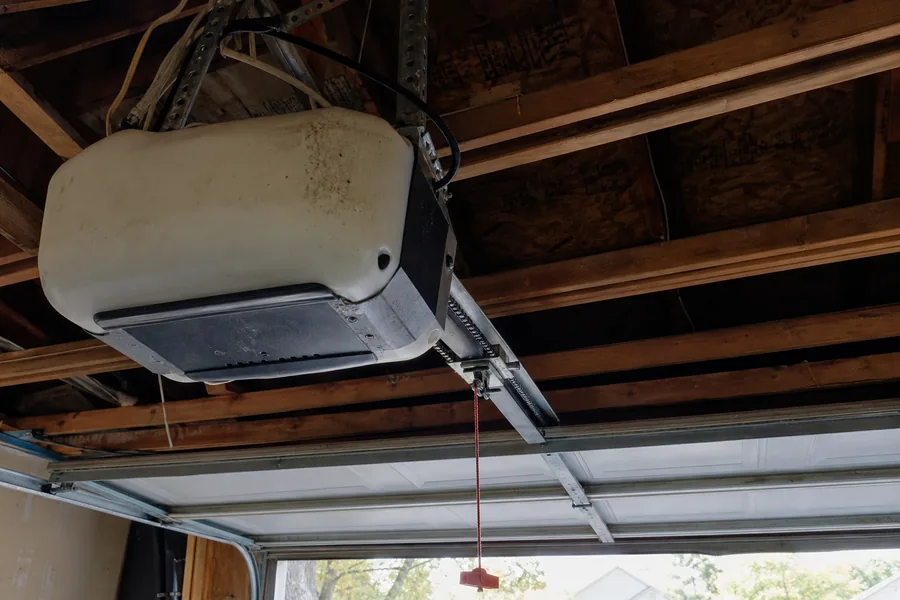
Genie openers are everywhere in Queens and on Long Island, and when one stops it's nearly always one of five things.
Tell us what the door is doing. The estimate is free either way.
Genie has been sold through the big-box stores around New York for decades, so it's the opener a lot of homeowners installed themselves and the one that came with the house for everyone else. That is good news for repair: the models repeat, the failure points repeat, and the parts are on the shelf.
The model matters more than the badge. A screw-drive Genie from the 2000s and a current belt-drive behave differently when they fail, and the technician will ask what the unit does and what it sounds like before loading up.

If the label has faded, a photo of the motor housing and the rail is enough for the technician to bring the right parts.


Five things, in roughly the order we get called about them.

A Genie that is under fifteen years old and stopped for one reason is nearly always worth repairing. The exceptions are a cracked housing, a board for a model Genie no longer supports, or an opener that has been struggling to lift a door with a tired spring for months, because that wears the drive.
If it's the door that's heavy rather than the opener that's weak, fixing the opener alone buys you a few weeks. The technician checks the door balance first, every time, because an opener is only meant to guide a door, not to lift it.
If the door has stopped part-way and the opener is straining, pull the plug rather than pressing the button again. An opener asked to drag a door with a broken spring burns out its gear in a handful of tries, and that turns a spring visit into two.
Around Queens and Nassau County the three we meet week in, week out are the older screw-drive units, the belt drives that came with a lot of new construction after 2015, and the current models with battery backup. The screw-drives are the noisy ones and the ones with the carriage problem. The belt drives are quiet and mostly give trouble through the sensors or a board after a storm.
If yours is older than any of those, it may still be repairable; some 1990s Genies are still running on Long Island. The technician will say on site whether parts exist for it, and if they don't, a belt-drive replacement goes in the same afternoon.
Genie parts are hard to get. The common ones aren't. Sensors, carriages, boards and remotes for the models we see most are stocked.
A flashing light means the opener is dead. It nearly always means the sensors, and the fix is a short visit.
It's better to replace than repair. Sometimes. On a unit that is otherwise sound and simply has one failed part, it's not, and we'll say which on site.
Yes. Screw-drive units from the 2000s are still common around Queens and Nassau County, and the carriage and drive parts for them are standard stock.
Almost always the safety sensors at the bottom of the track. They've been knocked out of line or something is blocking them. It's a short visit.
That's the remote or the receiver, not the door. New remotes pair in minutes, and if the receiver board has gone it can be replaced without changing the opener.
Yes, on any Genie with a working learn button. Bring up what you'd like on the call and the technician brings it.
Free, across Kings County and the towns around it. The visit tells you what has failed and what it takes to put right, and no is a complete answer.
More often than not. A garage that won't shut is one of the calls the schedule keeps room for.
Around Brooklyn, Queens and Hudson County, one call gets you a two-hour slot and a heads-up call before the technician sets off. We don't buy leads and nobody on a phone judges a door they can't see.
Free estimate. Throughout New York and Nassau County, Jersey City, Hoboken, Yonkers, Westchester, Hudson County.
Describe the fault and we'll give you an honest arrival time. The visit and the estimate is free, anywhere in Kings County.
Easier to explain by phone? Call (929) 429-2429.
Tell us what the door is doing. The estimate is free either way.