
Garage Door Tune-Up in Port Washington, NY
Lubrication, balance, safety reverse, photo-eye alignment, and hinge tightening. Serving Port Washington and surrounding neighborhoods.
Tune-Up: How We Handle It in Port Washington
Garage door problems in Port Washington are predictable once you've worked the area as long as we have. Same brands, same failure modes, same seasonal patterns — and we plan around all of it. Port Washington sits about 22 miles from Midtown Manhattan, putting us inside our core same-day response zone. Local climate is humid continental — cold winters that ice tracks and humid summers that swell wood, and that affects garage doors in predictable ways — frozen weatherstripping in winter, swollen wood panels in summer, salt-corroded springs in coastal pockets, and rust at the bottom seal where snow piles against the door.
If you are near Sands Point Preserve, you are squarely inside our daily service zone — we are there constantly.
The Step-by-Step Service Workflow in Port Washington
1. Up-Front Pricing Before Any Work. We diagnose, then we quote. You approve the price in writing before any tool comes out of the truck. No surprises, no scope creep, no "while I'm here" upsells.
2. Safety Reverse Calibration on Every Job. Federal UL 325 safety standard requires every residential opener to reverse on contact and reverse when the photo-eye beam is broken. We test both before we leave — every job, every time, even if you didn't call about safety.
3. Truck-Stocked Inventory. Every truck carries: torsion springs in the eight most common IPPT calibrations, lift cables in three gauges, full sets of nylon rollers, photo-eye sensor pairs, the ten most common LiftMaster and Chamberlain logic boards, weather seal in 16-foot rolls, and a complete bottom seal retainer kit. Result: 92% first-visit completion rate.
4. Written Warranty. 1 year parts and labor on standard springs, 3 years on high-cycle 25,000-cycle springs, 5 years on LiftMaster motors, 1 year on new openers, 90 days on most repair labor. Written on the invoice, not buried in fine print.
5. Phone Diagnostic Before Dispatch. When you call we ask three questions: what is the door doing right now, did you hear a loud bang or grinding sound, and what brand is the opener if you can read the label. From those answers we predict the failure mode and dispatch the right truck with the right parts.
Brands We Service in Port Washington
- LiftMaster — 8500W jackshaft, 8550WLB belt drive, 8160W chain drive, 3585 commercial. Common issues we fix: logic board failure on 5+ year units; MyQ Wi-Fi pairing problems; rail belt fraying. Parent: Chamberlain Group.
- Chamberlain — B970 belt drive, B6753T smart, B1381 jackshaft. Common issues we fix: MyQ disconnect after firmware updates; sprocket wear at 8-year mark; wall console blink codes. Parent: Chamberlain Group.
- Wayne Dalton — ProDrive belt, TorqueMaster spring system, 9100 series steel. Common issues we fix: TorqueMaster sleeve replacement; panel hinge crack; quiet operator gear failure. Parent: Wayne Dalton.
- Genie — SilentMax 1200, ChainDrive 750, StealthDrive Connect 7155D, Wall Mount 6172H. Common issues we fix: intellicode receiver replacement; blue dot beam misalignment; helical screw drive lubrication. Parent: Overhead Door Corporation.
- Craftsman — 1/2 HP chain drive, 3/4 HP belt drive. Common issues we fix: discontinued parts on pre-2014 units; obsolete logic boards. Parent: legacy Sears.
If your brand is not on this list, call us anyway — we work on every major and minor garage door manufacturer in active service across Nassau County, NY.
What Sets Us Apart from National Chains in Port Washington
National franchise call centers route your call to a dispatcher who has never been to Port Washington. They quote a flat rate, send the closest available tech regardless of training, and when something complicated comes up they order parts and reschedule. We're different. Our crew has been to Port Washington thousands of times. We know which streets have access constraints, which neighborhoods have older 7-foot doors versus modern 8-foot standard, and which NY weather patterns drive which failure types.
When you call us, you are not getting routed to a contact center. You are getting a dispatcher who can pull up your address on a route map and dispatch the closest of our trucks — usually under 60 minutes during business hours.
We carry insurance certificates for property managers and HOAs in Port Washington who require proof for work-order approval. We file W-9s on request, accept ACH for commercial accounts, and offer net-30 invoicing for verified property management companies.
Where We Serve in Port Washington
Port Washington {service.lower()} calls are dispatched from the closest of our routing trucks. Average arrival is under 60 minutes during business hours, often under 45 in dense neighborhoods.
Port Washington has its own quirks for garage door work. The local climate, the housing stock, and the seasonal failure patterns all factor into how we diagnose and fix. We are not a national franchise dispatching from a call center — we are a local crew with local routes and local truck inventory tuned to NY weather and NY housing.
The Garage Door Problems We See Most in Port Washington
- Opener motor and logic board failure. Most residential openers run 12-18 years before the logic board or motor gives up. We service every major brand and keep common boards in stock for first-visit repair.
- Bottom bracket corrosion. The bottom bracket (where the cable attaches at the lowest panel) takes salt-water spray and snowmelt. Corroded brackets fail under tension. We replace with stainless or galvanized.
- Weatherstripping and bottom seal degradation. The rubber bottom seal compresses and cracks after 5-8 years. Replacing it stops drafts, water intrusion, and pest entry. We use UL-rated EPDM seals.
- Noisy chain drive openers. An old chain drive opener with stretched chain and worn sprocket wakes up the whole house. Tightening the chain is a temporary fix; the real solution is sprocket and chain replacement or upgrade to belt drive.
- Photo-eye misalignment and safety reverse failure. Federal UL 325 standard requires safety reverse. A door that won't close is almost always a photo eye issue — leaf, spider web, sun glare, or one eye knocked out of plumb.
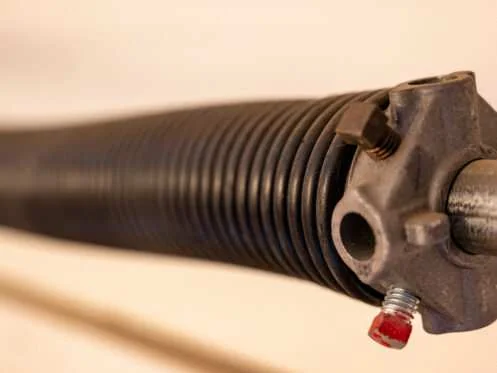
- Broken torsion springs. The single most common emergency call. Springs fatigue from cycle count — a daily-use door at 10,000 cycles is right at the average lifetime mark. We bring matched IPPT (inches per pound per turn) springs sized to your specific door, calibrate, and balance-test.
Recent Port Washington Service Highlights
The wood-door tune-up. Customer in Port Washington has a 22-year-old wood overlay door with original springs. Annual tune-up: lubrication, hinge tightening, spring inspection, photo-eye test. We caught one cable starting to fray and replaced it before failure. Customer paid $179 for tune-up plus $190 for the cable, saving an emergency call later.
The water-damaged keypad. Friday afternoon storm soaked an outdoor keypad mounted on the garage frame in Port Washington. Backlight flickered, then died. We replaced the keypad with a sealed Genie GIK-R rated for outdoor mounting, reprogrammed the customer's code, and re-sealed the housing. $149 done.
The remote that won't program. Customer in Port Washington bought a non-OEM clicker from Amazon. It pairs to the opener but only works from 5 feet away. Cheap clicker has a weak transmitter. We swap to a real LiftMaster Security+ 2.0 remote, pair on-site, range hits 35 feet. $89, ten minutes.
The HOA opener replacement. Property manager in Port Washington called for a unit-by-unit replacement of 12 obsolete pre-2010 Stanley openers (Stanley exited the market — no parts available). We scheduled four units per day for three days, staged the LiftMaster 8500W replacements, programmed all remotes, and provided net-30 invoicing. Volume pricing kicked in at $480/unit installed.
What People Ask Us About Tune-Up
How often should I have my garage door serviced?
Once a year for residential, twice a year for high-cycle commercial. A tune-up catches worn rollers, fatigued springs, loose hinges, and misaligned tracks before they fail.
How fast can you get a technician to Port Washington?
During business hours we are typically on-site within 60 minutes for emergency calls in Port Washington. For scheduled appointments we offer two-hour windows starting at 8 AM. After-hours dispatch is available for true emergencies — door stuck open, car trapped inside, broken spring blocking exit.
Are you licensed and insured to work in Port Washington?
Yes — fully licensed and insured for residential and commercial garage door work across all of NY. Insurance certificates available on request for property managers and HOAs.
Can you work on doors with TorqueMaster springs?
Yes — TorqueMaster is a Wayne Dalton-specific spring system housed inside a tube above the door. Replacement requires the matching brand-specific spring assembly, not a standard torsion spring. We carry the calibrations in stock.
Can I just replace one cable instead of both?
No, and any technician offering to do that is cutting corners. Cables are matched pairs — when one fails the other is right behind it. Replacing only one means another emergency call within 6-12 months. We always replace both sides.
Do you offer financing for big jobs?
Yes — instant approval at the truck for jobs over $1,000 through our financing partner. 12-month no-interest options available.
Do you handle insurance claims and homeowner warranties?
We work with all major homeowner-warranty providers and we provide detailed invoices, photos, and damage reports for insurance claims. We can talk to your adjuster directly if needed.
Year-Round Maintenance Tips for Port Washington Homeowners
Summer (June-August). Heat softens lubricants and accelerates rubber seal deterioration. A seal that lasted 6 winters can fail in one humid summer. Inspect bottom seal in July and replace before it crumbles.
Fall (September-November). Falling leaves clog tracks. Inspect rollers for any leaf debris that can cause the door to bind. Photo eyes should be wiped clean. Recheck weatherstripping before snow arrives.
Spring (April-May). Tune-up season. Springs that fatigued through winter are at peak risk now. Have the door balance checked — disconnect the opener manually and lift the door to chest height. It should stay roughly in place.
Summer (June-August). Wood doors swell. Tracks expand. Photo eyes pick up sun glare and give false reverses. We see the most won't-close calls in July and August because of photo-eye sun blinding. Solution: shade the eye sensor or reposition slightly.
Inside Our Trucks — Why First-Visit Completion Hits 92%
National-franchise techs roll up to your house, do the diagnostic, then need to go order parts. We don't. Each of our service trucks is a rolling inventory built around the failure patterns we see across NYC, Long Island, and New Jersey:
- Torsion springs in 8 IPPT calibrations covering 95% of residential door weights from 130 lb to 320 lb
- Extension springs in 4 stretch ratings for older 7-foot doors
- Lift cables in 3 gauges (1/8", 5/32", 3/16") rated for door weights up to 400 lb
- Full sets of 13-ball-bearing nylon rollers (10 per door) for noise reduction upgrades
- 10 most common LiftMaster, Chamberlain, Genie logic boards including pre-2018 generation
- Photo-eye sensor pairs (LiftMaster, Chamberlain, Genie) including the green/red Sears-spec pairs for Craftsman openers
- Remote transmitters: Security+ 2.0, Genie Intellicode, Chamberlain Smart, Wayne Dalton, Marantec, Linear Megacode
- 16-foot rolls of EPDM bottom seal in 3 widths plus retainer track and end caps
- Replacement hinges (#1 through #5), bottom brackets, top brackets, jamb hardware, drum cones
- Winding bars in matched pairs, calibrated tension gauges, fish tape, multimeter, RF signal analyzer
That inventory is the reason 92% of jobs are completed on the first visit without ordering parts. The remaining 8% are usually obsolete pre-2010 units where a part has to be sourced from a regional distributor — we order same-day and return within 24-48 hours.
When to DIY and When to Call a Pro
We tell every customer the truth: there are some things you can absolutely DIY, and some things you should never touch. Here's the honest breakdown:
SAFE TO DIY:
- Replacing remote batteries (9V or AA, depending on model)
- Cleaning and dusting photo-eye lenses
- Tightening bolts on hinges and brackets if visible (use a 7/16" socket; do not over-tighten)
- Lubricating tracks, hinges, and rollers with white lithium grease (NEVER WD-40 — it's a solvent and washes lubricant out)
- Reprogramming HomeLink in your vehicle
- Resetting the opener via wall-console reset button
NEVER DIY:
- Spring replacement — the springs hold 800-1,500 lbs of stored energy and have killed DIYers
- Cable replacement — same stored-energy issue, plus precise tension calibration
- Track adjustment when off-track — door will fall
- Opener motor or logic board work — voltage hazard plus calibration issues
- Anything involving disconnecting the spring stack
If you've already started a DIY repair and the door is now in a worse state, we don't lecture — we just fix it. The "you started it" surcharge does not exist on our invoices.